
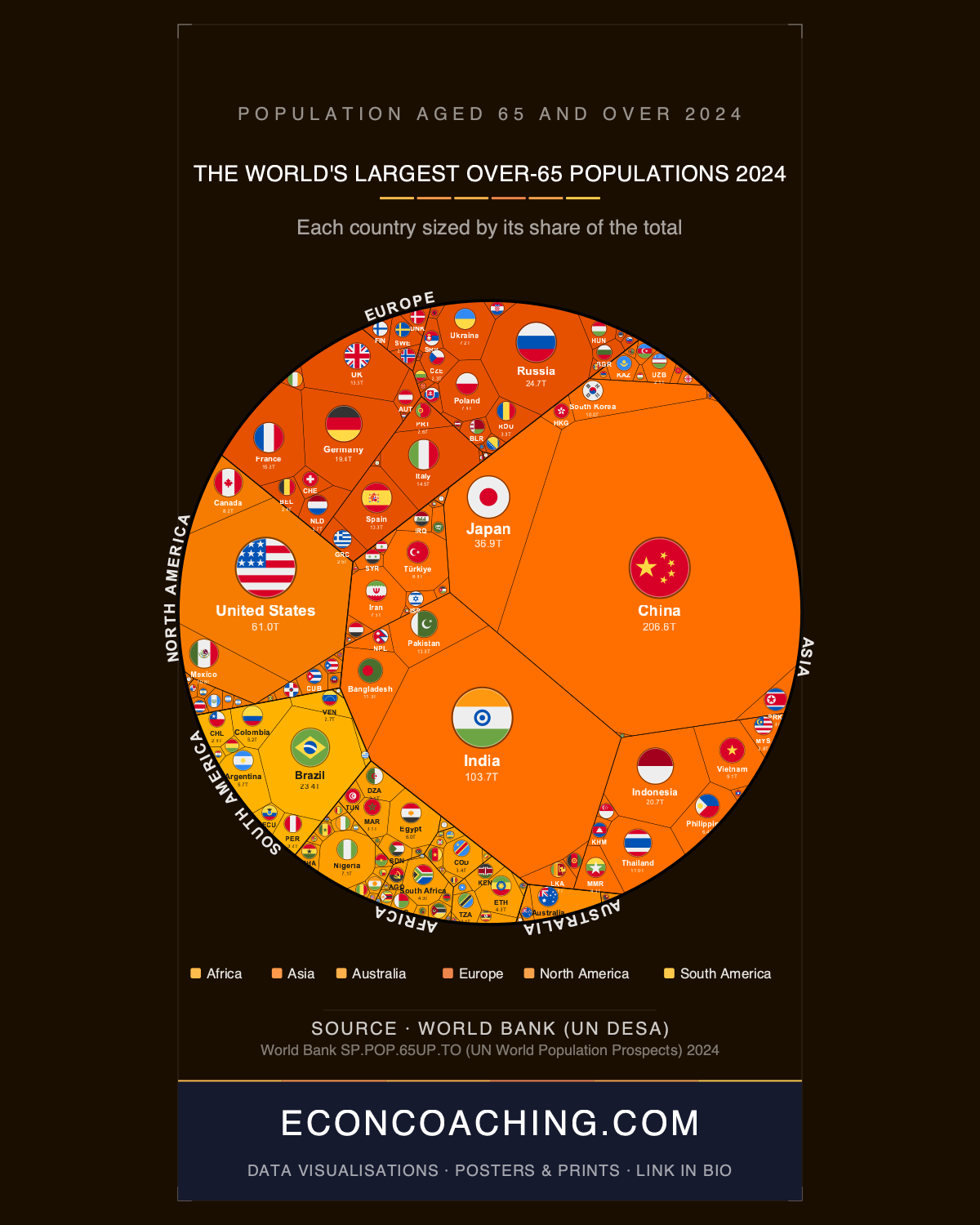
China alone contains more people aged 65 and over than the entire European continent. China's elderly population stood at 206.6 million in 2024 — 25% of the global total of 825.7 million — while all of Europe combined accounted for 152.6 million, or 18.5%. That comparison, made visible in the treemap accompanying this article where cell size represents elderly population rather than geographic area, inverts the dominant assumption in Western aging discussions: that Europe is the world's demographically oldest heartland. Asia holds that position, with 477.7 million elderly — 57.9% of the global total.
Asia's Structural Dominance of the Global Elderly Count
Asia's 477.7 million elderly are more than three times Europe's share and nearly nine times Africa's 54.9 million. The treemap's most counterintuitive detail is not China's block but Indonesia's: ranked seventh globally with 20.7 million elderly, Indonesia exceeds Germany (19.4 million, eighth) and France (15.2 million, ninth) — two countries that appear in virtually every Western aging discussion while Indonesia appears in almost none. Brazil (23.4 million, sixth) and Russia (24.7 million, fifth) round out a top ten in which Asia holds four of the five leading slots, interrupted only by the United States at third with 61 million.
India's position requires qualification. At 103.7 million elderly, India ranks second globally, but that figure represents only approximately 7–8% of its 1.4 billion population. India remains structurally young, and the UN projects at least another decade of demographic dividend before aging becomes a macroeconomic constraint of the kind already visible in China and Japan.
China's One-Child Policy Echo
China's 206.6 million elderly are the direct demographic consequence of the One-Child Policy, which ran from 1980 to 2015. Thirty-five years of suppressed births created a generational gap now producing a sharply rising dependency ratio: 4.4 working-age people supported each retiree in 2024, falling to a projected 2.8 by 2035. In September 2024, the China State Council raised the statutory retirement age for the first time in decades — from 60 to 63 for male workers and from 50 to 55 for female blue-collar workers — citing accelerating pension insolvency risk. No government in Beijing had adjusted retirement age in decades, making the reform as significant as a political signal as an actuarial measure.
China's absolute elderly count carries a structural caveat: at roughly 14–15% of its total population, China's elderly share remains well below Japan's 29% or Italy's 24%, meaning each elderly Chinese person is currently supported by a larger working-age base than in either of those countries. That buffer is shrinking faster in China than anywhere else of comparable scale. The 'silver economy' — products and services targeting elderly consumers — was already worth approximately $982 billion (7 trillion yuan) in 2024, about 6% of GDP, and is projected to reach $4.2 trillion by 2035, demonstrating that an aging population generates commercially significant demand even as it strains public pension systems.
South Korea's Historic Aging Acceleration
South Korea's total fertility rate reached 0.72 in 2023 — the lowest ever recorded for any major country in human history — recovering only marginally to 0.82 in 2024, still far below Japan's 1.15 and less than half the 2.1 replacement level. France took over 150 years to transition from an 'ageing' society (7% elderly) to an 'aged' society (14% elderly); South Korea completed the same shift in 17 years between 2000 and 2017, the fastest demographic aging transition ever recorded for a large economy. South Korea currently ranks only 17th globally in absolute elderly numbers at 9.97 million, but demographers project it will surpass Japan as the world's most aged country by 2044, with 36.7% of its population over 65 — narrowly exceeding Japan's projected 36.5%.
Japan itself became the world's first recognized 'super-aged' society, with over 21% elderly, around 2005, and has functioned ever since as the global reference case for pension reform, elder-care robotics, and deflation management. Its 36.9 million elderly (fourth globally) give it enduring analytical relevance even as its total population continues to contract.
Africa's Youth and Its Limits
Africa has 54.9 million elderly — just 6.7% of the global total — despite holding roughly 18% of the world's total population. The continent's median age is 19.7 years; Niger and Uganda register median ages of 15.1 and 16.1 years respectively. Africa's low elderly share is partly structural, sustained by high fertility rates that maintain large young cohorts, but it also reflects persistently lower life expectancy across much of sub-Saharan Africa, where reaching age 65 is statistically far less common than in high-income countries. The WHO confirmed in 2024 that the European Region's 65+ cohort now outnumbers its under-15 cohort for the first time in that region's recorded history — a demographic crossover that illustrates where the global trajectory eventually leads, regardless of the current gap between regions.
The 30-Year Doubling
The global elderly population stood at approximately 826 million in 2024, already ahead of prior UN projections, and is on track to reach 1.7 billion by 2054. The UN projects that by the late 2070s, people aged 65 and over will outnumber children under 18 globally for the first time in human history. The policy response — pension reform, immigration strategy, elder-care infrastructure, silver-economy investment — will be determined primarily in Asia, not Europe, because that is where the problem is largest in absolute terms and where the fiscal arithmetic is deteriorating fastest. China's September 2024 retirement age reform, South Korea's emergency demographic policy debates, and Japan's three decades of elder-care experimentation are the leading indicators of structural adjustment that no high-income Asian economy can defer much longer, and whose outcomes will shape global labour markets, capital flows, and public debt trajectories well into mid-century.
For more data-driven analysis of global economics and the trends reshaping the world economy, visit econcoaching.com.
Take this one home
Get this visualisation as a download, wallpaper, or printed poster.
← Back to all visualisations & articles
Follow Everything Econ: YouTube · TikTok · X · Instagram · Facebook