
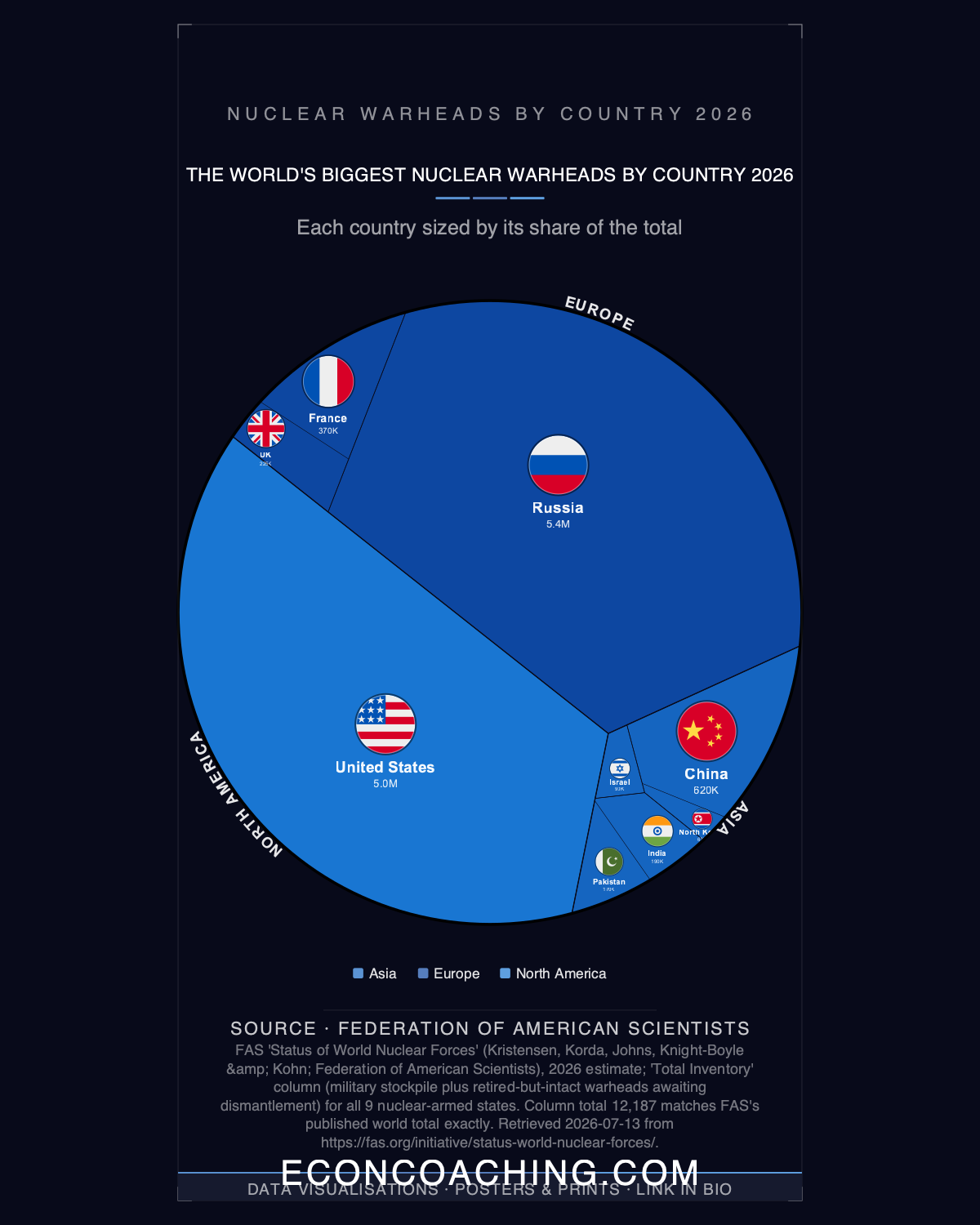
The treemap accompanying this article distorts geography in a specific direction: Russia and the United States together consume 85.84% of the chart. That visual fact has a number behind it — 10,462 warheads between two countries, out of 12,187 worldwide — and as of February 5, 2026, it now has no legal constraint behind it. On that date, New START expired without a successor agreement, ending an unbroken 57-year chain of US-Soviet and US-Russia arms-control treaties stretching back to SALT I negotiations in 1969. For the first time since 1972, no legally binding treaty limits the world's two largest nuclear arsenals.
The Last Treaty and What Its Expiry Actually Removed
New START, signed in 2010 and extended in 2021, capped each side at 1,550 deployed strategic warheads and 700 deployed delivery vehicles. The expiry does not immediately mean arsenals will grow — Russia currently fields approximately 1,718 deployed strategic warheads and the US slightly fewer — but it eliminates the on-site inspection regime and data-exchange protocols that gave both sides verified knowledge of the other's deployments. Arms control has always rested on two pillars: numerical limits and verification. Both are now absent simultaneously. The historical context matters: the global stockpile fell from approximately 70,000 warheads at the Cold War peak in 1986 to today's 12,187 — a reduction of more than 82% driven almost entirely by successive treaties. The mechanism that produced that decline no longer exists.
China's 3.3% Annual Growth Is the Most Consequential Trend in the Data
China's 620 warheads appear modest against Russia's 5,420 — China's entire arsenal represents roughly 11.4% of Russia's total — but the trajectory is reshaping what the Pentagon plans around. China added 20 warheads in the past year, a roughly 3.3% increase, and is the only NPT-recognized nuclear state actively expanding its stockpile; the US, Russia, UK, and France have all held steady or marginally reduced. SIPRI confirms that China has loaded hundreds of missiles into three large silo fields in northern China and is completing 30 additional silos in eastern mountainous regions. The Pentagon projects China will exceed 1,000 warheads by 2030 — 61% above its current level — and SIPRI now assesses that China could potentially field as many ICBMs as Russia or the United States by the end of the decade. That benchmark would produce the first genuinely three-sided nuclear competition the world has seen, and it poses a structural problem for any future arms-control architecture: bilateral US-Russia treaties cannot constrain Beijing.
The Periphery Is Expanding, Not Contracting
The seven countries outside the US-Russia dyad collectively hold 1,725 warheads — 14.16% of the global total — and the trend within that group is upward. SIPRI's 2026 Yearbook contains a notable first: India is assessed as having operationally deployed nuclear warheads, rather than merely stockpiling them, elevating the readiness calculus on a subcontinent where India (190 warheads) and Pakistan (170 warheads) combined hold 360 weapons and have fought three wars. North Korea's official SIPRI estimate has risen to 60 warheads — up from 50 in 2025, a 20% single-year increase — but independent assessments from the Federation of American Scientists and other think-tanks suggest Pyongyang may already possess 115–150 warheads, potentially more than twice the SIPRI figure, due to uranium-enrichment capacity that outside observers cannot fully monitor. A Bloomberg analysis in 2026 found that the US ground-based interceptor system in Alaska is designed to handle approximately 44 incoming warheads — a threshold North Korea's official count already exceeds. Israel, which neither confirms nor denies possessing nuclear weapons under a policy of deliberate ambiguity, is estimated by SIPRI at 90 warheads, placing it eighth globally and making it the only nuclear-armed state in the Middle East and the only NPT non-signatory whose existence is treated as an open public fact.
What the Treemap Obscures: Deployment vs. Stockpile
The cell areas in this chart represent total warhead counts, not operational readiness — and the gap between those two figures matters for calibrating the risk correctly. Of the 12,187 warheads worldwide, approximately 4,012 are actively deployed on missiles or aircraft; roughly 2,100–2,200 are kept at high operational alert, meaning they could be launched within minutes. Russia's 5,420 total includes roughly 1,718 deployed strategic warheads alongside a large non-deployed reserve. The headline figures in the treemap overstate immediate launch capacity — but they accurately capture industrial and political commitment, because a stored warhead can be deployed faster than a new one can be built, and reserve stockpiles are not disarmament.
The only country to have verifiably disarmed is South Africa, which independently developed six nuclear devices between the mid-1970s and 1989, then dismantled its entire arsenal by 1991 before joining the NPT — a model that no other state has replicated in the 35 years since. Two entire inhabited regions — Latin America and the Caribbean under the 1967 Treaty of Tlatelolco, and the South Pacific under the 1985 Treaty of Rarotonga — are nuclear-weapon-free zones by treaty law, demonstrating that legal frameworks can hold when the underlying political conditions support them.
Three Conditions That Have Not Coincided Since the Cold War
The summer of 2026 is the first moment in more than three decades in which three simultaneous conditions are present: no US-Russia arms-control treaty, a third power actively building toward superpower-scale arsenals outside any bilateral verification regime, and at least one additional state — North Korea — whose warhead count has outgrown the missile-defense infrastructure designed to contain it. France (370 warheads) and the UK (225 warheads) retain independent deterrents despite NATO membership, reflecting a Cold War insistence on sovereign nuclear identity that complicates any future multilateral framework. The IAEA and the NPT were designed for a relatively static nuclear club; neither instrument was built for a period in which the club's fastest-growing member is an NPT signatory facing no treaty constraint on its expansion, and in which the two states that wrote the original rulebook are operating without a legal ceiling for the first time in living memory.
One chart like this in your inbox each week, explained in plain English — join the Everything Econ newsletter. Always free, and you can unsubscribe any time.
Take this one home
Get this visualisation as a download, wallpaper, or printed poster.
← Back to all visualisations & articles
Follow Everything Econ: YouTube · TikTok · X · Instagram · Facebook