
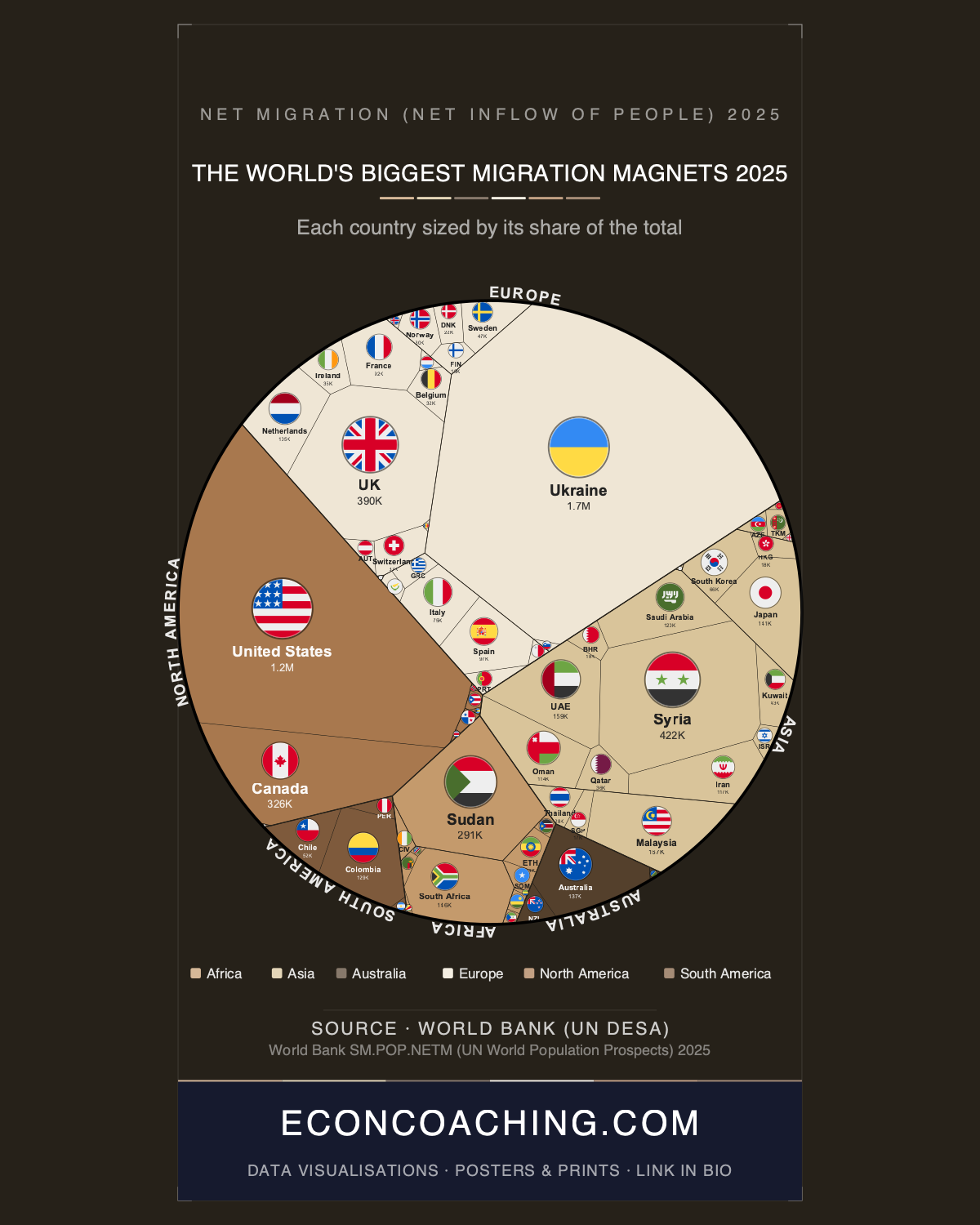
The country that attracted more net migrants in 2025 than any other on Earth — more than the United States, more than the United Kingdom, more than Canada — was Ukraine, a country under active Russian military assault. Ukraine's 1.70 million net arrivals represent 25.45% of all positive net migration worldwide, a figure driven not by peacetime opportunity but by Ukrainian refugees and displaced persons choosing to return home even as the war continues. IOM recorded 306,300 documented returns in the first half of 2025 alone. The treemap accompanying this article, where cell area is proportional to migration value rather than geographic size, makes the distortion immediate: Ukraine's block dominates the chart not because the country is large or stable, but because a mass displacement event is running in partial reverse.
Ukraine and Syria: When the Displaced Go Home
Ukraine's #1 ranking directly inverts the 2022 crisis. Russia's February 2022 full-scale invasion triggered one of the fastest mass exoduses in recorded history, sending over 8 million Ukrainians abroad within months. That displaced population is now returning — but the return does not signal recovery. As of early 2025, one in four recent Ukrainian returnees was already considering leaving again, and only 22% reported sufficient access to basic goods and services. The #1 net migration ranking and a functioning civilian infrastructure are not the same thing.
Syria's position at #3, with 422,000 net migrants, represents the most structurally significant reversal in the 2025 data. Following the fall of Bashar al-Assad in December 2024, UNHCR confirmed over 1 million Syrian refugees had returned home by September 2025, with 2.6 million displaced Syrians — refugees and internally displaced persons combined — returning across the full year, cutting the global Syrian refugee population from 6 million to 4.9 million. The Assad regime's civil war after 2011 created the largest refugee crisis of the 21st century prior to Ukraine, displacing over 13 million Syrians at its peak; Syria's #3 ranking in 2025 marks the first meaningful reversal of that 14-year catastrophe. Approximately 4.7 million Syrian refugees remain abroad, electricity and clean water remain patchy across large areas of the country, and the 2025 return wave could partially reverse if reconstruction financing fails to materialise.
The United States: From Record High to Demographic Contraction
The United States recorded 1.23 million net migrants in 2025, ranking it #2 globally, but the annual aggregate conceals a more significant shift. Net migration fell from approximately 2.8 million in 2024 and from a 2023 all-time record of over 3 million — a decline of more than 56% in a single year driven by Trump administration enforcement actions and restricted asylum access. By late 2025, the foreign-born US population was shrinking for the first time since the 1960s, per US Census Bureau data. The 1.23 million full-year figure blends months when inflows were still elevated with a second half in which the trend had reversed sharply negative, meaning the annual total substantially flatters the underlying trajectory.
Sudan, Colombia, and Net Inflows in Crisis States
Sudan ranks #6 globally with 291,469 net migrants despite simultaneously hosting the world's largest internal displacement crisis: 9.1 million internally displaced persons and 2.8 million refugees who fled abroad by end of 2025, a 35% year-on-year increase tracked by the Internal Displacement Monitoring Centre. Sudan's positive net migration reflects large cross-border inflows from neighbouring conflict states that numerically exceed its documented outflows — a product of its position as a regional transit and settlement hub rather than any indicator of domestic stability.
Colombia presents a comparable paradox at #12 with 129,139 net migrants while hosting over 2.9 million Venezuelan migrants and recording the worst conflict-induced internal displacement in the Americas. A single confrontation between armed groups in the Catatumbo region in early 2025 forced approximately 80,000 people from their homes within days. Both countries illustrate how national-level net migration figures can run positive while internal displacement crises continue to expand — the two metrics measure different populations moving in different directions simultaneously.
Japan, Malaysia, and the Gulf's Quietly Shifting Hierarchy
Japan's appearance at #10 with 140,579 net migrants is historically unprecedented. The country explicitly rejected mass immigration as official policy for most of the 20th century; Japan received 177,000 new long-term or permanent immigrants in 2024, up 8.6% year-on-year, as acute labour shortages from a shrinking working-age population — total population has been declining since 2011 — have forced a policy recalibration that would have been unthinkable three decades ago.
Malaysia outranks the UAE in 2025 — 166,615 versus 158,634 net migrants — despite the Gulf's dominant reputation as the world's primary labour migration destination. The three Gulf states in the top 15 — UAE (#8, 158K), Saudi Arabia (#13, 119K), and Oman (#15, 113K) — attracted approximately 391,000 net migrants combined, nearly matching the entire United Kingdom's 390,000 figure, while operating almost exclusively on fixed-term contract labour with no pathway to permanent residency. South Korea, at 65,731 net migrants, recorded foreign residents at 5.3% of total population — up from near-zero three decades ago — and launched a 'Top-Tier' visa for elite global talent and a 'Youth Dream' visa for young immigrants in September 2024 to accelerate the shift.
What Europe's 41% Share Actually Measures
Europe accounts for 41.1% of all global positive net migration in 2025 — a figure that appears to confirm the continent as the world's dominant immigration destination. Remove Ukraine, and Europe's share collapses to roughly 15.7% of the global total, approximately on par with North America's 23.5%. Ukraine alone constitutes nearly two-thirds of Europe's entire net migration figure. The 41.1% headline is almost entirely a product of a single war-driven return migration event, and its implications for European immigration policy debates are correspondingly limited: the continent's underlying pull, outside of the Ukrainian displacement reversal, is modestly above average rather than structurally dominant.
The central question heading into 2026 is whether Syria's return wave consolidates — which requires reconstruction financing and political stability that are not yet secured — or reverses, returning millions of people to the refugee system just as European and Gulf host countries had begun adjusting their planning around reduced Syrian caseloads.
One chart like this in your inbox each week, explained in plain English — join the Everything Econ newsletter. Always free, and you can unsubscribe any time.
Take this one home
Get this visualisation as a download, wallpaper, or printed poster.
← Back to all visualisations & articles
Follow Everything Econ: YouTube · TikTok · X · Instagram · Facebook