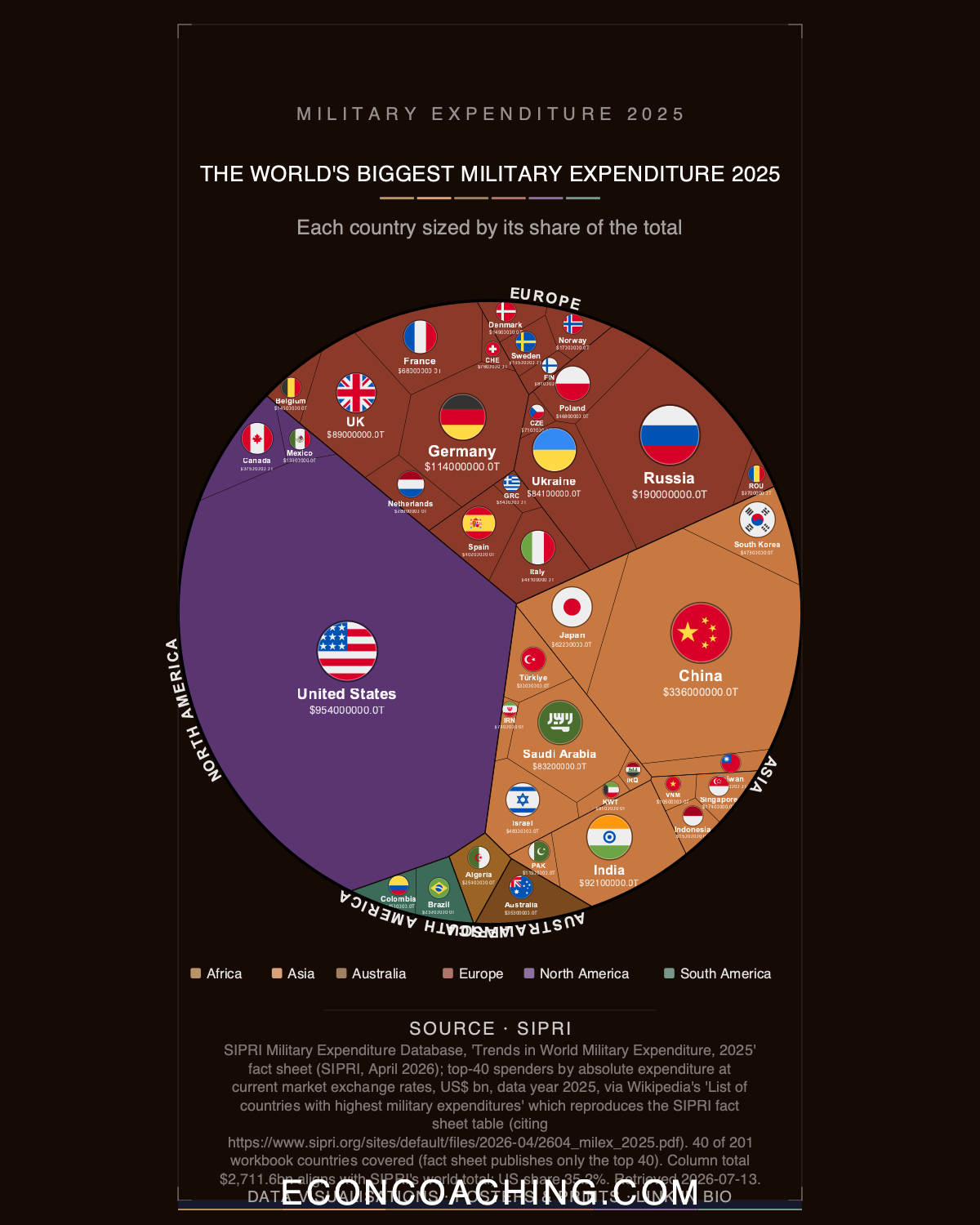
When you look at a treemap of global military spending sized by dollar value rather than geography, the rectangle marked "Germany" sits fourth in the world — larger than India's, larger than the United Kingdom's, wedged between Russia and a combined European block that now nearly matches all of Asia. That visual rearrangement is not distortion. It is data. Global military spending hit $2.887 trillion in 2025 — a record high for the 11th consecutive year, according to SIPRI's Military Expenditure Database — and the first time the global military burden has reached 2.5% of world GDP since 2009, when the US-led War on Terror was at its peak. The difference this time is who is driving it.
Germany's Transformation and Its Limits
Germany spent $114 billion on defense in 2025 — a 24% increase in a single year, enough to vault it to fourth globally and past the NATO 2% of GDP threshold for the first time since German reunification in 1990. From 1990 to 2014, Germany averaged roughly 1.1–1.3% of GDP on defense, a deliberate posture rooted in post-World War II pacifist culture and the assumption that American hegemony guaranteed European security. Russia's full-scale invasion of Ukraine in February 2022 ended that assumption. Chancellor Olaf Scholz's Zeitenwende speech and a €100 billion Bundeswehr modernization fund were the political rupture; 2025 is where that commitment reached its full budget reality.
The caveat is significant: Germany's headline spending increase is far larger than its actual near-term capability gain. Decades of deliberate underinvestment left the Bundeswehr with serious readiness deficits and procurement backlogs that a single year's budget cannot repair. The jump from serial under-spender to fourth-largest military budget reflects a historically low baseline as much as genuine new military power.
Poland and Ukraine: The Eastern Flank's Economics
Poland spent 4.5% of GDP on defense in 2025 — the highest share among all 32 NATO members, more than double the alliance's 2% threshold, and above even the United States. Polish military spending has more than tripled since 2016, funded in part through the Armed Forces Support Fund. For comparison, Brazil and Colombia — the two largest South American defense budgets at $23.9 billion and $14.5 billion respectively — combined total $38.4 billion, less than Poland's $46.8 billion from a country of 38 million people.
Ukraine's position in the treemap is the most arresting: ranked seventh globally at $84.1 billion, its rectangle sits ahead of Saudi Arabia's $83.2 billion, France's $68 billion, and Japan's $62.2 billion. Before 2022, Ukraine budgeted roughly $4–6 billion per year on defense. Its rise to $84.1 billion in three years compresses what most nations took decades to build. That figure represents approximately 40% of Ukraine's GDP — the highest defense-to-GDP ratio of any country in the world — but it is only fiscally sustainable because of massive Western transfers and loans. Without external financing from NATO allies, the burden would be economically catastrophic. The true cost of Ukraine's war economy is being socialized across the alliance, which means the stated $84.1 billion understates the real burden placed on allied public finances.
The U.S. Paradox and China's Unbroken Streak
The United States still accounts for 35.18% of all global military spending at $954 billion — outspending the next five countries combined: China, Russia, Germany, India, and the United Kingdom total $821.1 billion. Yet US spending fell 7.5% in 2025, the sharpest American decline in years, while the rest of the world grew 9.2%. American retrenchment and allied expansion occurred simultaneously, translating the NATO burden-sharing debate into real-dollar terms for the first time in a generation.
China logged its 30th consecutive year of real-terms military spending growth in 2025, reaching $336 billion, a 7.4% increase. In direct response, Taiwan raised its defense budget 14.2% to $18.2 billion — the island's largest single-year increase since at least 1988. Russia's $190 billion figure, meanwhile, understates its operational weight: at domestic purchasing power, that budget funds a mass-mobilization military most analysts consider considerably more capable than a raw dollar comparison to Western budgets suggests, given the lower cost of Russian personnel and domestically produced equipment.
Algeria and the Opportunity Cost of Defense
Algeria is the only African country among the global top 40 military spenders at $25.4 billion — roughly 44% of Africa's entire $58.2 billion in military expenditure spread across 54 countries. More telling is the fiscal dimension: Algeria devoted 25% of its total national public expenditure to defense in 2025, the second-highest share of any country in the world behind only Ukraine, and 8.8% of GDP. That allocation crowds out spending on education, healthcare, and infrastructure in ways that directly constrain human development — a reminder that defense spending carries substantial opportunity costs for developing economies where those trade-offs are most acute. Australia ($35.3 billion, ranked 17th globally) outspends Brazil ($23.9 billion) despite having a population of 27 million versus Brazil's 215 million, illustrating that defense budgets reflect threat perceptions and alliance commitments more than economic scale.
What 2025 Closes
Europe's total military expenditure surged 14% to $812.9 billion in 2025 — the largest annual increase the continent has ever recorded — and now nearly matches all of Asia's combined defense spending. The top five spenders — the United States, China, Russia, Germany, and India — together accounted for 58% of all global military spending. The return to 2.5% of world GDP marks the definitive end of the post-Cold War peace dividend, this time driven by European and Asian threat perceptions rather than American overseas operations. Whether Europe's buildup translates into genuine military capability — given Germany's readiness gaps, the pace of NATO procurement cycles, and the open question of how long Ukraine can sustain 40% of GDP in defense spending — will determine both European public finances and the economics of the Atlantic alliance for the next decade.
One chart like this in your inbox each week, explained in plain English — join the Everything Econ newsletter. Always free, and you can unsubscribe any time.
Take this one home
Get this visualisation as a download, wallpaper, or printed poster.
← Back to all visualisations & articles
Follow Everything Econ: YouTube · TikTok · X · Instagram · Facebook