
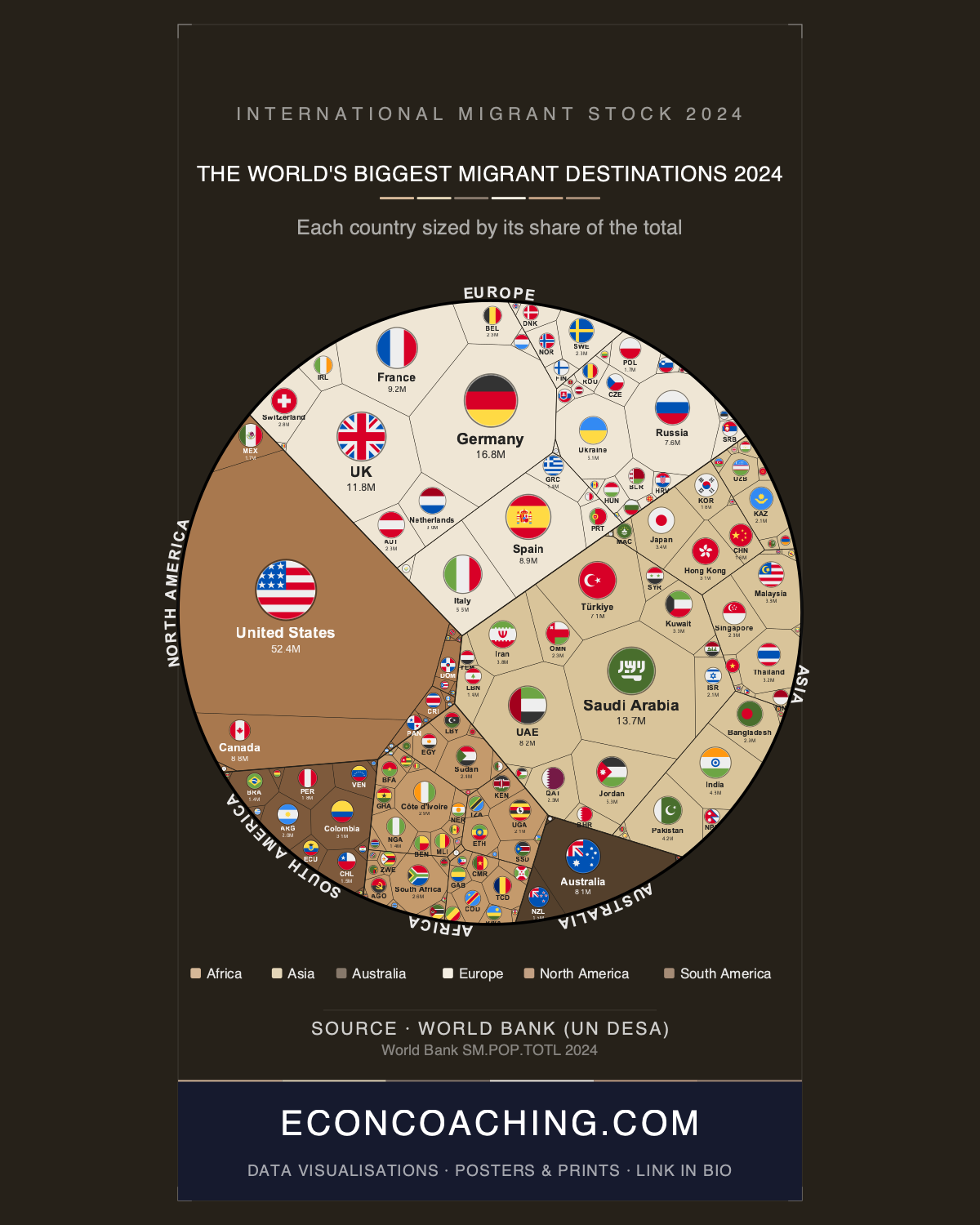
The treemap accompanying this article shows the United States as the dominant rectangle — 52.4 million migrants, representing 17% of the entire global migrant population, a block that dwarfs every other country by area. That visual is accurate but misleading as an entry point. The more disorienting data point is that the UAE, a country of roughly 10 million people, has approximately 8.16 million foreign-born residents — meaning about 80% of everyone living in the UAE was born somewhere else. The world's largest immigrant country by share of population is not the United States. It is a Gulf state that most visitors pass through as transit passengers.
The Gulf Rewrites the Per-Capita Table
On absolute numbers, the US ranks first, Germany second (16.75 million), Saudi Arabia third (13.7 million), and the UK fourth (11.8 million). On per-capita terms, the ranking inverts almost entirely. Kuwait's 3.32 million migrants represent approximately 68% of its total population, yet Kuwait ranks only 20th globally in absolute terms. Saudi Arabia's 13.7 million migrants amount to roughly 38% of its population. Jordan, ranked 12th globally with 5.28 million migrants in a country of only 11 million people, carries a foreign-born share of approximately 48% — higher than any large Western democracy — driven by successive waves of Palestinian refugees from 1948 and 1967, 1.3 million Syrian refugees registered by UNHCR, and sustained labour migration.
The Gulf per-capita figures require a structural qualifier. The kafala sponsorship system, operating across the UAE, Kuwait, Saudi Arabia, Qatar, and Bahrain, ties migrant workers to specific employers with no independent residency rights and no legal pathway to permanent settlement or citizenship regardless of years of residence. A separate ILO methodology puts the UAE's foreign-national share as high as 91%, reflecting that most Gulf migrants are temporary contract workers whose presence depends on continued employment. The per-capita share is real; the permanence is not.
The United States at Its 1890 Watermark
The US figure of 52.4 million migrants, representing 14.8% of the population, matches the all-time foreign-born share recorded in 1890, at the height of European mass immigration. That historical parallel matters: the US foreign-born share had fallen as low as 4.7% in 1970 before recovering steadily, meaning the country has absorbed a near-tripling of its immigrant share in 54 years. The 2.4 million increase from 2023 to 2024 alone was the largest single-year gain since at least 2010, according to UN DESA data. Australia's trajectory is similarly steep: 8.1 million migrants constitute 31.5% of its population — one of the highest foreign-born shares of any large developed nation — and 2024 marked the first time India overtook England as Australia's top country of birth, confirmed by the Australian Bureau of Statistics.
Germany's Decade-Long Transformation
Germany's 16.75 million migrants make it Europe's largest migrant destination in absolute terms and second globally, behind only the United States. Its foreign-born share rose from 13.4% in 2015 — the year of the Syrian refugee influx — to approximately 20.9% by 2024, a near-50% increase in the share within a decade and the fastest demographic transformation of any G7 economy over that period. Poland's migrant stock has also surged, reaching 1.74 million by 2024, largely because of Ukrainian refugees since February 2022 — a displacement UNHCR describes as the fastest large-scale forced movement in Europe since World War II. Ukraine itself paradoxically ranks 14th globally with 5.06 million migrants on its soil, even as millions of Ukrainians have fled abroad since 2022, demonstrating that migrant stock figures can shift dramatically in short windows rather than tracking slowly with economic fundamentals.
304 Million: A Doubling in One Generation
Global migrant stock reached 304 million in 2024 — nearly double the 153.9 million counted in 1990. If migrants formed a country, it would rank fourth in the world by population, behind India, China, and the United States. That doubling was driven by economic pull from aging developed economies, conflict-driven displacement from Syria, Afghanistan, Venezuela, and Ukraine, and a post-COVID mobility rebound that accelerated flows paused between 2020 and 2022. Colombia's absorption of approximately 3 million Venezuelan migrants — the largest Venezuelan diaspora of any single country, part of nearly 8 million Venezuelans displaced globally — represents the biggest forced displacement crisis in Latin American history. Türkiye, ranked 11th at 7.08 million migrants, has become the largest refugee-hosting country in the region by absolute numbers despite being a middle-income economy. The financial dimension of that 304 million figure is underappreciated in political debate: remittances sent by migrants worldwide were projected to reach a record $905 billion in 2024, more than three times total global foreign-aid flows and the largest development finance mechanism on Earth.
Africa and China: The Understated Cases
Africa accounts for only 9.6% of global migrant stock — 28.9 million people — despite hosting several of the world's largest displacement crises. That figure understates actual mobility, since most intra-African migration is informal, circular, and unregistered in national statistics. West Africa's leading destination, Côte d'Ivoire at 2.88 million, hosts more migrants than many European nations. China presents the opposite distortion: with 1.64 million migrants, just 0.12% of its 1.4 billion people, China ranks 44th globally despite being the world's second-largest economy and one of the top global sources of emigrants. Economic scale does not predict openness to receiving migrants.
The political salience of the 2024 UN DESA data is unusually high. Migration is the defining electoral issue in the United States, the primary driver behind far-right gains across European parliaments, and the central humanitarian burden on Colombia, Türkiye, and Jordan — middle-income countries absorbing displacements at a scale that high-income governments have resisted absorbing themselves. On absolute rankings, the US appears to carry the world's migration weight. On per-capita terms, the weight falls almost entirely elsewhere.
One chart like this in your inbox each week, explained in plain English — join the Everything Econ newsletter. Always free, and you can unsubscribe any time.
Take this one home
Get this visualisation as a download, wallpaper, or printed poster.
← Back to all visualisations & articles
Follow Everything Econ: YouTube · TikTok · X · Instagram · Facebook