Divide a country's total economic output by the number of people producing it, and you get a rough measure of how much value the average worker generates in a year. It's not take-home pay — plenty of that output goes to profits, taxes and investment rather than wages — but it's a useful stand-in for how productive an economy is. And the range is staggering: workers at the top of this ranking generate over a hundred times more than workers at the bottom.
At a glance · Top 5
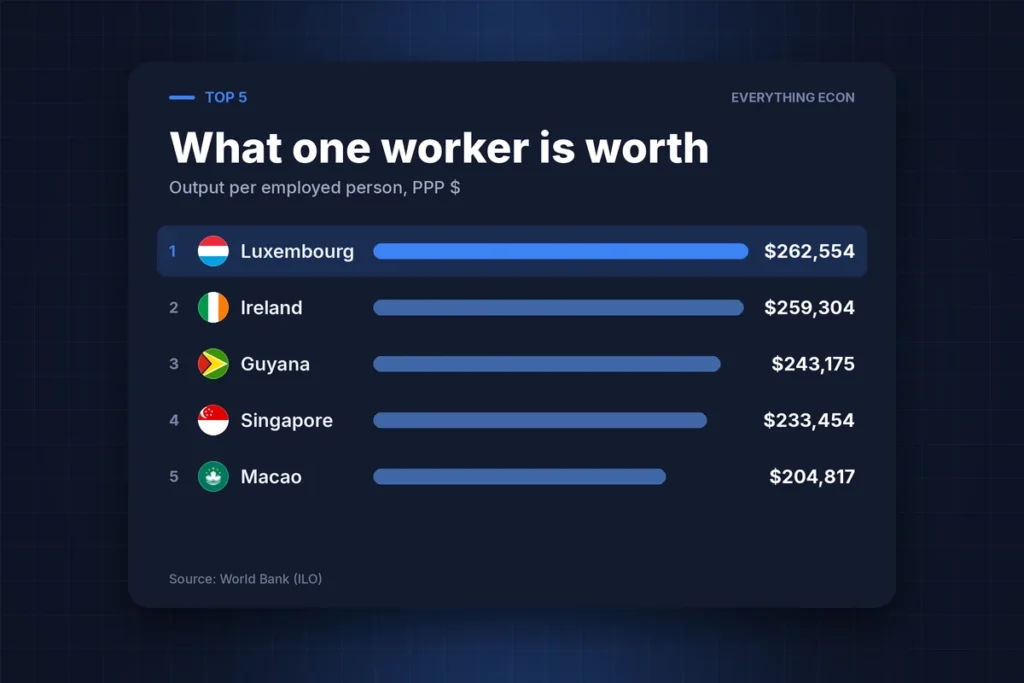
Output per employed person, PPP $
- 1Luxembourg$262,554
- 2Ireland$259,304
- 3Guyana$243,175
- 4Singapore$233,454
- 5Macao$204,817
Source: World Bank (ILO)
The oil shock nobody saw coming
Most of the countries near the top are the ones you'd expect — small, wealthy, finance-heavy economies. Then there's Guyana, sitting at third place with $243,175 per worker. Five years ago this would have been unthinkable. Guyana's economy has roughly tripled in size since oil extraction began in late 2019, and in 2024 its oil-driven GDP surged nearly 58%, giving it the fastest real growth rate of any country on Earth — averaging 47% a year since 2022. It's a reminder that this ranking measures the size of the economic pie relative to the workforce, not broad-based prosperity; a small population sitting on a newly discovered oil field can vault up the table almost overnight.
Diversified giants versus one-trick economies
Further down the top tier, the story splits in two. The United States, in ninth place at $156,983, is the highest-ranked large, diversified economy — its output spread across tech, finance, energy and capital markets rather than resting on one industry. Switzerland, in eighth at $158,634, tells a similar story on a smaller scale, built on life sciences, precision manufacturing and finance. Qatar, tenth at $149,105, is the opposite case: a huge hydrocarbons sector still does most of the heavy lifting despite efforts to diversify. Ireland's second-place figure of $259,304 belongs in its own category — it's inflated by multinational companies booking profits there for tax reasons, so the true domestic picture is considerably more modest than the headline number suggests.
Not every established economy is holding its position, either. Italy sits fourteenth at $131,481, and was one of the only economies in the European Union to see productivity actually shrink in 2025, down 0.6%. Japan and Greece show a longer-run version of the same pattern — both have drifted further below the average for the world's richer economies since 2000, even as many other lagging countries have been catching up.
At the very bottom, the picture is stark and consistent. Burundi ranks last of all at just $2,456 per worker, with 85% of its workforce in subsistence agriculture — farming mainly to feed their own households rather than to sell into a market. The Central African Republic, Madagascar, Mozambique and Liberia fill out the rest of the bottom five, all under $3,750. These are economies with little industry, limited infrastructure, and a workforce still concentrated in low-output farming rather than the factories, offices and services that drive output higher elsewhere.
The country on top
That leaves Luxembourg in first place, at $262,554 per worker — nearly double the figure for the United States. It's a small, finance-dominated economy with a standard working week of 40 hours and at least five weeks of mandatory annual leave, so the number isn't a story of overwork. It reflects a workforce concentrated in high-value financial and professional services, in a country small enough that this one sector can dominate the whole economy's output.
Source: World Bank, ILO modelled estimates.
Get a new data story like this every week — join the newsletter.
Browse every visualisation on the visualisations page.
Take one home
Every country drawn to scale, as an instant printable download or a museum-quality matte poster printed to order.