
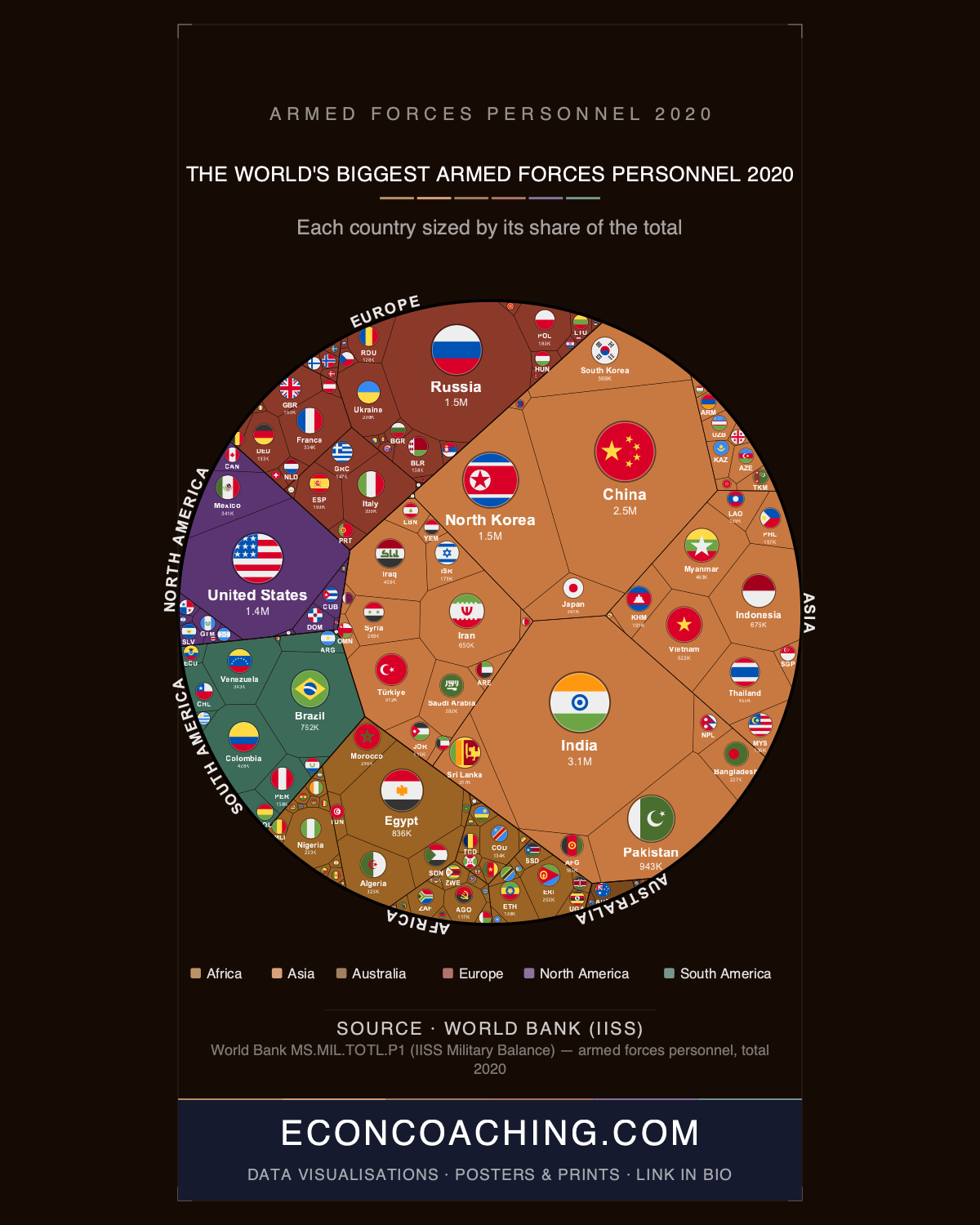
On the treemap accompanying this article, India's rectangle is the largest on the page at roughly 3.07 million personnel, ahead of China's 2.54 million. Most people asked to name the world's biggest army would say China. Both answers are defensible, and the reason they conflict is a matter of definition rather than dispute over facts: this dataset counts active-duty troops plus paramilitary forces, and on that basis India leads with 11.3% of the global total. Strip paramilitary forces out and count active-duty troops alone, the approach used by the Global Firepower Index, and China's roughly 2.0 million overtakes India's roughly 1.46 million. The treemap does not resolve which of these is correct. It shows why both claims keep circulating.
The India-China Split, and Why It Matters Beyond Trivia
India and Pakistan both maintain large standing forces with roots in the 1947 Partition and the unresolved border disputes that followed, including Kashmir and the Line of Actual Control with China, which have sustained troop buildups on the subcontinent for decades. Pakistan ranks sixth globally at 943,000. China's headcount, meanwhile, has trended downward for decades even as its defence budget and technological sophistication have risen sharply, which is the clearest illustration in this data of why raw personnel counts do not measure military capability. A country can shed troops and still modernise its military into a more capable force. Any claim about the "world's biggest army" needs to specify whether it means total force or active-duty force, because the two produce different winners.
North Korea's Economy Runs Through Its Barracks
North Korea ranks third globally with about 1.47 million personnel, extraordinary for a population of only around 26 million: roughly 5% of the entire population is in uniform. The U.S. Army War College's Strategic Studies Institute has called North Korea the most militarized country on Earth, and the labour-market data supports that framing. Military personnel make up an estimated 8.9% of North Korea's total labour force, compared with 2.1% in South Korea, 4.3% in Israel, and 0.8% in the United States. This scale traces to Cold War-era guidelines that mobilised citizens aged 14 to 60 into reserve and paramilitary structures, producing reserve estimates that run into the millions on top of the active-duty figure. A ratio this high is not evidence of strategic strength so much as evidence of an isolated, conscription-dependent state organised around near-total mobilisation.
A Snapshot Already Overtaken by Events
Two entries in this 2020 dataset are now materially out of date. Russia sits at 1.45 million in the chart, fourth globally, but Vladimir Putin ordered active troop strength up to 1.32 million with a total force near 2.2 million by late 2023, and Russia recruited roughly 450,000 contract soldiers in 2024 alone, a scale of expansion driven by the invasion of Ukraine that began in 2022. The 2020 figure understates Russia's current force by a wide margin. Myanmar's military, at 463,000 in this dataset, has been fighting a nationwide civil war since the 2021 coup and introduced its first conscription law in 2024 as its effective force reportedly shrank toward 150,000 to 250,000 amid mass defections, even as resistance forces gained control of over 40% of the country's territory. The United States, ranked fifth at 1.395 million, presents the opposite kind of gap: its active-duty end strength in 2024 was the smallest since before the Second World War, a decline this chart's static figure cannot convey.
Forces That Outweigh Their Economies
Egypt is Africa's largest force by a wide margin: 836,000 personnel, seventh globally, more than triple Algeria's 326,000, the next-largest African military in the dataset. Vietnam fields 522,000, more than the United Kingdom and France combined at 457,000, despite a fraction of either country's GDP. Poland is the only major European country actively growing its armed forces, reaching 216,000 troops by 2024 and building one of NATO's largest armies even as most EU militaries have shrunk since Cold War-era cuts that roughly halved the forces of Germany and Italy and produced comparable reductions in France, Spain, and the UK as conscription was phased out. Eritrea, a country of roughly 3.5 million people, maintains an estimated 200,000 to 300,000 active personnel, a ratio driven by indefinite national-service conscription introduced after its 1998 to 2000 border war with Ethiopia.
The Countries With No Army at All
Around 20 countries in this dataset, including Costa Rica, Iceland, Panama, and several Pacific microstates, maintain no standing military. Costa Rica abolished its army entirely in 1949 after a civil war and redirected the funds toward education and healthcare, a decision still cited globally as an example of a state choosing demilitarisation over deterrence.
The next edition of this dataset will look very different from 2020's. Russia's contract recruitment, Poland's buildup, and Myanmar's conscription law are all post-2020 developments large enough to reorder several positions in this ranking, and the India-China methodology gap will keep producing two different "largest army" headlines from the same underlying reality.
For more data-driven analysis of global economics and the trends reshaping the world economy, visit econcoaching.com.
Take this one home
Get this visualisation as a download, wallpaper, or printed poster.
← Back to all visualisations & articles
Follow Everything Econ: YouTube · TikTok · X · Instagram · Facebook