
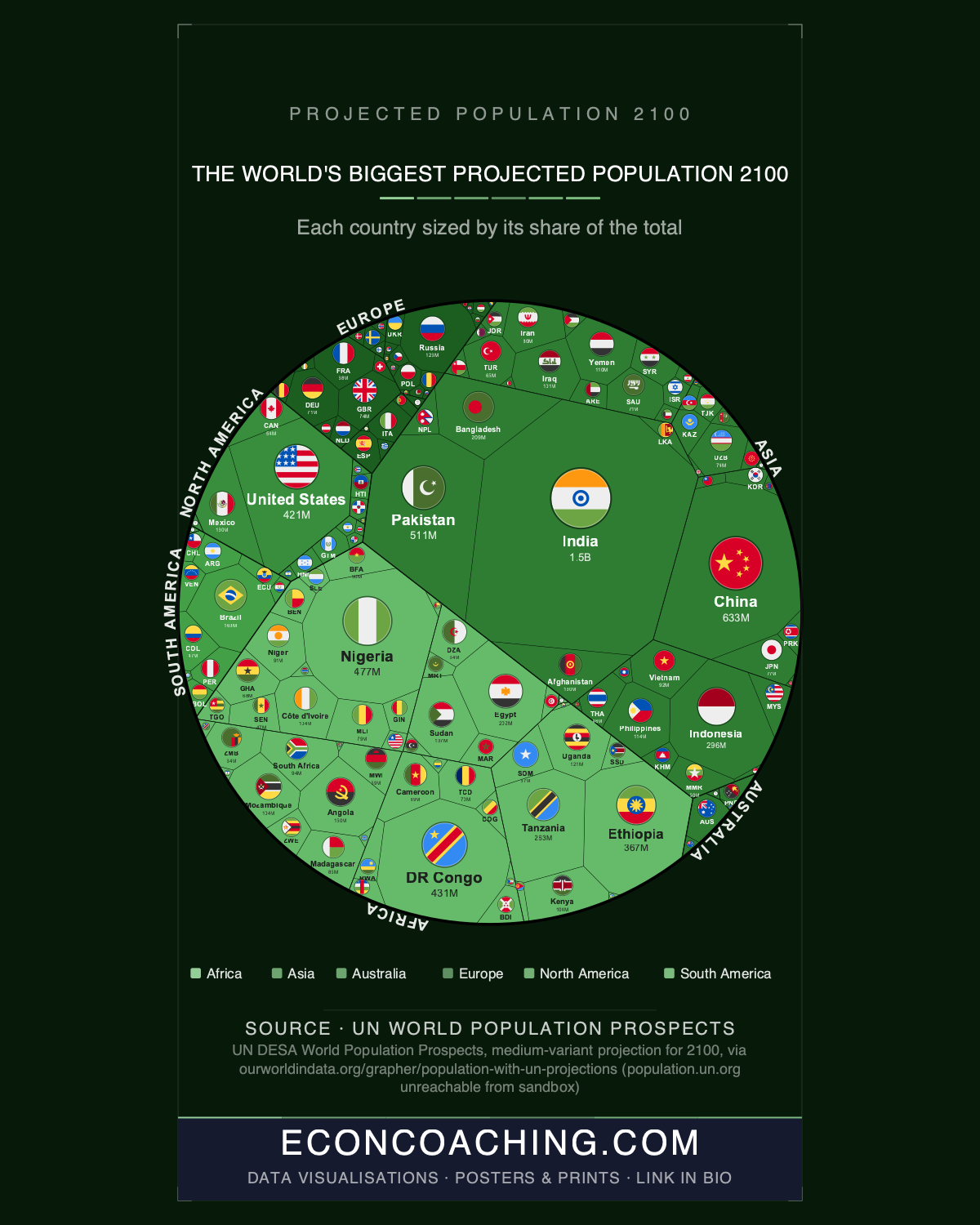
The Democratic Republic of the Congo currently has roughly 103 million people — a country most people struggle to locate on a map, smaller today than Mexico. By 2100, UN World Population Prospects 2024 projects it will reach 431 million, ranking fifth globally and exceeding the present-day population of the United States. The treemap accompanying this article makes this visible in a way a conventional map cannot: the DRC's rectangle is larger than anything in Europe, larger than Japan or Brazil, positioned just below Nigeria in a chart where cell area reflects demographic reality rather than land mass.
That single data point encodes the central story of global population through 2100: a continent currently holding 17% of the world's people will hold 38% by century's end, meaning more than 1 in 3 humans will be African.
Africa's Demographic Scale Has No Recent Parallel
Africa's population is projected to grow from roughly 1.45 billion today to 3.81 billion by 2100. Tanzania will expand from 65 million to 263 million, nearly quadrupling to enter the global top ten. Ethiopia will grow from roughly 127 million to 367 million, ranking 7th most populous on Earth. Nigeria — already the continent's largest nation, with a fertility rate of roughly 5.1 children per woman, more than twice the global average — will reach 477 million, despite that figure already representing a dramatic downward revision: the UN's 2012 edition of World Population Prospects projected Nigeria at 914 million, nearly double the current estimate, illustrating how sensitive these forecasts are to assumptions about when fertility transitions occur.
In 1950, the world's five most populous countries were China, India, the USSR, the United States, and Japan. By 2100, four of those five will be replaced by Pakistan, Nigeria, the DRC, and Ethiopia — none of which ranked in the global top ten in 1950.
The UN's projections assume continued improvements in female education and child mortality across sub-Saharan Africa that would, if they materialize, actually accelerate the fertility decline and put real 2100 populations below these headline numbers. Climate change, water scarcity, and conflict — especially in the Sahel and Congo Basin — introduce further downside risk. The IHME, publishing in The Lancet, projects a more compressed arc: global population peaking at around 9.7 billion in 2064 and declining to 8.8 billion by 2100, well below the UN's 10.3 billion figure. The precise numbers are uncertain; the directional dominance of sub-Saharan Africa across every plausible scenario is not.
China and East Asia Are Running in Reverse
China's population is projected to fall from roughly 1.42 billion today to 633 million by 2100 — returning it to the population size it had in the late 1950s, with a current fertility rate estimated at around 1.0 births per woman. The one-child policy, enforced from 1980 to 2015, eliminated the cohorts who would otherwise be today's parents, creating a demographic spiral that cash incentives have so far failed to reverse. Pakistan — at 511 million by 2100, with a fertility rate not expected to fall below replacement level until around 2080 — will sit just 24% behind China in the global ranking, a gap that would have seemed implausible from any point in the 20th century.
South Korea, with the world's lowest recorded fertility rate of 0.75 births per woman, is projected to reach 21.8 million people by 2100, down from 51.7 million today — a 57.8% decline. Japan will shrink from roughly 124 million to 76.8 million, its lowest population since the 1940s, extending what is already the longest-running case of sustained national demographic decline among major economies; Japan has been losing people continuously since 2010.
The New Global Top Ten Is Barely Recognizable
World Population Prospects 2024 ranks the top ten by 2100 as follows: India at 1.51 billion, China at 633 million, Pakistan at 511 million, Nigeria at 477 million, the DRC at 431 million, the United States at 421 million, Ethiopia at 367 million, Indonesia at 296 million, Tanzania at 263 million, and Bangladesh at 209 million. The United States, at sixth, is sandwiched between the DRC above it and no other wealthy country anywhere in the top ten. Europe as a whole — including Russia — will account for just 5.8% of world population by 2100, down from roughly 10% today and from approximately 22% in 1950, when the continent still held nearly a quarter of global demographic weight. The EU is projected to shrink by 12% from current levels; Italy alone faces a 40% decline. Brazil, today South America's demographic engine at roughly 215 million, will contract to 163 million — a 24% decline — while the entire South American continent will account for just 3.7% of world population, down from roughly 5.4% today.
Peak Humanity and What Comes After
World population is projected to peak at approximately 10.3 billion around 2084 — the first time in recorded history that global population will have peaked and then begun declining. The global median age will rise from 31 today to 42 by 2100, and the number of people over 65 will more than double to 2.4 billion. Oceania is the only non-African region where every major country still grows over the century, with Australia reaching 43 million and Papua New Guinea nearly doubling to 18.6 million — the exception that underscores the near-universality of decline everywhere else outside sub-Saharan Africa.
The policy and investment implication runs in two simultaneous directions. For Africa, the question is whether institutions, infrastructure, and human capital development can convert demographic scale into economic weight — the same translation challenge Asia faced in the late 20th century, but under greater climate risk and with more compressed timelines. For East Asia and Europe, the question is whether productivity gains can offset contraction severe enough to shrink absolute GDP regardless of output per worker. Pew Research's May 2026 Africa demographic update and the UN's July 2024 release of World Population Prospects 2024 together mark the moment when both sides of that equation are simultaneously in focus, making the 2100 population map one of the more consequential documents in global economics right now.
For more data-driven analysis of global economics and the trends reshaping the world economy, visit econcoaching.com.
Take this one home
Get this visualisation as a download, wallpaper, or printed poster.
← Back to all visualisations & articles
Follow Everything Econ: YouTube · TikTok · X · Instagram · Facebook