Manufacturing used to be the engine of almost every rich nation. Today, most wealthy economies have shifted towards services — banking, tourism, software — and let their factory floors quietly shrink. But some countries still make things as their primary business, and the gap between the top and bottom of this ranking is genuinely startling. The metric here is manufacturing value added as a share of GDP: in plain terms, how much of a country's total economic output comes from making physical goods.
At a glance · Top 5
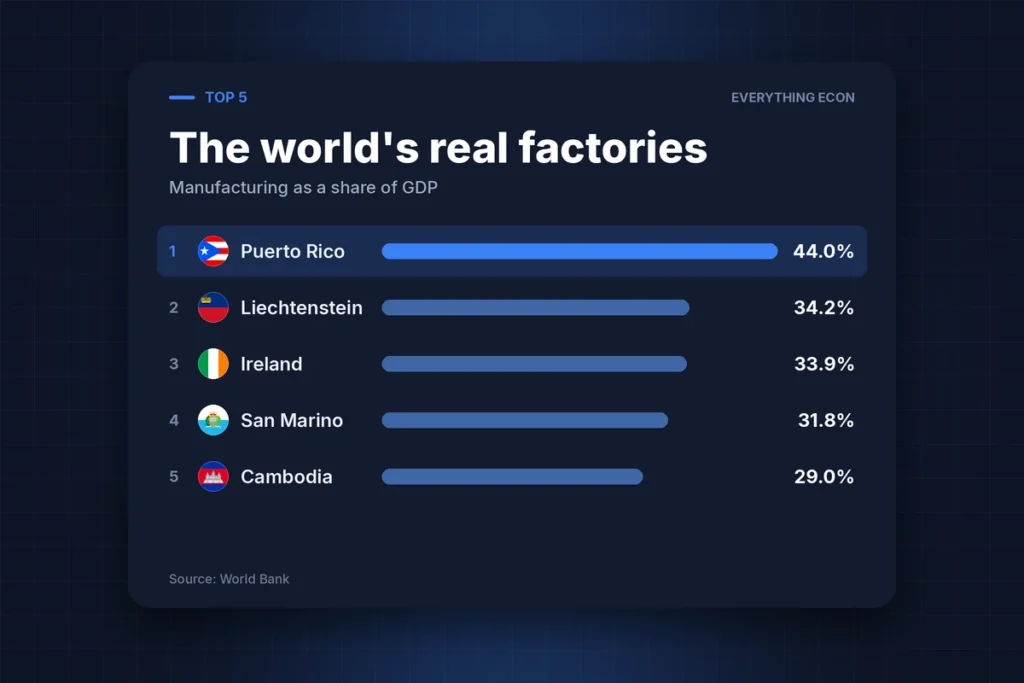
Manufacturing as a share of GDP
- 1Puerto Rico44.0%
- 2Liechtenstein34.2%
- 3Ireland33.9%
- 4San Marino31.8%
- 5Cambodia29.0%
Source: World Bank
The Asian Factory Belt — and One African Surprise
The middle of the ranking is dominated by a cluster of Asian economies that have built their growth on manufacturing. Cambodia sits at number five with 29%, its garment factories pulling in $11.56 billion in apparel exports in 2025 alone — a surge of nearly 17% as buyers shifted orders away from China. Rising wages in China have nudged brands to seek cheaper alternatives, and Cambodia has been one of the clearest beneficiaries.
China itself sits at number nine, with 24.7%. That figure sounds modest compared to the top of the table, but consider the scale: this means roughly a quarter of the world's second-largest economy still consists of factories. For a country of China's size and wealth, that is an extraordinarily high ratio. South Korea, just above it at number seven with 27.4%, tells a more concentrated story. Nearly a fifth of all South Korean exports in 2022 were semiconductors — $129 billion worth of chips. That dominance is a strength and a vulnerability. When global demand for chips collapsed in 2023, South Korea's semiconductor sector was expected to contract by around 30%, dragging the whole manufacturing share with it.
Eswatini, the small landlocked kingdom in southern Africa, appears at number six with 28.1% — a reminder that manufacturing intensity is not purely an Asian story.
When the Numbers Lie: Ireland and the Accounting Effect
Ireland ranks third at 33.9%, which sounds impressive until you look at how that number is constructed. Nineteen of the world's top 20 pharmaceutical companies have a presence in Ireland, and a large share of their global output — including Botox and Viagra — is officially recorded as Irish production, even when the physical manufacturing happens elsewhere. Around 70% of those pharma exports head to the United States.
The fragility this creates became visible in early 2026, when Ireland's GDP fell more than 12% in a single quarter. Pharmaceutical firms had rushed to ship products to the US ahead of threatened tariffs, then abruptly stopped. One sector, moving in one direction, moved the entire country's headline economic number by double digits.
The Curious Case of Number One
The country at the top of the ranking is Puerto Rico, at 44% — a figure that dwarfs every other economy on the list. And yet, manufacturing employs only around 8% of the island's workforce. That gap between output and jobs is one of the starkest anywhere on Earth, and it points to the same accounting dynamic seen in Ireland, but more extreme. Multinational companies — particularly pharmaceutical firms — assign drug patents and intellectual property to Puerto Rican subsidiaries, so profits generated worldwide are legally attributed to the island. The factories are partly real, but the number is significantly inflated by where companies choose, for tax reasons, to say their value was created.
At the other end, Hong Kong (0.9%), Macao (0.6%), and the Bahamas (0.6%) record almost no manufacturing at all — economies built almost entirely on finance, tourism, and trade, where the concept of a factory floor barely applies.
Data: World Bank, most recent available year.
Get a new data story like this every week — join the newsletter.
Browse every visualisation on the visualisations page.
Take one home
Every country drawn to scale, as an instant printable download or a museum-quality matte poster printed to order.