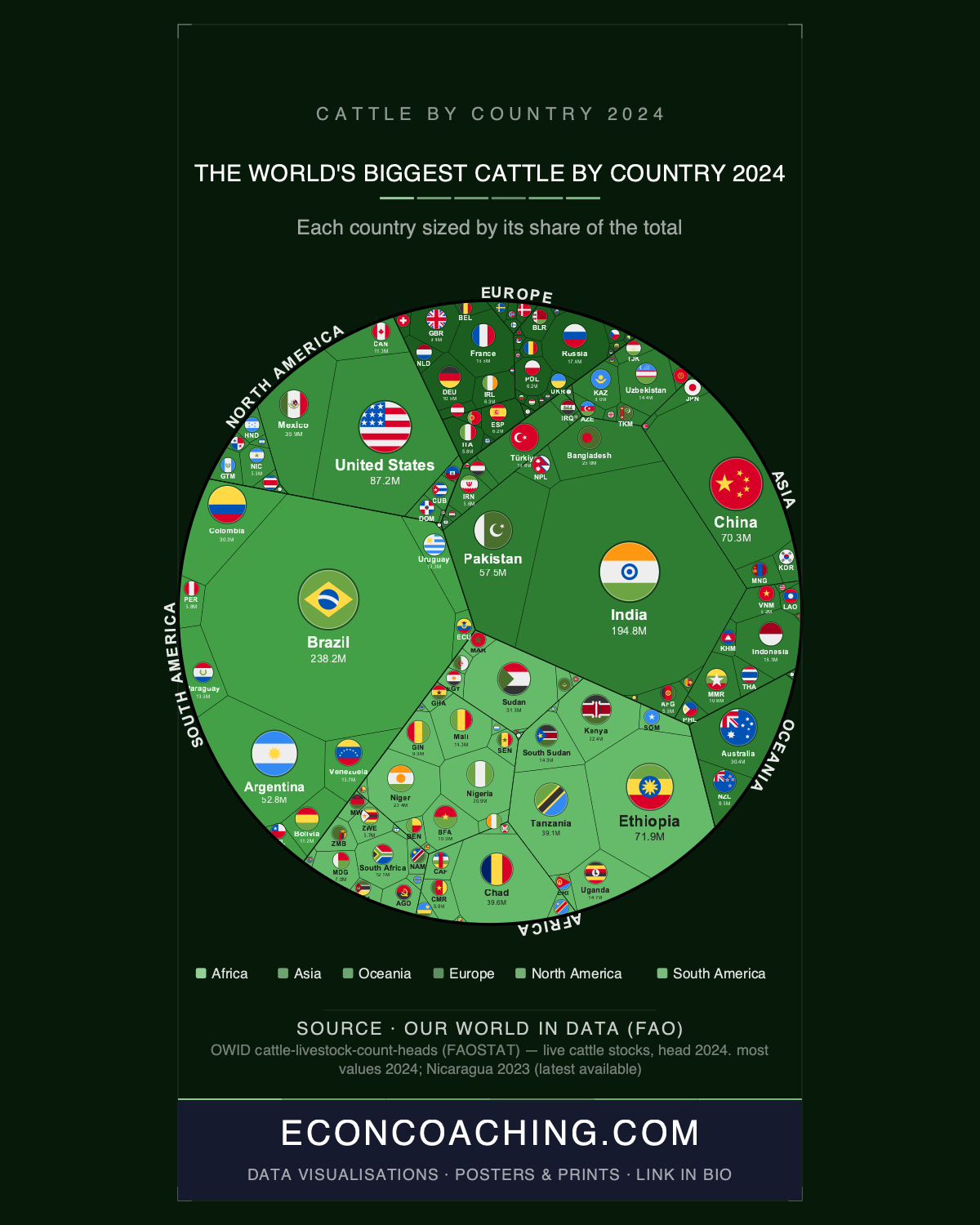
Brazil holds roughly 238 million cattle, the largest national herd on Earth, while India, the country most associated with cows in the global imagination, counts about 195 million. That gap of some 43 million animals is the single largest distortion visible on the treemap accompanying this article, where each country's rectangle is sized by cattle count rather than land area. India's cell looks large, but Brazil's is larger still, and the reason for the mismatch between reputation and rank says more about how cattle are counted than about which country actually farms more of them.
Why Brazil Outranks the Country Associated With Sacred Cows
Brazil's 238 million head represent about 15% of the global cattle population, more than any other nation. India's cattle total of roughly 195 million sits second, but India also maintains a separate population of about 109 million water buffalo, animals that are not classified as cattle and therefore don't appear in this ranking. Add the two together and India's bovine footprint looks very different, which is precisely the point: whether Brazil or India "leads" the world in cattle depends entirely on whether buffalo are counted alongside cows. This dataset counts cattle only. That single definitional choice, not a difference in farming scale, is the main reason Brazil sits at number one.
India's relationship with its cattle also differs fundamentally from Brazil's. Most Indian cows are kept for dairy, draft labour, or religious reasons and are rarely slaughtered domestically, a pattern reinforced by state-level slaughter bans that expanded significantly after 2014. Yet India remains the world's largest beef exporter. The explanation is carabeef: exported meat that comes from water buffalo, which carry no religious protection in the way cows do. India's cattle herd, in other words, is not primarily a beef-production asset in the way Brazil's or the United States' herds are.
America's Shrinking Herd Meets Brazil's Rise
The United States held about 87.2 million cattle on 1 January 2024, the smallest count since 1951, down from a peak near 94 to 95 million in the late 2010s. Years of drought across the Great Plains forced ranchers to cull breeding stock rather than expand it, and the contraction has continued: by January 2026 the herd had fallen further, to roughly 86.2 million. That multi-year destocking has helped push consumer beef prices to record highs.
A shrinking herd is not automatically a shrinking industry. The US remains among the world's top beef and dairy producers with less than half of Brazil's cattle count, a productivity gap built on feedlot efficiency and higher slaughter weights per animal, according to USDA and Drovers reporting. Even so, 2025 could mark the first year since the 1960s that Brazil overtakes the United States as the world's largest beef producer, a shift built on decades of Brazilian gains in beef and milk output per animal, even as the US continues to extract more meat from each individual head it raises.
Chad and Ethiopia Outrank Far Wealthier Cattle Economies
Chad, a landlocked Sahel nation more often discussed in terms of drought and conflict than agribusiness, ranks eighth in the world with nearly 39.6 million cattle, more than Tanzania (39.05 million) and Mexico (36.93 million). That total reflects large-scale pastoralist herding traditions rather than industrial ranching infrastructure. Ethiopia goes further still: its roughly 71.9 million cattle make it Africa's largest cattle population and place it among the world's top five countries, ahead of far more industrialised cattle economies including China, at 70.33 million, and Pakistan, at 57.54 million.
Where Cows Outnumber People
Only four countries on Earth have more cattle than human residents: Uruguay, at roughly 3.5 cows per person, New Zealand at about 2.5, Argentina at around 1.2, and Brazil at about 1.1. Argentina's 52.78 million cattle rank seventh globally, reinforcing that South America's Southern Cone, alongside Oceania, is where livestock density most visibly exceeds population density. Globally, the world holds about 1.58 billion cattle against a human population of roughly 8 billion, close to one cow for every five people alive.
Europe's Fading Share and the Climate Arithmetic
Europe, historically central to the world's dairy trade, now accounts for under 7% of global cattle. France, Western Europe's largest cattle producer, holds about 16.5 million head, fewer than Chad alone. That is a striking reversal for a continent whose dairy institutions once set the template for the rest of the world, and it underscores how far cattle production has shifted toward South America, South Asia, and Sub-Saharan Africa.
The scale of the global herd is not just an agricultural statistic. Livestock, overwhelmingly cattle, generate about 14.5% of human-caused greenhouse gas emissions and roughly a third of global methane output, figures that CGIAR and FAO researchers track closely. With the world herd rising only modestly, from about 1.57 billion in 2023 to 1.58 billion in 2024, national rankings like Brazil's and India's are as relevant to climate policy as they are to trade and diet.
The years 2024 to 2026 mark a rare moment where the raw cattle count, the beef trade, and the climate ledger are all shifting at once: Brazil's herd advantage is translating into production leadership just as America's herd hits a 75-year low, and the next several years of USDA, FAO, and IBGE data will show whether that realignment holds or reverses.
For more data-driven analysis of global economics and the trends reshaping the world economy, visit econcoaching.com.
Take this one home
Get this visualisation as a download, wallpaper, or printed poster.
← Back to all visualisations & articles
Follow Everything Econ: YouTube · TikTok · X · Instagram · Facebook