Across the world, roughly one in four workers holds an industrial job — in a factory, on a construction site, or down a mine. This ranking measures what share of each country's employed population works in "industry", a category that covers manufacturing, construction, mining and utilities, using modelled estimates from the International Labour Organization. The numbers reveal two very different stories: rich oil states running on imported labour, and manufacturing exporters betting their economies on factory floors.
At a glance · Top 5
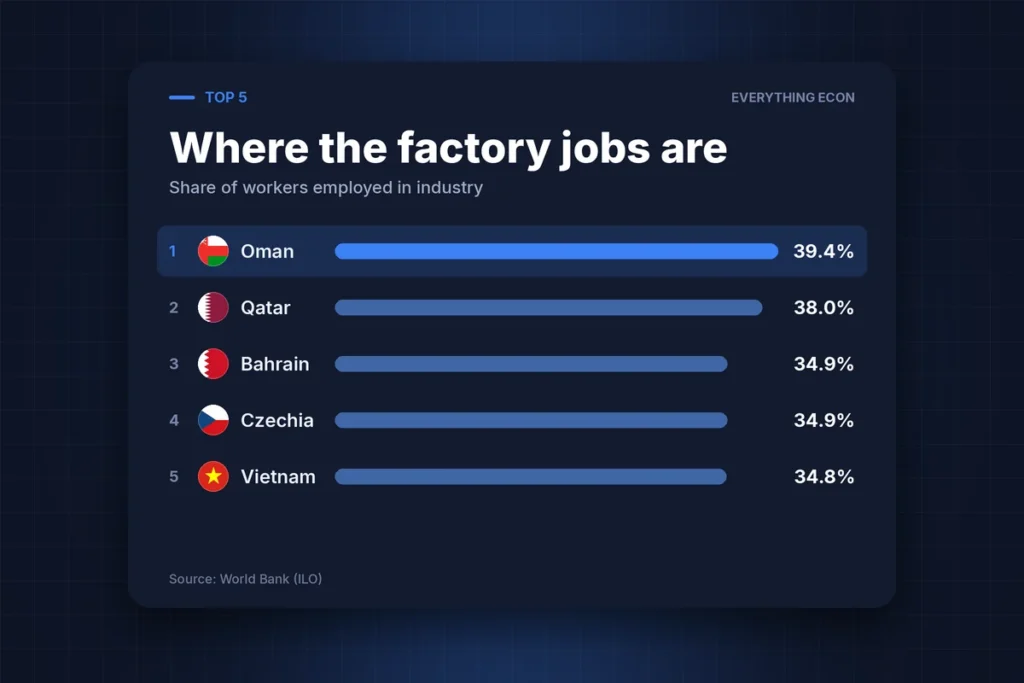
Share of workers employed in industry
- 1Oman39.4%
- 2Qatar38.0%
- 3Bahrain34.9%
- 4Czechia34.9%
- 5Vietnam34.8%
Source: World Bank (ILO)
The Gulf's construction economy
Four of the top ten spots belong to Gulf states — Oman, Qatar and Bahrain sit 1st, 2nd and 3rd, all above 34%. This isn't really about domestic industrial strength. Across Gulf Cooperation Council countries, foreign workers make up around 70% of the employed population, and most are concentrated in construction and energy. In Oman, expats fill a quarter of all private-sector construction jobs alone. The high industrial share reflects oil wealth funding building booms staffed largely by migrant labour, not a broad-based manufacturing sector employing citizens.
Europe's carmakers and Asia's factory floors
A different pattern shows up in Central Europe and East Asia, where industrial jobs come from genuine manufacturing strength. Czechia and Slovakia rank 4th and 7th, both around 34.5-34.9%, anchored by car plants — Slovakia in particular builds more vehicles per person than almost anywhere else in the world. Vietnam ranks 5th at 34.8%, having added 17.4 million industrial workers by 2024, up 167,000 in a single year, making manufacturing the country's second-biggest employer after farming. Much of that growth is foreign investment: Samsung alone has poured over $23 billion into Vietnam and employs more than 200,000 people there, its biggest production base outside South Korea. China, at 13th with 31.8%, has industrialised more gradually but steadily, with its industrial employment share up over 10 percentage points since 1991.
Not every manufacturing story is a success story, though. Lesotho ranks 9th at 33%, a share built almost entirely on garment exports, which once made up around 60% of the country's exports and nearly a fifth of its economy. But that industry has been shrinking: factory jobs fell from over 51,000 in 2020 to about 34,000 by 2024, and a 50% US tariff has since forced further closures — one factory alone, employing 1,300 people, shut its doors. With roughly three-quarters of Lesotho's textiles sold to the US, the country is exposed to decisions made far outside its borders.
What the bottom of the table shows
At the other end, the lowest-ranked countries — Ethiopia and Mozambique (6.4%), Timor-Leste (3.8%), Burundi (3.1%) and South Sudan (1.7%) — are economies still dominated by subsistence agriculture, with little industry to speak of. These are largely poorer nations where most people work the land rather than a factory or building site, and industrialisation simply hasn't taken hold yet.
The country on top
Topping the whole ranking is Oman, at 39.4%. It's a reminder that the highest industrial employment share in the world doesn't necessarily signal a manufacturing powerhouse — it reflects a construction-heavy economy propped up by a migrant workforce, in a country where expats fill a quarter of private construction jobs. Qatar and Bahrain follow closely behind for similar reasons, meaning the world's three most "industrial" economies by this measure are all small, oil-rich Gulf states rather than manufacturing giants.
Source: World Bank, ILO modelled estimates.
Get a new data story like this every week — join the newsletter.
Browse every visualisation on the visualisations page.
Take one home
Every country drawn to scale, as an instant printable download or a museum-quality matte poster printed to order.