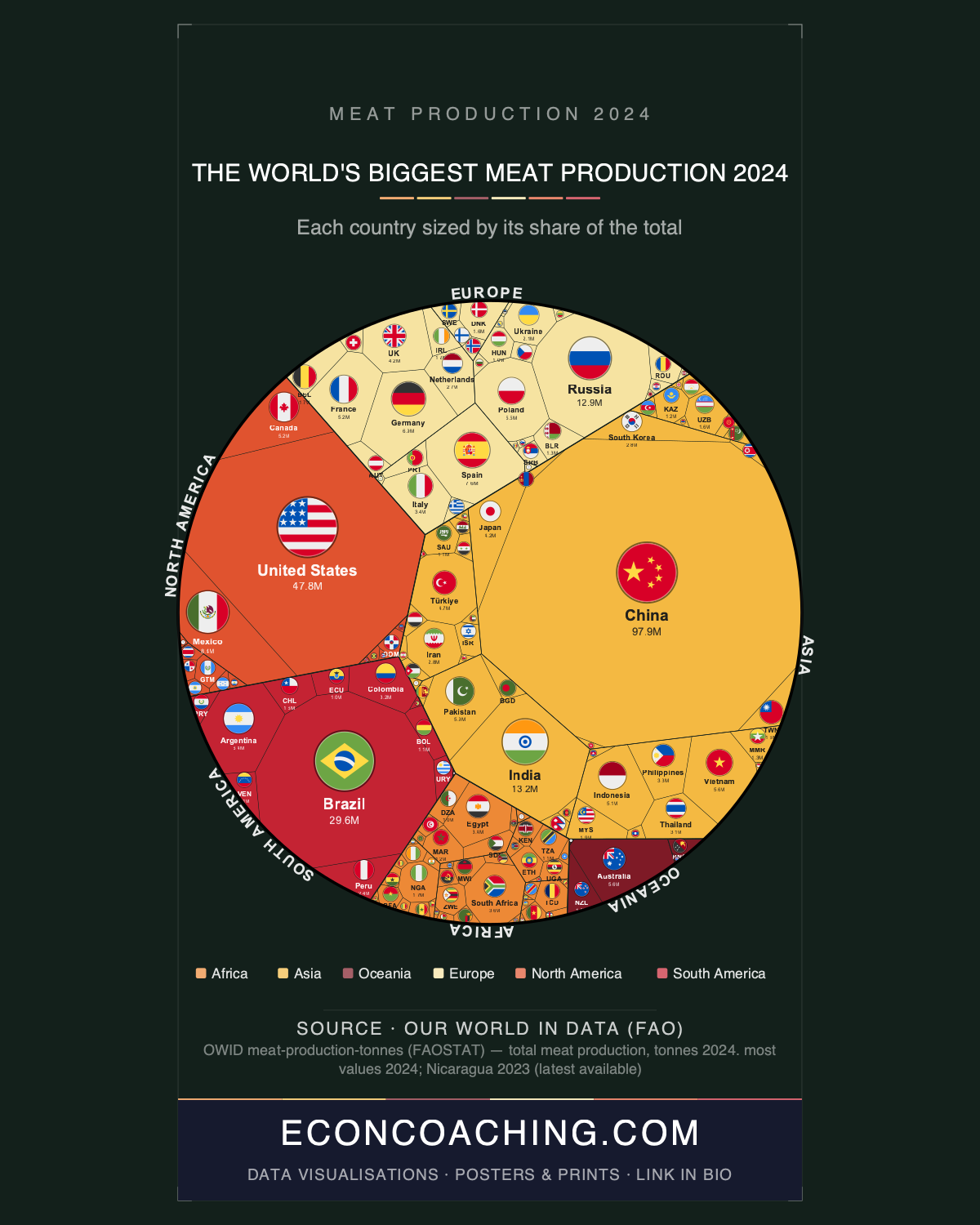
China produced 97.9 million tonnes of meat in 2024, more than the entire continent of Europe's 64.5 million tonnes across roughly 30 countries, and more than all of North America's 64.6 million tonnes combined. The gap runs to roughly 33 million tonnes in each case. The treemap accompanying this article sizes each country by output rather than land area, and China's cell alone covers over a quarter of the total picture: 26.2% of the world's 373.7 million tonnes of meat produced in 2024.
One Country, Two Continents
China's single-country output exceeding two entire continents is not a rounding artefact. Europe's 64.5 million tonnes is spread across roughly 30 producing nations, while North America's near-identical 64.6 million tonnes comes from a much smaller set of countries, chiefly the United States and Mexico. China matches both totals combined using one national supply chain. The FAO's Meat Market Review 2024 forecast global production would rise about 1.4% in the year to roughly 373 million tonnes, driven mainly by higher poultry and bovine output, with pig meat output expected to slip slightly. That forecast lines up closely with this dataset's 373.7 million tonne total, and China's scale is the single largest reason the aggregate figure sits where it does.
Three Countries, Nearly Half the World's Meat
China, the United States (47.8 million tonnes) and Brazil (29.6 million tonnes) together account for 46.9% of all meat produced on Earth, out of 155 countries in the dataset. That concentration extends down the ranking in unexpected ways: Brazil alone produces more meat than the entire African continent, 29.6 million tonnes against Africa's 24.2 million tonnes spread across 54 countries. India ranks fourth at 13.2 million tonnes, followed by Russia (12.9 million tonnes), Mexico (8.4 million tonnes), Spain (7.6 million tonnes), Germany (6.9 million tonnes), Argentina (6.4 million tonnes) and Pakistan (5.9 million tonnes) rounding out the top ten. North America's 64.6 million tonnes and Europe's 64.5 million tonnes, each at 17.3% of world output, sit in a near-exact statistical tie despite Europe having roughly double the number of producing countries, meaning European output is far more fragmented per nation than North America's.
Pork Explains China's Lead, Not Beef
China's top ranking in total meat obscures a sharper species-level story. China produces roughly 59.4 million tonnes of pork, about half of the world's entire pork supply, more than three times the European Union's 18% share and five times the United States' 10% share. Yet in beef specifically, China ranks only third globally at around 13% of world supply, behind the United States at roughly 20% and Brazil at roughly 19%. A single aggregate "meat" ranking flattens these differences: China's dominance is a pork story built on an enormous domestic hog industry, while the beef leadership board looks entirely different, led by the United States and Brazil.
Production Leadership Does Not Mean High Consumption
India's position as the fourth-largest meat producer at 13.2 million tonnes sits alongside the lowest per-capita meat consumption on the planet, estimated at only 4 to 8 kilograms per person per year, a consequence of widespread religious and cultural vegetarianism across the world's second-most-populous country. Production rank and domestic eating habits are separate variables. Argentina illustrates the opposite extreme: despite ranking ninth in total output at 6.4 million tonnes, it posts the highest per-capita beef and veal consumption in the world, at roughly 51 kilograms per person in 2024. China's own consumption story has a longer arc than its current production dominance suggests: it overtook the United States to become the world's leading meat consumer as far back as 1992, decades before building the production lead it holds today.
Brazil's Record Year and Where Demand Grows Next
Brazil set an all-time record in 2024, exporting 2.89 million tonnes of beef, a 26.2% jump over 2023, generating $12.8 billion in revenue, with China the top destination at 1.33 million tonnes worth $6 billion. Researchers at the Stockholm Environment Institute's Trase initiative have linked this kind of export growth to deforestation pressure in the Amazon and Cerrado, a complication that sits uneasily alongside the headline export numbers. Meanwhile the demand picture is shifting geographically: global meat consumption is projected by FAO and OECD to rise nearly 73% by 2050, with Africa the fastest-growing region, its consumption expected to climb from about 10.5 million tonnes to 35 million tonnes a year, an increase of roughly 150%, as its population nearly doubles to 2.2 billion. Africa's current 24.2 million tonnes of output, smaller than Brazil's alone, understates how central the continent will become to global meat markets.
The OECD-FAO Agricultural Outlook 2025-2034 projects that growth in meat production and consumption is increasingly concentrated in upper-middle-income countries, expected to account for 45% of global consumption growth through 2034, a shift away from the historically dominant role of established producers like the United States and the European Union. China's current scale advantage was built over three decades; the next one looks set to be shaped by a different set of countries entirely.
For more data-driven analysis of global economics and the trends reshaping the world economy, visit econcoaching.com.
Take this one home
Get this visualisation as a download, wallpaper, or printed poster.
← Back to all visualisations & articles
Follow Everything Econ: YouTube · TikTok · X · Instagram · Facebook