
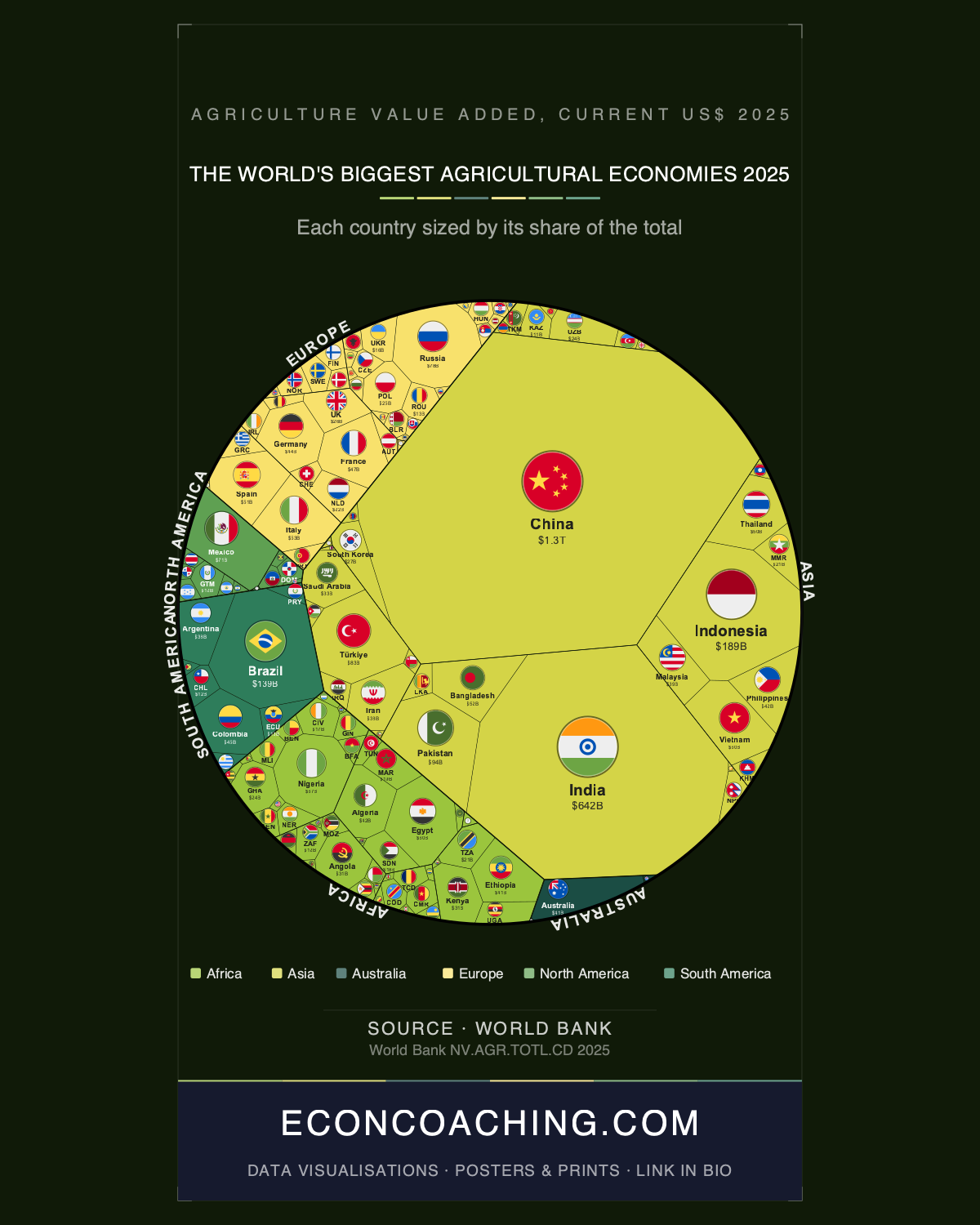
The treemap accompanying this article makes one fact immediately disorienting: China's rectangle is larger than all of Europe, all of Africa, and all of the Americas combined. China alone accounts for 30.82% of global agricultural output — nearly one-third of everything the world grows — and when India's 15.25% share is added, two countries sharing a land border in Asia produce close to half of all food on Earth. The continental picture is equally stark: Asia generates 65.8% of global agricultural output, while Europe contributes 11.9%, Africa 12.4%, South America 6.2%, and North America just 2.7%.
China and India: Half the World's Food From Two Countries
China's agricultural dominance is not static — it is accelerating. In 2024, China's grain production surpassed 700 million metric tonnes for the first time in recorded history, rising 1.3% to 706.5 MMT, with corn alone hitting a record 294.92 MMT. The government has set a target to add a further 50 MMT by 2030, another 7% increase from an already unprecedented base. India's trajectory over the same period is comparable in its pace: foodgrain production reached a record 357.73 million tonnes in 2024–25, an 8% jump in a single year and an increase of more than 106 million tonnes over the prior decade, from 251.54 MMT in 2015–16. Union Agriculture Minister Shivraj Singh Chouhan cited it as one of the fastest sustained agricultural expansions ever recorded for a major economy, and the FAO data supports that characterisation.
The counterpoint to China's production dominance is critical: China is simultaneously the world's largest importer of agricultural products, with soybean imports alone reaching a record 105 million metric tonnes in 2024. High output does not equal food self-sufficiency when a population of 1.4 billion demands protein-intensive diets requiring feed crops that domestic land cannot supply. India, by contrast, is a net agricultural exporter and the world's leading producer of milk — contributing nearly one-quarter of global output — as well as pulses, millets, dry onions, coconuts, and spices, yet ranks only second overall behind China.
Ukraine's War-Driven Collapse and Russia's Deteriorating Position
The most consequential shift in the 2025 agricultural map is not a record harvest but a sustained production collapse. Ukraine's grain and industrial crop output fell from a record 106 million tonnes in 2021 to approximately 77 million tonnes by 2024 — a 27% decline driven by the Russian invasion, which has left around 2 million hectares of arable land too dangerous to cultivate. Harvested areas for wheat, corn, and barley have fallen 32%, 27%, and 37% respectively from 2021 levels. Total damages and losses to Ukraine's agricultural sector are estimated at $80 billion, and the country's 2025 exports of corn, barley, wheat, and meslin were 35% below pre-invasion 2020 levels. Russia's deliberate targeting of Black Sea export infrastructure — with at least 50 documented attacks — and its exit from the Black Sea Grain Initiative compounded the disruption to global supply chains.
Russia itself, ranked seventh globally at 1.86% of world output, is not immune to structural pressure. Russian wheat exports are projected to fall 20% in 2025–26 from their record highs, as adverse domestic weather offsets the geopolitical leverage Moscow has sought to extract from its position as the world's largest wheat exporter.
Brazil's Rise and Africa's Structural Underperformance
Brazil ranks fourth in global agricultural output, yet its influence on specific commodity markets exceeds that ranking. Agribusiness exports reached a record US$169.2 billion in 2025, representing 48.5% of all Brazilian exports — a transformation from modest figures in the early 2000s driven by soybean, beef, and sugarcane expansion. Brazil is the world's largest producer and exporter of both beef and broiler meat. The contrast with Africa is instructive: Nigeria ranks ninth globally at 1.59% of world agricultural output, yet between 2021 and 2024 it imported ₦16 trillion in food while exporting only ₦7 trillion — running a food trade deficit equivalent to 3% of agricultural GDP. Africa as a whole contributes only 12.4% of global output despite holding an estimated 60% of the world's uncultivated arable land. That gap is not a resource constraint but a governance and infrastructure one: chronic underinvestment, poor transport networks, and acute climate vulnerability have prevented conversion of land potential into production at scale.
Records at the Margins: Rice, Australia, and Colombia
Global rice production reached a record 535.8 million tonnes in 2024/25 — the ninth consecutive year of record harvests, according to FAO data. Indonesia, projected to produce 34.6 MMT, is now the largest rice producer in Southeast Asia and may eliminate its structural import dependency for the first time. Australia's winter crop output surged 26% in 2024–25 to an estimated 59.8 million tonnes, with wheat rising 31% year-on-year to 34.1 million tonnes following a drought-hit prior season, according to ABARES. Australia's gross agricultural value reached approximately AUD $100.3 billion in 2024–25, a 45% real-terms increase over twenty years. Colombia, ranked seventeenth globally at 1.08% of world output, is projected by the OECD to grow its agriculture market at a CAGR of 4.56% from 2026 to 2031, driven by climate-smart commodity development and Hass avocado export growth — the fastest projected growth rate among South America's major agricultural economies.
What the Treemap Obscures
Europe's 11.9% share understates its agricultural fragility. EU agricultural output value fell 1.5% in 2023 — the first decline in over a decade — as farm profitability crises intensified across the bloc. The EU's four largest producers — France, Germany, Italy, and Spain — generate 56.5% of bloc output but face compounding climate and cost pressures that the headline share figure does not capture. The 2025 data therefore represents a system under visible stress at multiple points simultaneously: record outputs from Asia's two giants, a fourth year of war-induced contraction in Europe's former breadbasket, and an African continent structurally unable to convert land endowment into production at anything approaching its potential. The direction of the next decade's global agricultural geography will be determined primarily by whether those divergences narrow or compound.
For more data-driven analysis of global economics and the trends reshaping the world economy, visit econcoaching.com.
Take this one home
Get this visualisation as a download, wallpaper, or printed poster.
← Back to all visualisations & articles
Follow Everything Econ: YouTube · TikTok · X · Instagram · Facebook