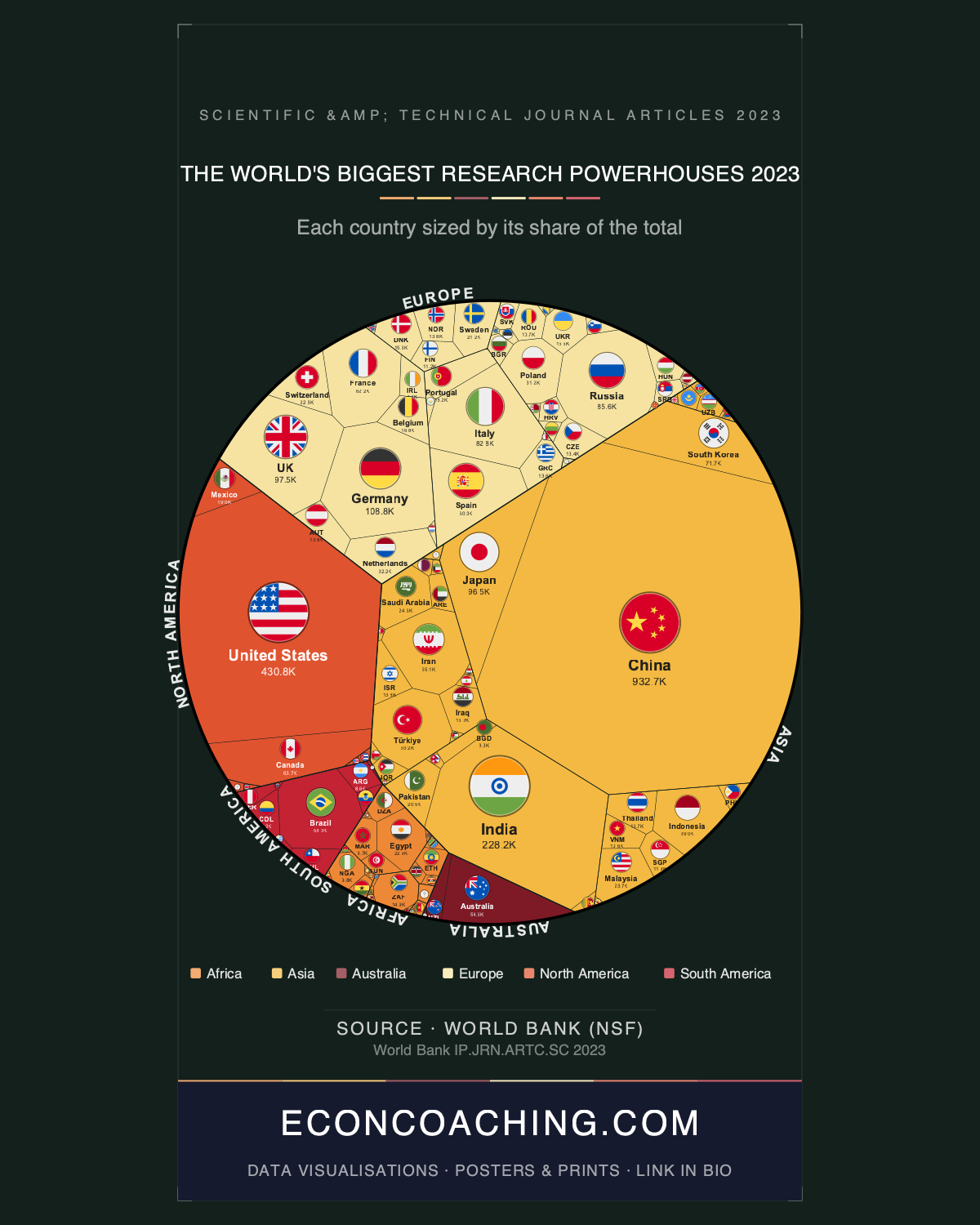
China published 932,712 scientific papers in 2023 — more than the entire continent of Europe, which produced 803,654 across 44 countries with centuries of accumulated research tradition. That single comparison, made visible in the treemap accompanying this article where cell area is proportional to paper count rather than land mass, produces an image that defies geographic instinct: China's rectangle is larger than all of Western Europe combined, and it dwarfs North America, where the United States, Canada, Mexico, and every country in the Caribbean and Central America together total just 517,431 papers.
The Fastest Power Shift in the History of Organised Science
In 2000, the United States produced roughly 30% of all globally indexed scientific papers while China contributed under 5%. By 2023, China's share has reached 28.79% and America's has fallen to 13.3% — a near-complete reversal accomplished within 23 years. The volume story alone is striking, but 2023 added a qualitative milestone: for the first time in history, China topped the Nature Index Research Leaders list in the natural sciences, surpassing the United States not just in raw paper counts but in contributions to the world's 145 most prestigious scientific journals. That distinction partially addresses the most credible counterargument to China's rise — that publication volume inflated by lower-tier output doesn't translate to scientific influence.
That counterargument still has force. Chinese research has been accompanied by a documented surge in paper-mill fraud; Springer Nature and other major publishers have retracted thousands of fabricated Chinese papers in recent years, and Clarivate's Web of Science has flagged anomalous citation patterns in Chinese journal clusters. The Nature Index result, weighted toward elite journals with rigorous peer review, is a more meaningful signal than headline totals, but it does not fully resolve the integrity question around China's raw count.
America's Volume Decline and Persistent Quality Lead
The United States' fall from roughly 40% of global scientific papers in 1980 to 13.3% today is dramatic in relative terms but does not represent a collapse in absolute output — it reflects the scale of new entrants. The US still publishes 430,843 papers annually, more than any country except China. More importantly, WIPO's 2025 Global Innovation Index finds the United States still leads the world by a wide margin in high-impact, citation-weighted research quality — h-index rankings and top-1% cited paper counts both favour American institutions heavily. Volume decline is masking a quality advantage that raw paper counts cannot capture, and the NSF's National Center for Science and Engineering Statistics consistently confirms that US researchers retain disproportionate influence over the global citation network.
Asia Crosses 51% and Rewrites the Rankings
Asia now accounts for 51.4% of all global scientific papers — 1,665,447 of 3,239,269 — the first time in modern history that a single continent has held the majority of published scientific knowledge. Until the 1970s, English-language Western institutions so thoroughly dominated scientific publishing that non-Western work rarely gained acceptance in top journals. That hierarchy has inverted completely within one generation.
India's position within this shift is particularly stark. India published 228,174 papers in 2023 to claim the world's #3 rank, overtaking the United Kingdom (97,536) — it now publishes more than twice the UK's output. From 2014 to 2023, India accounted for 13% of all net new global publications. South Korea, which produced barely any internationally indexed papers in 1960, now ranks #9 with 71,724 — a transformation from war-devastated poverty to global science powerhouse achieved in under 70 years.
The rankings also surface surprises that no geographic intuition would predict. Iran ranks #14 globally with 55,085 papers, narrowly outranking Australia (#15, 54,589) despite decades of international sanctions that restrict journal access, collaboration tools, and research funding channels. Indonesia ranks #17 with 38,992 papers, ahead of the Netherlands (32,207, #18) and Switzerland (22,804, #23), countries with substantially higher R&D spending per capita and research infrastructure that predates Indonesia's independence. Saudi Arabia, Egypt, and Pakistan recorded the world's highest publication growth rates from 2020 to 2023, driven by COVID-19 research incentives and national policies tying university rankings to publication counts — a dynamic that produces quantity but concentrates output in lower-tier venues rather than the journals where scientific influence is actually built.
The African Research Gap
Africa produces 2.9% of global scientific papers — 94,232 — despite holding roughly 18% of the world's population, the starkest per-capita research gap of any major region. Egypt leads the continent at 22,854, followed by South Africa (14,949) and Nigeria (9,799). That gap is wider than raw figures suggest: much of Africa's recent publication growth is concentrated in lower-tier or predatory journals, meaning the real shortfall in rigorously peer-reviewed output is more severe than headline totals imply. South America produces a nearly identical 2.9% share (95,470 papers), with Brazil alone accounting for 58,292 of those — 61% of the entire continent's output — illustrating how sharply regional research capacity can concentrate within one national system.
What the Data Actually Measures
Russia (#7, 85,558 papers) and Ukraine (#32, 15,498) together produced more than 101,000 papers in 2023 — more than France (#11, 62,180) alone — despite an active war now in its second year. The Soviet Union was once the world's second-largest scientific producer; Russia's 2.64% share today reflects decades of post-Soviet brain drain and chronic underfunding, a fall that shows how quickly scientific capacity erodes without sustained institutional investment. That it can still sustain output through active conflict illustrates how durable established research infrastructure can be even under severe pressure.
The 2023 data marks three simultaneous milestones: Asia crossing 51% of world output for the first time, China overtaking the United States in the Nature Index natural sciences ranking, and India surpassing the United Kingdom to claim third place. Whether these volume gains convert into sustained scientific influence — measured by citation impact, patent generation, and commercial application — will determine whether 2023 represents a genuine rebalancing of where human knowledge is created, or a partially inflated count that quality metrics will eventually correct downward.
One chart like this in your inbox each week, explained in plain English — join the Everything Econ newsletter. Always free, and you can unsubscribe any time.
Take this one home
Get this visualisation as a download, wallpaper, or printed poster.
← Back to all visualisations & articles
Follow Everything Econ: YouTube · TikTok · X · Instagram · Facebook