
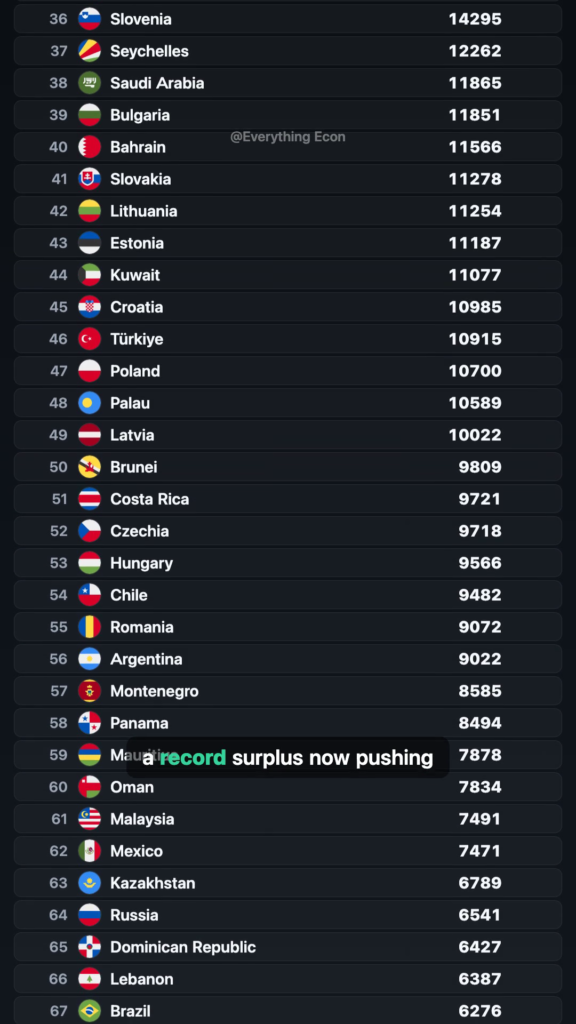
Every year, the World Bank tallies how much people around the world actually spend — not what their government spends, not what companies invest, but the money that flows through ordinary households on food, rent, transport, healthcare, and everything else that makes up daily life. This single number, converted to a per-person figure so that countries of different sizes can be compared fairly, tells a stark story: where you're born still overwhelmingly determines how much of the world's output you get to consume.
A five-way gap between giants
The scale of the imbalance is easiest to see by comparing the world's biggest economies. The United States spends $46,041 per person and more than $19 trillion in total — a figure so large it exceeds the combined household spending of India and China multiplied by five. Yet China's own household spending sits at just $4,900–$7,500 per person, less than a tenth of the American figure. That's not because Chinese households are poor by global standards; it's a structural choice. Consumption is capped at around 40% of China's economy, compared with 60–70% in wealthy nations, because so much of China's growth has been funnelled into investment and exports rather than household spending.
India tells a different story again. Household spending drives 61% of its economy, and its consumer base added 33 million people in 2024, edging out even China's addition of 31 million. India isn't rich yet, but its growth is increasingly powered by its own citizens spending money, not by factories built for export.
Europe's cushion, Africa's shortfall
Zoom out to whole regions and the pattern holds. Europe is the highest-spending region in the world, averaging $16,599 per person, while Sub-Saharan Africa sits at the opposite extreme with just $1,809 — nine times lower. That regional gap plays out starkly at the bottom of the ranking: Niger, Madagascar, DR Congo, Burkina Faso, Central African Republic and Mozambique all fall below $511 per person, making seven of the bottom eight countries African. The sole outlier is Syria, in second-last place at $242 per person, where over a decade of civil war has gutted the economy rather than long-term poverty alone. Dead last is Burundi, at just $195 a year — about 0.4% of what the average American spends.
Worth a special mention is Ireland, which ranks 15th at $24,486 per person. That figure is inflated by an accounting quirk: multinational companies book enormous profits through Ireland for tax reasons, which distorts the national statistics. Strip that out, and Ireland's real living standards likely sit closer to 8th–12th place — still comfortable, just not quite as extreme as the headline number suggests.
The near-tie at the top
That brings us to the very top of the table, and it's closer than almost anyone expects. The United States leads at $46,041 per person, but Switzerland trails by a mere $28, at $46,013 — effectively a statistical tie for the world's biggest spender. Norway ($39,799), Luxembourg ($38,321) and Australia ($33,634) round out the rest of the top five, all small, resource-rich or highly specialised economies where wages and consumption run far above the global norm.
What unites the top spenders isn't just wealth — it's economies structured so that a large share of national income actually reaches households, rather than being retained by the state or reinvested abroad. That single structural difference explains more of this ranking than raw GDP ever could.
Data source: World Bank.
Get a new data story like this every week — join the newsletter.
Browse every visualisation on the visualisations page.