Total emissions tell you which countries burn the most fuel overall — but that mostly just tracks population and industrial size. Divide a country's carbon dioxide emissions by its number of people, and a very different picture appears: one where small, wealthy nations often outpace giants like China or India by a wide margin. This "per person" figure, tracked by Our World in Data, shows how much CO2 an average resident of a country is responsible for each year, through electricity use, transport, heating, cooling and industry. It reveals lifestyle and energy choices that raw totals hide entirely.
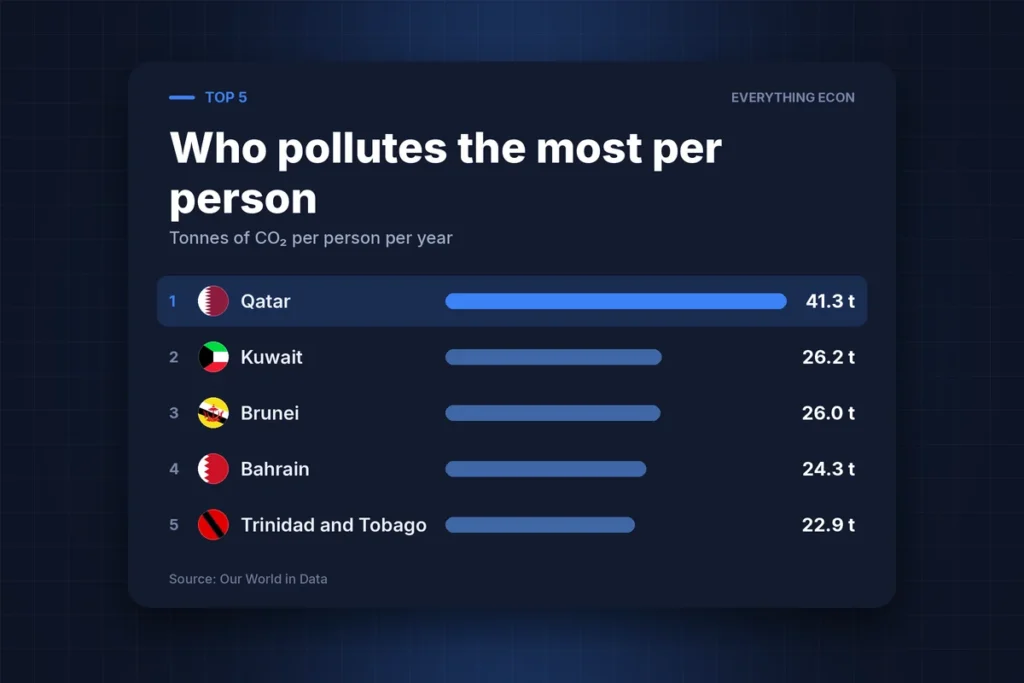
At a glance · Top 5
Tonnes of CO₂ per person per year
- 1Qatar41.3 t
- 2Kuwait26.2 t
- 3Brunei26.0 t
- 4Bahrain24.3 t
- 5Trinidad and Tobago22.9 t
Source: Our World in Data
The desert cluster at the top
Eight of the fifteen highest emitters per person are oil and gas producers in the Gulf and nearby regions: Kuwait (26.2 tonnes), Brunei (26.0 tonnes), Bahrain (24.3 tonnes), Trinidad and Tobago (22.9 tonnes), Saudi Arabia (20.4 tonnes), the United Arab Emirates (20.1 tonnes), Oman (15.7 tonnes) and, at the very top, one country pulling far ahead of the rest. These countries share a pattern: fossil fuels are extracted locally and sold to residents at heavily subsidised prices, so petrol, electricity and air conditioning cost a fraction of what people elsewhere pay. That cheapness drives heavy use, especially for cooling homes and offices in extreme heat.
Further down the top fifteen sit a different kind of high emitter — large, wealthy countries with a lot of space and heavy reliance on cars: Australia (14.5 tonnes), the United States (14.2 tonnes), Kazakhstan (13.9 tonnes), Canada (13.4 tonnes), Mongolia (12.9 tonnes), Palau (12.8 tonnes) and Russia (12.3 tonnes). The US figure is notable partly for its context: national emissions actually fell 11.3% recently, dropping to 4.9 billion tonnes, yet the country's per-person figure remains among the highest in the world simply because there are so few people spread across so much energy-intensive infrastructure.
Fast risers and quiet cutters
Regional trends are just as telling as the rankings themselves. Some of the fastest-growing economies in Asia are also posting the sharpest increases in emissions: Vietnam's emissions rose 106%, the fastest growth of any country, while Indonesia's grew 63% as coal power and industry expanded rapidly. India's emissions grew 49%, but its emissions per person remain low — only a few tonnes each — because its population is so large that growth gets divided among more than a billion people.
Meanwhile, some wealthy countries are cutting emissions substantially even as their economies keep growing. The UK has cut emissions by more than 40% since 1990 and shut down its last coal-fired power plant entirely. Germany's energy-sector emissions have fallen roughly 60% since 1990 by phasing out lignite coal and expanding wind and solar power. China's emissions per person have now risen to roughly match the UK's level and have overtaken the average across the European Union — a sign of how much its energy mix has shifted toward coal-fired industry over recent decades.
The country at the very top — and the bottom
Topping the entire ranking is Qatar, at 41.3 tonnes per person — more than 400 times higher than the lowest countries. Qatar's position comes down to three factors: it is one of the world's largest producers of liquefied natural gas, it relies on energy-intensive desalination to turn seawater into drinking water, and its extreme heat makes air conditioning a year-round necessity rather than a luxury.
At the opposite end, seven countries are tied at just 0.1 tonnes per person: Malawi, the Central African Republic, Somalia, Burundi, DR Congo, Ethiopia, Uganda and Niger. These are among the world's poorest nations, where limited access to electricity, vehicles and industry keeps individual energy use — and emissions — minimal.
Source: Our World in Data.
Take one home
Every country drawn to scale, as an instant printable download or a museum-quality matte poster printed to order.
Get a new data story like this every week — join the newsletter.
Browse every visualisation on the visualisations page.