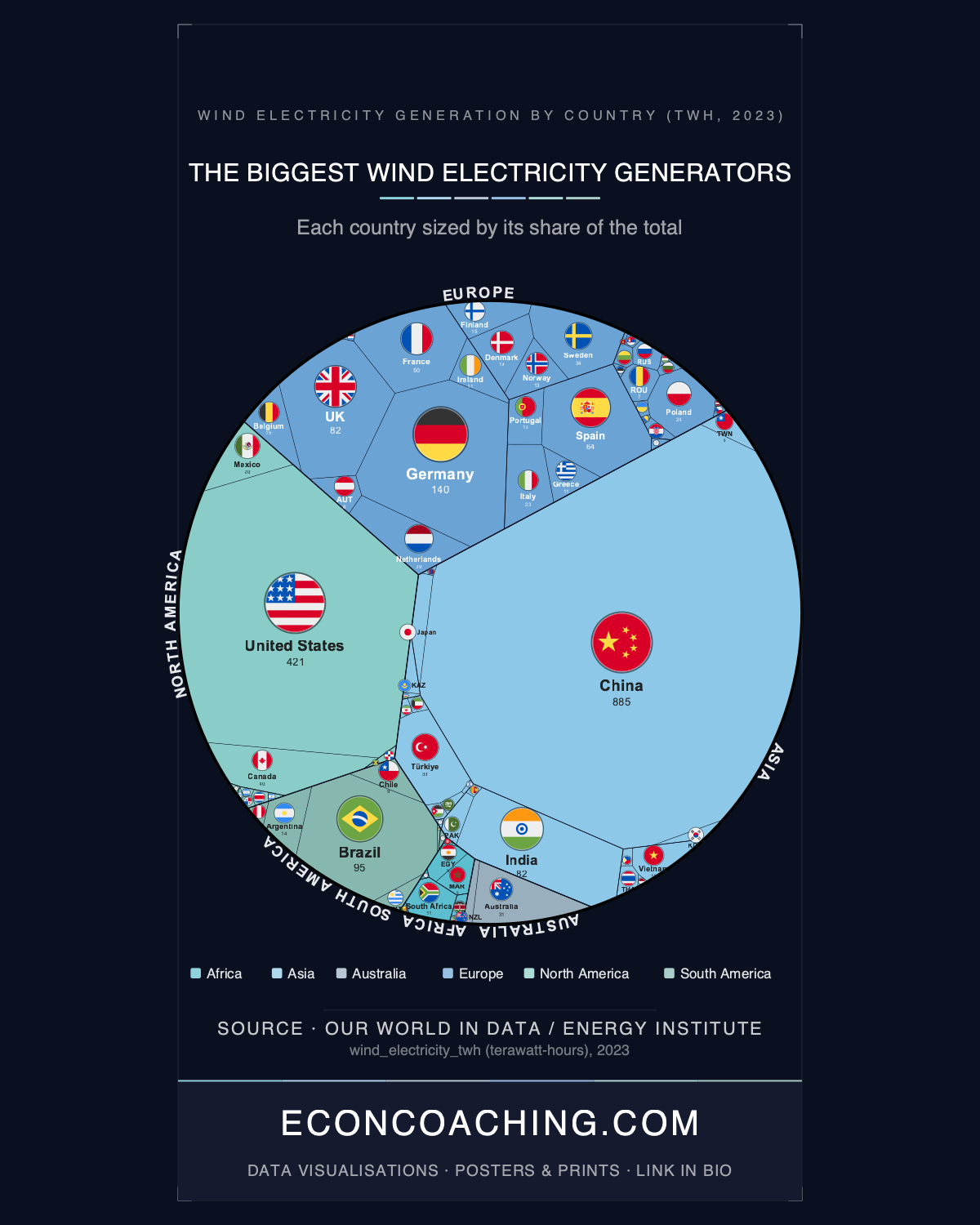
China generated 886 terawatt-hours of wind electricity in 2023 — more than all European nations combined, which together produced 583 TWh across more than 30 countries. The treemap accompanying this article makes that comparison concrete: China's cell is not just the largest on the chart, it is larger than the entire European continent's combined area. That single number — 38.2% of all wind electricity generated on Earth — restructures every other data point in the ranking.
China's Dominance, and Its Limits
The scale of China's wind output is easier to grasp through comparisons than through the raw figure. China produced more than twice the United States' 421 TWh, outgenerating the second-ranked country by 465 TWh — a margin larger than Germany's entire output. China holds roughly 50% of the global offshore wind fleet, with 37.7 GW of installed offshore capacity by end-2023, in a sector that was practically non-existent in China before 2015. The United States held the top position in global wind generation for most of the 2000s; China overtook it around 2012 in cumulative installed capacity and by 2023 generates more than double the US total, a shift that has restructured the global turbine supply chain.
The necessary counterweight is that China's 886 TWh from wind sits inside a power system where coal still accounts for roughly 60% of total electricity generation. China is simultaneously the world's largest wind producer and a system in which wind remains a relatively modest share of a massive fossil-fuel-dominated grid. IEA data for 2023 show China adding more renewable capacity than any other country while also expanding coal generation — two trends that are not yet in conflict because the overall system is growing so fast that renewables and fossil fuels are both increasing in absolute terms.
The Two-Country Concentration
China and the United States together generated 1,307 TWh of wind electricity in 2023 — 56.4% of the global total of 2,319 TWh. That means the remaining 78 countries split just 43.6% between them. Germany, at 141 TWh and ranked third globally, is the only other country above 100 TWh. Germany long led Europe in absolute wind output, but growth has slowed sharply due to permitting bottlenecks and community opposition — a constraint that GWEC and the IEA have repeatedly cited in European energy policy discussions as other nations accelerate their build rates. 2023 was the first year cumulative global wind capacity surpassed 1 terawatt (1,000 GW), with capacity growing by more than 100 GW — a 12.5% annual growth rate, up from 10.2% in 2022.
Brazil's Position and the South American Anomaly
Brazil ranked fourth globally with 96 TWh, ahead of both the United Kingdom and India, which are in an exact statistical tie for fifth and sixth place at 82 TWh each — 3.54% of global output apiece. Most readers associating wind power with Europe or North America would not place Brazil ahead of the UK. The more striking comparison is regional: Brazil alone generated 96 TWh in 2023, while all of Africa produced 28 TWh and Australia and New Zealand combined produced 35 TWh — meaning one country outproduced two entire macro-regions by a combined margin of 33 TWh. Brazil's wind resource is concentrated in the northeast, where consistent trade winds have enabled a rapid build-out with relatively high capacity factors, giving it an output-to-capacity ratio that compares favorably with many European nations.
Denmark and the Per-Capita Reframe
Denmark appears at position 17 in the absolute ranking with 19 TWh — a cell barely visible on the treemap. That number looks modest until placed in context: Denmark generated approximately 58% of its national electricity from wind in 2023, the highest share of any country on Earth. Denmark essentially invented the modern commercial wind turbine industry in the late 1970s and deployed the world's first offshore wind farm (Vindeby, 5 MW) in 1991 — its current ranking by absolute output reflects a population of 5.9 million, not a lack of wind ambition. Ireland, Uruguay, and Portugal sit alongside Denmark in the group of countries where wind's share of the national electricity mix dwarfs their absolute output rankings. That said, Denmark's 58% figure is partly enabled by deep grid interconnections to Norway's hydroelectric reserves and Germany's broader network, which balance intermittency — making it a regionally distributed achievement rather than a purely domestic one. On a per-capita basis, Denmark, Ireland, Uruguay, and Portugal all outperform China, the United States, and Brazil by significant margins.
Africa's 1.2% and What the Data Misses
All of Africa produced 28 TWh of wind electricity in 2023 — 1.2% of the global total across a continent of 1.4 billion people. South Africa generated 12 TWh of that, accounting for approximately 43% of the entire continent's output, more than Morocco (7 TWh) and Egypt (6 TWh) combined. Türkiye, ranked 11th globally at 34 TWh, generates roughly 17 times more wind electricity than any single Middle Eastern nation. Vietnam, ranked 25th with 12 TWh — tied with South Africa — operated near-zero wind capacity as recently as 2019, making it one of the fastest wind build-outs in the developing world. Africa's 1.2% share does not reflect absence of resource: IRENA estimates the continent's technically exploitable onshore wind potential exceeds its total electricity demand by a wide margin. The constraint is chronic underinvestment and transmission infrastructure gaps, not wind availability. Morocco's MASEN has made progress on utility-scale projects, but the continent-wide numbers remain a function of financing conditions and grid infrastructure rather than physical endowment.
The 2023 data establishes a baseline in which two countries dominate a technology that IEA projections require to scale dramatically by 2030 to meet climate targets. Whether that scaling replicates the same geographic concentration or distributes more broadly across Africa, Southeast Asia, and Latin America will define both the climate trajectory and the economic geography of the energy transition.
One chart like this in your inbox each week, explained in plain English — join the Everything Econ newsletter. Always free, and you can unsubscribe any time.
Take this one home
Get this visualisation as a download, wallpaper, or printed poster.
← Back to all visualisations & articles
Follow Everything Econ: YouTube · TikTok · X · Instagram · Facebook