Every country on Earth is ageing — but some are doing so far faster than others. This ranking measures the share of each nation's population aged 65 and over, a widely used marker of how old a country's population has become. The figures, drawn from World Bank data, reveal a world split between societies grappling with too few young people and those still defined by youth.
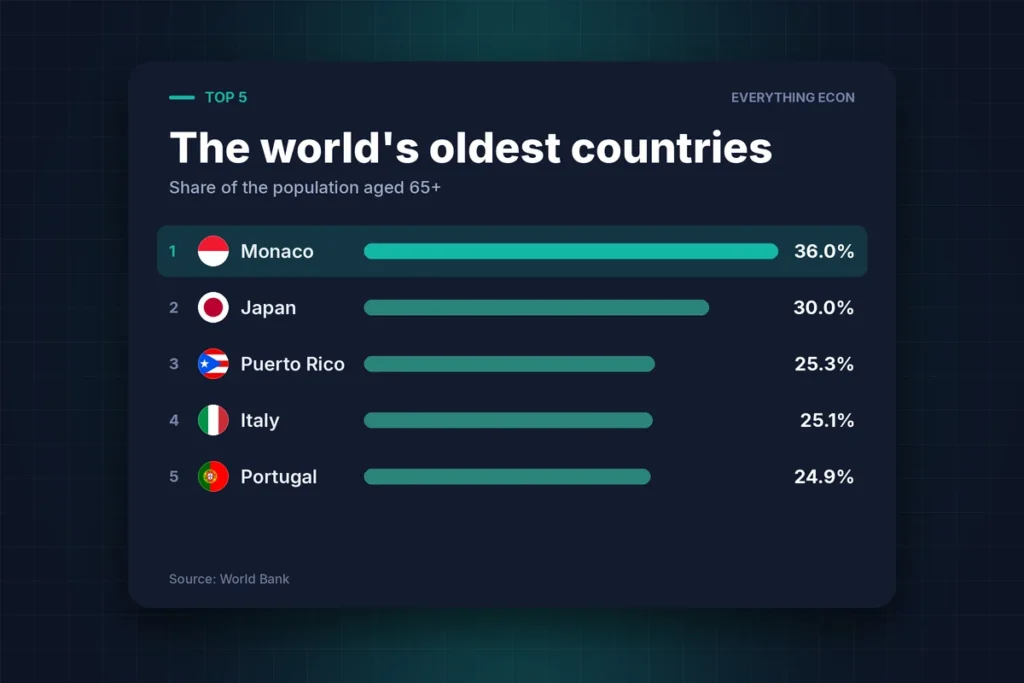
At a glance · Top 5
Share of the population aged 65+
- 1Monaco36.0%
- 2Japan30.0%
- 3Puerto Rico25.3%
- 4Italy25.1%
- 5Portugal24.9%
Source: World Bank
Europe Is Leading the Ageing World — For Now
If you want to find the world's oldest populations, Europe is the obvious place to start. The continent averages 20.6% of its residents aged 65 or older — higher than any other region. The top 15 in this ranking are almost entirely European, with Japan and Hong Kong the notable exceptions.
Italy (25.1%), Portugal (24.9%), Greece (24.4%), Finland (24.2%), Germany (23.7%), and Croatia (23.6%) all sit in the top ten. The pattern across these countries is similar: falling birth rates over decades, strong healthcare systems that have extended life, and in some cases significant emigration of younger people seeking work elsewhere — a trend visible in countries like Croatia, Serbia, and Bosnia and Herzegovina, which also appear in the top 15.
France (22.5%) and Bulgaria (22.2%) round out the list, showing that ageing is not limited to wealthy Western Europe. Bulgaria's inclusion is notable because it sits alongside some of the richest countries in the world despite having a far smaller economy — a reminder that demographics and wealth do not always move together.
That said, Europe's lead may not last long. By 2050, around 40% of the populations of Japan, South Korea, Hong Kong, and Taiwan are projected to be aged 65 or older, overtaking today's European frontrunners.
The Young End of the Scale
At the other end of the ranking, Central African Republic (2.2%), Chad (2.1%), Zambia (2.0%), Qatar (1.7%), and the United Arab Emirates (1.8%) record the lowest shares of older residents.
For the African nations, this reflects persistently high birth rates and, in some cases, lower life expectancy — meaning far fewer people survive into old age. For Qatar and the UAE, the explanation is quite different: both countries have enormous migrant worker populations, most of whom are young men. This skews the overall population dramatically towards working-age adults, making the 65+ share appear very low even if the native population is itself ageing.
The Country That Stands Apart
At the very top of the ranking sits Monaco, where 36% of the population is aged 65 or older. No other country comes close. Monaco's median age reached 54.6 years in 2025 — more than 22 years above the global average — and it has held the number one position for at least 65 consecutive years.
The reasons are not hard to find. Monaco is extraordinarily wealthy, with a life expectancy of 87 years. It attracts affluent retirees, has almost no heavy industry, and offers world-class healthcare. The result is a tiny city-state that functions, demographically speaking, like a retirement community on the Mediterranean.
Japan, ranked second at 30%, tells a more consequential story for the wider world. More than 36 million Japanese citizens are aged 65 or older, and more than one in ten is now aged 80 or above. All of Japan's post-war baby boomers have now turned 75, pushing over 18% of the entire country into what demographers call "late-stage elderly" status. Japan's pension spending has more than tripled as a share of the economy since 1980, reaching an estimated 13.4% by 2025.
The coming decades will test many more countries in the same way.
— Data: World Bank.
Get a new data story like this every week — join the newsletter.
Browse every visualisation on the visualisations page.
Take one home
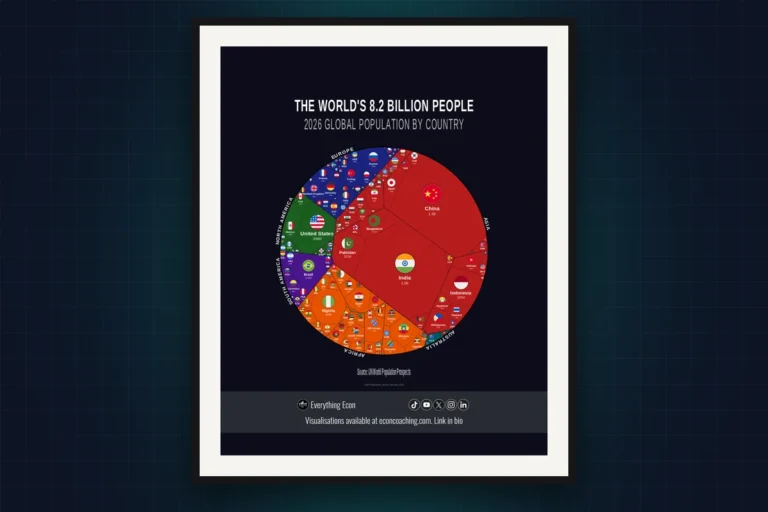
Every country drawn to scale, as an instant printable download or a museum-quality matte poster printed to order.