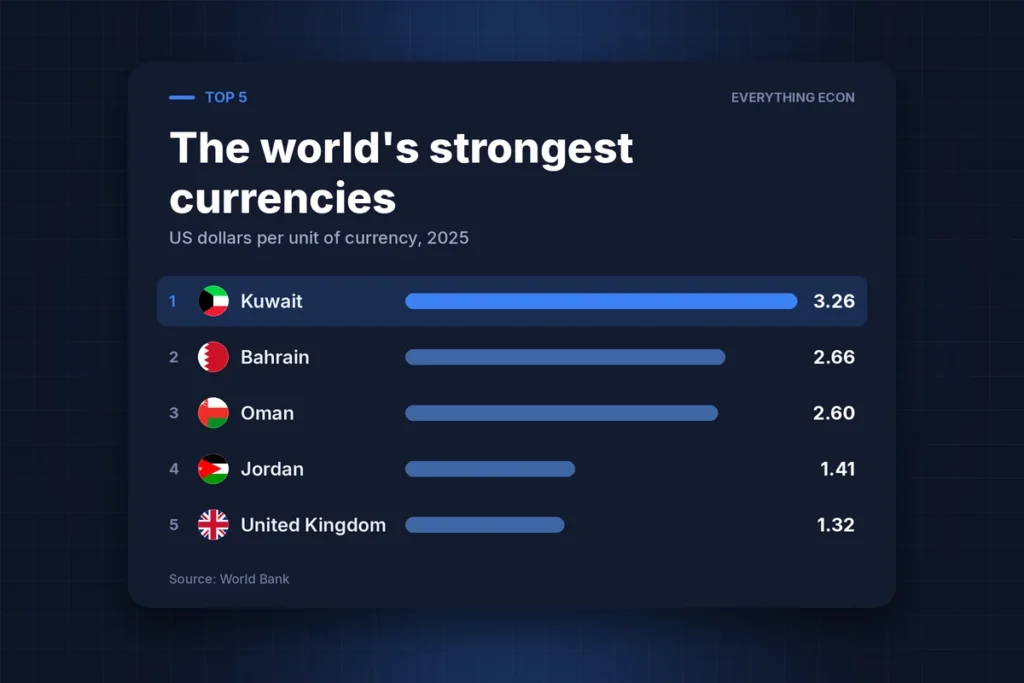
Exchange rates tell you how far a unit of one country's money goes when converted into US dollars. A rate above 1.00 means a single unit of that currency buys more than one dollar — a sign of strength. Below 1.00, and you need many units to match a single dollar. This ranking, drawn from World Bank data, spans 185 countries and reveals a striking divide: a handful of currencies command extraordinary value, while others have collapsed to the point where tens of thousands of units are needed to buy a single dollar.
At a glance · Top 5
US dollars per unit of currency, 2025
- 1Kuwait3.26
- 2Bahrain2.66
- 3Oman2.60
- 4Jordan1.41
- 5United Kingdom1.32
Source: World Bank
Oil, Pegs, and Political Stability at the Top
The upper end of the ranking is dominated by the Gulf states, where small populations sit atop enormous oil wealth. Bahrain ranks second at $2.66 per dinar, combining oil and gas revenues with a growing finance and tourism sector. Its currency is pegged directly to the US dollar — meaning the government fixes the exchange rate rather than letting markets decide — which adds predictability and investor confidence.
Jordan is perhaps the most surprising entry in the top five, sitting at fourth place with a rate of $1.41. Unlike its Gulf neighbours, Jordan has almost no oil. Yet its dinar outvalues the British pound, sustained by a tight peg to the dollar, inflation held to around 2%, and a reputation for political steadiness in an unstable region. When the Arab Spring brought currency collapses in Egypt, Syria, and Lebanon, Jordan held its exchange rate intact through careful fiscal tightening and consistent central bank action. It is a reminder that disciplined economic management can substitute for natural resources.
Switzerland ranks sixth at $1.20 per franc — the strongest currency in Europe outside the pound — built not on commodities but on political neutrality, low government debt, and cautious monetary policy stretching back generations. That reputation was reinforced in 2025, when the announcement of sweeping US tariffs sent investors rushing into the franc as a safe place to park money, pushing its value up further against currencies seen as riskier.
Europe in the Middle, and Collapse at the Bottom
The euro, used by Austria, Belgium, Cyprus, Germany, Spain, Estonia, Finland, and France, sits at $1.13 — placing a large block of European economies in the upper-middle tier. The British pound at $1.32 edges ahead of them, reflecting the UK's status as a major financial centre. These currencies owe their strength not to oil but to stable institutions, trusted central banks, and large, diversified economies.
At the other end of the table, the picture is deeply troubling. Iran's rial stands at roughly 42,000 to the dollar, battered by decades of sanctions and economic mismanagement. Vietnam and Laos sit in similar territory, with tens of thousands of units required per dollar, though in their cases the low nominal value reflects history and denomination choices rather than necessarily the same scale of economic crisis.
Lebanon, however, is in a category of its own at the very bottom — 89,500 Lebanese pounds to the dollar. For 22 years, Lebanon held a fixed rate of 1,507.5 pounds per dollar. That peg collapsed in 2019 following a sovereign debt default and a banking system implosion. Since then, the pound has lost more than 98% of its value, with annual inflation running between 150% and 200%. It is the fastest and most severe currency collapse in this entire ranking.
The World's Strongest Currency
At the very top sits Kuwait, with one Kuwaiti dinar worth $3.26. Kuwait produces vast quantities of oil, shared among a population of just 4.3 million people — giving each citizen an exceptionally high share of that national wealth. The Central Bank deliberately limits how much currency circulates and enforces strict controls on moving money in and out of the country, keeping the dinar scarce and its value high.
Data: World Bank, official exchange rate, period average.
Get a new data story like this every week — join the newsletter.
Browse every visualisation on the visualisations page.
Take one home
Every country drawn to scale, as an instant printable download or a museum-quality matte poster printed to order.