One of the clearest ways to understand a country's future is to look at how young its population is. This ranking measures the share of each country's population aged under 15 — a simple but powerful indicator of birth rates, healthcare, and long-term economic prospects. The picture it reveals is striking: a handful of countries have nearly half their entire population made up of children, while others are ageing so rapidly that children have become a rarity.
At a glance · Top 5
Share of the population under 15
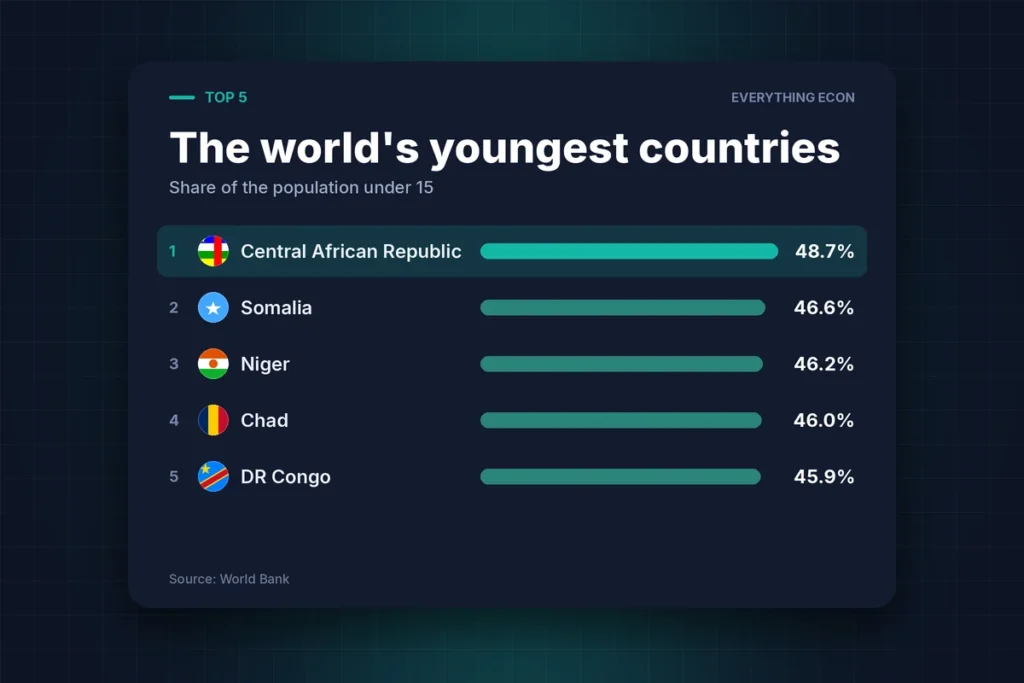
- 1Central African Republic48.7%
- 2Somalia46.6%
- 3Niger46.2%
- 4Chad46.0%
- 5DR Congo45.9%
Source: World Bank
The Pattern Is Almost Entirely African
Every single country in the top 15 is in sub-Saharan Africa, with one exception: Afghanistan, which sits at number 11 with 42.6% of its population under 15. That figure is driven by extraordinary population growth — Afghanistan's population of roughly 43.8 million in 2025 grew by nearly 30% in just one decade — compounded by displacement, climate stress, and decades of conflict. It is a rare case where the causes are political and humanitarian rather than primarily cultural or economic.
The African pattern, by contrast, is deeply structural. As a region, sub-Saharan Africa has just under 41% of its population below age 15. Compare that to Europe and North America combined, where the figure is only 17%, and the scale of the difference becomes clear. The main driver is fertility: Chad, DR Congo, Somalia, Niger, and the Central African Republic all have total fertility rates above six children per woman — meaning the average woman in each of these countries will have more than six children in her lifetime. High infant mortality, limited access to healthcare, food insecurity, and early marriage all reinforce one another in a cycle that keeps birth rates elevated and populations extraordinarily young.
Niger's situation is particularly acute. It ranks third overall with 46.2% of its population under 15, but it holds an even more troubling distinction: it has the world's highest fertility rate, at nearly seven children per woman. It also has the world's highest adolescent fertility rate. A major factor is child marriage — 59% of girls in Niger are married by the age of 18 and face immediate pressure to have children. This is not simply a demographic statistic; it reflects a profound constraint on the lives of young women.
The Other End of the Scale
At the bottom of the ranking sit some of the world's wealthiest and most developed economies. South Korea (10.2%) and Hong Kong (10.3%) have the smallest shares of under-15 populations anywhere on earth. Japan and Puerto Rico are close behind at 11.2% each. These are societies where people are living longer, having fewer children, and ageing rapidly — a different kind of demographic pressure, but a pressure nonetheless.
Italy, just outside the bottom five at 11.7%, is the European Union's most demographically aged nation. Its population is projected to fall from 59 million in 2024 to 45.8 million by 2080 — a decline that will strain pension systems, healthcare, and public finances for decades.
The Country at the Top
The Central African Republic sits at number one, with a staggering 48.7% of its population under 15 — nearly half the entire country. Its fertility rate stands at around six children per woman, infant mortality is close to 83 deaths per 1,000 live births, and life expectancy is just 55.5 years. These numbers tell a story of a country where children are everywhere and old age is rare, shaped by poverty, instability, and limited access to basic services.
Experts describe Africa's youth bulge as a potential demographic dividend — a window of opportunity if young people can be educated and employed. But many warn that without serious investment, it risks becoming a crisis instead.
Data is drawn from the World Bank.
Get a new data story like this every week — join the newsletter.
Browse every visualisation on the visualisations page.
Take one home
Every country drawn to scale, as an instant printable download or a museum-quality matte poster printed to order.