
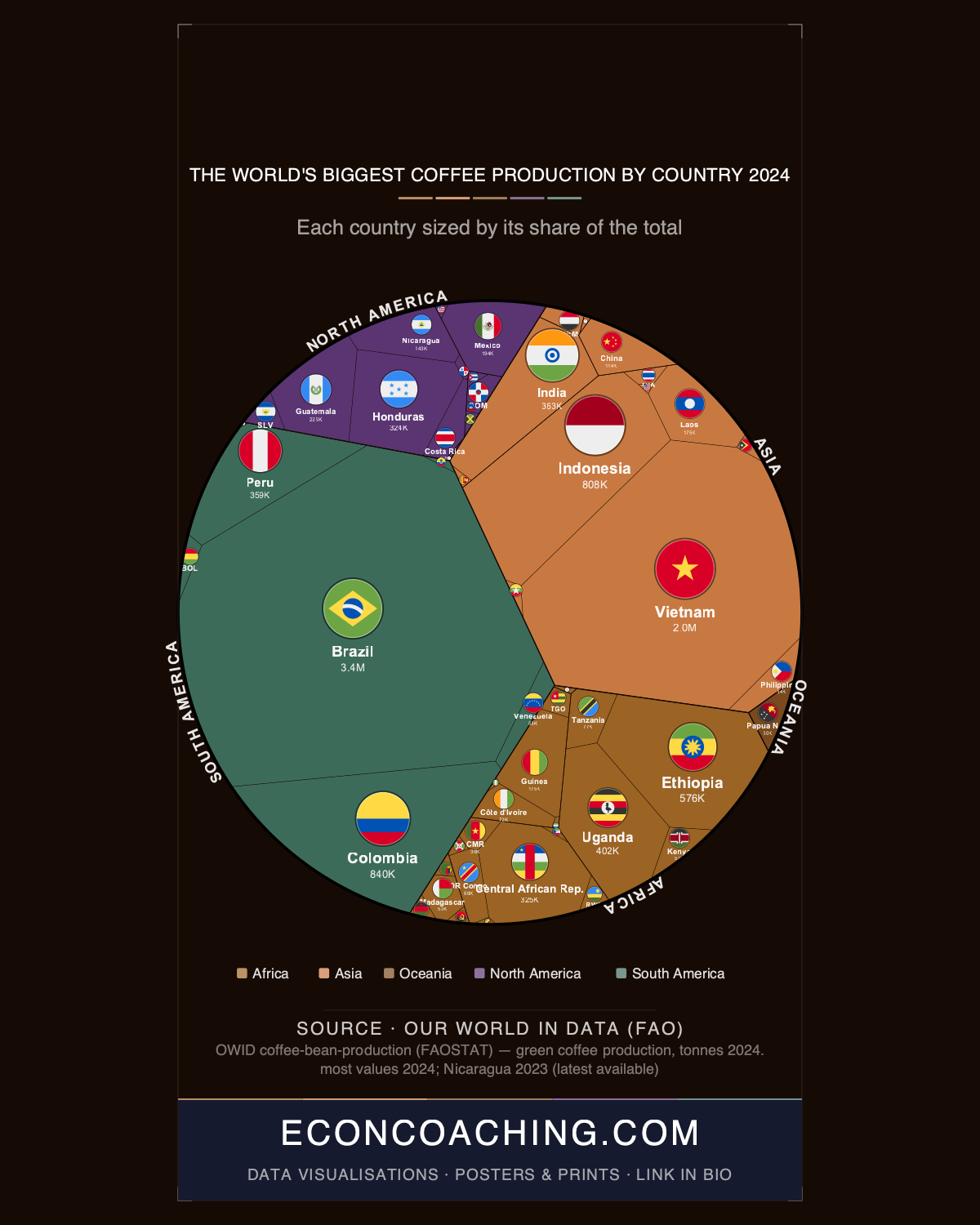
Brazil and Vietnam together grow just under half the world's coffee, 47.9% of it, and the treemap accompanying this article renders that fact as two blocks that swallow most of the frame while 54 other producing countries fight for the remainder. Brazil alone accounts for 30.04% of global output, 3.39 million tonnes, more than the combined total of third-ranked Colombia, fourth-ranked Indonesia and fifth-ranked Ethiopia. Vietnam adds another 17.87%, 2.02 million tonnes. That concentration is not a historical curiosity. It is the reason coffee prices spiked through 2024 and into 2025, and it is the lens this ranking demands.
Brazil's Century-Old Lead
Brazil's dominance traces to a 19th-century coffee boom that funded much of the country's early infrastructure, including its first railways, and the lead it built then has held for well over a century. At 3.39 million tonnes in 2024, Brazil's output exceeds the combined total of Colombia (840,000 tonnes), Indonesia (808,000 tonnes) and Ethiopia (576,000 tonnes), three countries that between them cover Latin America, Southeast Asia and East Africa. No single competitor has closed the gap in over a hundred years, and the treemap's largest rectangle reflects that continuity rather than a recent surge.
Vietnam's Robusta Machine
Vietnam's rise is far more recent. Robusta cultivation expanded rapidly from the 1990s under state-backed agricultural policy, taking Vietnam from a minor producer to the world's second-largest within a few decades, and it now sits at 2.02 million tonnes, 17.87% of global supply. Between 95% and 96% of that output is robusta, meaning Vietnam is less a rival to specialty arabica producers than the backbone of the instant coffee and espresso-blend supply chain. That position has turned into an unusually lucrative one: robusta futures in London hit a record $5,821 per tonne in February 2025, and Vietnamese farm-gate robusta prices rose roughly 125% year-on-year in the 2024/25 season, prompting local traders to describe the crop once treated as a low-value commodity as a "money-printing machine," according to the Vietnam Coffee and Cocoa Association.
Why Two Countries Move the World's Price
World coffee prices rose 38.8% in 2024 against the prior year's average, according to the UN Food and Agriculture Organization, with arabica up 58% and robusta up 70%. Arabica futures spiked to an all-time high near $4.41 per pound in February 2025, more than double the level a year earlier. The driver was drought damage concentrated in Brazil and Vietnam, the two countries responsible for close to half of world supply, which meant a weather event in either place moved the entire global price rather than a localised one. This volatility has a longer history: the 1989 collapse of the International Coffee Agreement's export quota system deregulated global coffee trade, and the price swings visible today follow the same pattern of instability that deregulation introduced. The 2024-2025 shock is best read as a temporary supply disruption layered onto structural climate pressure rather than an ongoing crop failure. Both Brazil and Vietnam are forecasting production recoveries for the 2025/26 season.
Ethiopia's Paradox and Uganda's Export Rise
Ethiopia is where the coffee plant originated, in its highland forests, and legend credits a goat herder named Kaldi with first noticing the stimulant effect of the berries before the crop spread through Yemen and the Arab world. Despite that origin, Ethiopia ranks only fifth globally in 2024, at 576,000 tonnes and roughly 5% of world output, less than a sixth of what Vietnam alone produces. Ethiopia's International Coffee Organization-recognised specialty arabica commands higher per-kilogram value than Vietnam's robusta, so raw tonnage understates its market position. Uganda, ranked sixth at 402,000 tonnes, has overtaken Ethiopia as Africa's top coffee exporter, earning about $1.14 billion from coffee exports in 2024, a 30-year high in export volume, and then $2.4 billion from 8.4 million bags exported between October 2024 and October 2025, its best year on record. That headline understates the caveat: Uganda's story is an export-value and single-season volume achievement, not a total-production one. It still trails Ethiopia, Indonesia and Colombia in tonnage grown.
The Producers Who Don't Consume, the Consumers Who Don't Produce
Central African Republic, a country more associated with prolonged civil conflict than agricultural trade, ranks ninth globally at 325,000 tonnes, just ahead of Honduras (324,000 tonnes, tenth) and Guatemala. Not one European country appears among the world's coffee producers at meaningful scale, yet Europe consumes and re-exports more coffee than almost any other region, growing effectively none of the crop it depends on. Finland illustrates the consumption side starkly: Finns drink roughly 12 kilograms of coffee per person a year, about four cups a day on average, the highest true per-capita rate in the world, and Finnish labour law guarantees employees paid coffee breaks. The United States, the largest consuming market, produces well under 0.1% of world supply, limited effectively to Hawaii and Puerto Rico. Papua New Guinea is the only meaningful producer in Oceania, accounting for virtually all of that region's roughly 0.4% share.
The 2024 ranking shows an industry where growing the bean and profiting from it are increasingly separate activities, and where price stability depends on harvests in exactly two countries. Whether Uganda's export gains translate into higher production rank, and whether Brazil and Vietnam's forecast recoveries hold through 2025/26, will determine if this price cycle proves temporary or becomes the new baseline.
For more data-driven analysis of global economics and the trends reshaping the world economy, visit econcoaching.com.
Take this one home
Get this visualisation as a download, wallpaper, or printed poster.
← Back to all visualisations & articles
Follow Everything Econ: YouTube · TikTok · X · Instagram · Facebook