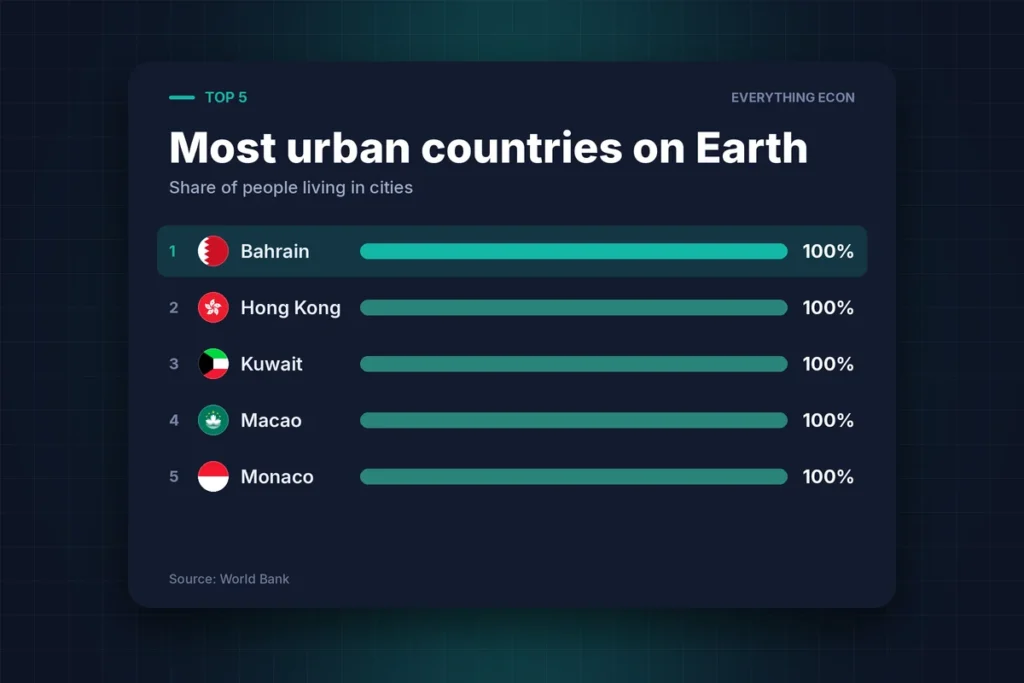
Urbanisation sounds like a dry statistic, but it answers a simple question: what share of a country's population lives in towns and cities rather than in villages and the countryside? The World Bank tracks this for 233 countries and territories, and the range is startling — some places are effectively a single city with a flag, while others remain almost entirely rural. At the very top of the table, six countries and territories are recorded as 100% urban.
At a glance · Top 5
Share of people living in cities
- 1Bahrain100%
- 2Hong Kong100%
- 3Kuwait100%
- 4Macao100%
- 5Monaco100%
Source: World Bank
The city-states at the top
Bahrain, Hong Kong, Kuwait, Macao, Monaco and Singapore all sit at exactly 100% urban. This isn't really a policy achievement so much as a definitional one — each of these places is a city-state, so there's no meaningful "countryside" left to count as rural. Everyone lives in the city because the city is, for practical purposes, the whole country. Just below them, Qatar (99.4%) and San Marino (97.2%) show the same pattern on a slightly larger scale.
More interesting are the countries that are large and genuinely urban without being city-states. The Netherlands (95.9%) and Uruguay (95.7%) are proper nations with real rural areas, yet nearly everyone lives in urban centres anyway. Jordan is a standout at 93.2% — an unusually high figure for a country outside the wealthy Gulf states, driven by decades of refugee inflows swelling the capital, Amman.
Rich, poor, and everything in between
There's a common assumption that urban means wealthy and rural means poor, but the picture is messier than that. Japan sits at 92.4% urban after decades of young people leaving the countryside for Tokyo and Osaka. The UK is roughly 85% urban and the US 83.5%, both figures inflated by counting sprawling suburbs as "urban" rather than rural.
Meanwhile, the two most populous countries on Earth tell opposite stories. China's urban share only passed roughly 67% in 2024, the tail end of the largest rural-to-urban migration in human history. India, despite being the world's most populous country, is just 35.7% urban in 2025 — most Indians still live in villages. And Sri Lanka, at 20.5%, ranks among the five least-urbanised places measured despite not being a poor country, a reminder that low urbanisation isn't automatically a sign of underdevelopment.
At the very bottom, geography does a lot of the explaining. Papua New Guinea (15.8%) is fragmented by mountainous terrain into more than 840 language groups, making the kind of large-scale city-building seen elsewhere far harder. Niger (18.4%) and Malawi (17.6%) round out the lowest ranks. Worth noting too: Burundi posted the fastest urbanisation growth rate on Earth for 2020-2025, at 5.43% a year, showing that today's rural countries can shift quickly.
The surprise at the very bottom
The single least-urbanised place in the entire ranking isn't a poor, mountainous, or war-affected country at all — it's Liechtenstein, at just 14.6%. It's one of the wealthiest microstates in Europe, yet almost nobody there lives in what counts as a city. It's a useful reminder that urbanisation measures how people are distributed across the landscape, not how developed or prosperous a country is. A tiny, affluent country can arrange its population in small towns and villages just as easily as a large developing one can — the number tells you about settlement patterns, not living standards.
Data from the World Bank, most recent available figures as of 2025.
Take one home
Every country drawn to scale, as an instant printable download or a museum-quality matte poster printed to order.
Get a new data story like this every week — join the newsletter.
Browse every visualisation on the visualisations page.