Every country has an official measure of how likely a 15-year-old boy is to reach his 60th birthday. Flip it around, and it becomes a measure of how many men, out of every 1,000, are expected to die as adults before old age even starts. The gap between the best and worst places on this list isn't small — it's the difference between a country where dying young is a rare tragedy and one where it's practically the norm. At the very top, Lesotho records 464 male deaths per 1,000 — meaning close to half of the country's men don't make it to 60. At the bottom, Monaco records just 31.
At a glance · Top 5
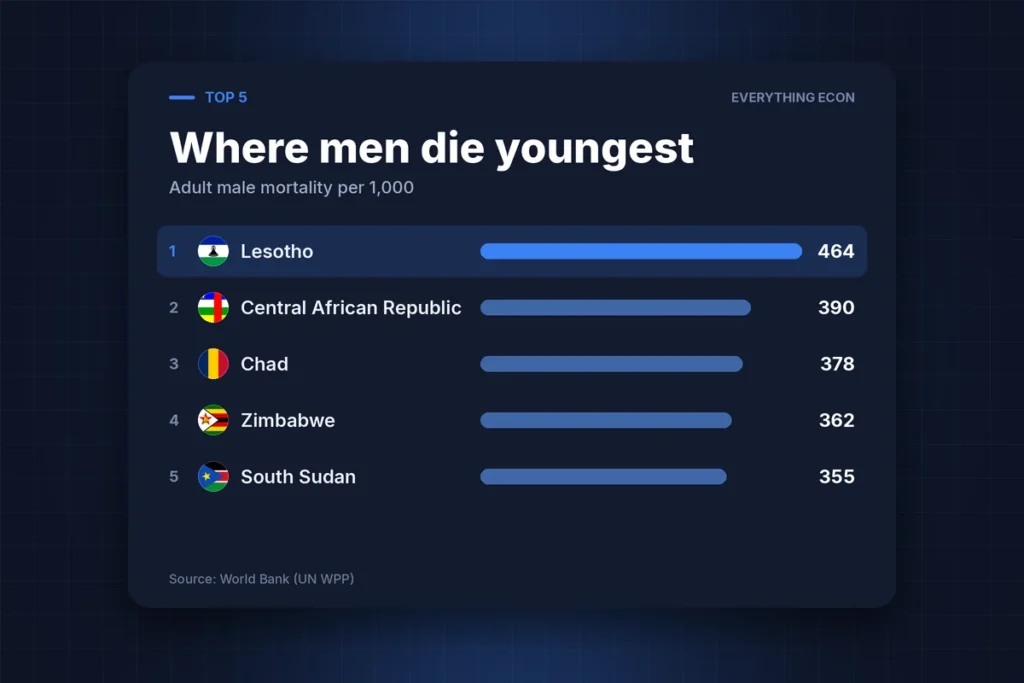
Adult male mortality per 1,000
- 1Lesotho464
- 2Central African Republic390
- 3Chad378
- 4Zimbabwe362
- 5South Sudan355
Source: World Bank (UN WPP)
Africa's health emergency, in one number
Of the top 15 countries on this list, 12 are in Africa, and the reasons cluster around a small set of causes. Lesotho tops the ranking outright, driven by an HIV prevalence rate of 21.1% — roughly one in five adults living with a virus that, without consistent treatment, cuts life dramatically short. Nigeria (355) and South Sudan (355) sit further down the list but face a different squeeze: malaria remains a major killer, and Nigeria has one of the lowest ratios of doctors to patients anywhere in the world, meaning treatable illness often goes untreated. Zimbabwe's rate of 362 tells a third story — one of collapse and slow recovery. The country's health system buckled under hyperinflation in the 2000s, and doctors left in large numbers. Decades later, the country is still living with the consequences.
Not every story on this list is bleak, though. South Africa, at 354, has actually added over 15 years to adult male life expectancy since 2004, thanks to the rollout of antiretroviral drugs for HIV treatment. It's a reminder that these numbers aren't fixed — they move, sometimes dramatically, when the right treatment reaches enough people.
One outlier, far from Africa
Russia is the exception that breaks the regional pattern. At 294 male deaths per 1,000, it posts the highest rate of any country outside Africa — worse than several nations with far lower incomes. The driver here isn't infectious disease or a shortage of doctors; researchers link alcohol to as much as 43% of deaths among working-age Russian men, a toll that has persisted for decades despite the country's wealth and medical infrastructure.
Why the bottom of the list barely counts as a fair comparison
At the other end, the United Arab Emirates (38), Qatar (39) and San Marino (36) all report remarkably low mortality — but not necessarily because their men are exceptionally healthy. The UAE and Qatar's populations are made up of 80–88% young migrant workers, a demographic that skews young, fit and unlikely to fall into the older age brackets where death rates naturally climb. San Marino and Monaco, meanwhile, are tiny, extremely wealthy micro-states with populations too small and unusual to represent anything beyond themselves. Monaco's rate of 31 makes it the statistically "safest" place in the world to be a man — but it says more about the limits of comparing a city-state to a country than about health policy.
Lesotho: the number one, and why it's there
That brings us back to Lesotho, which sits alone at the top of the ranking with 464 deaths per 1,000 — nearly 15 times Monaco's rate, and well above every other country on the list. The driver is almost entirely one disease: an HIV prevalence rate of 21.1%, among the highest in the world. Where South Africa has managed to claw back over 15 years of life expectancy through widespread antiretroviral treatment, Lesotho's smaller economy and thinner health infrastructure have made the same fight far harder to win. It's the starkest illustration on this list of how one epidemic, left only partially addressed, can define a nation's mortality statistics for a generation.
Source: World Bank, based on UN World Population Prospects data.
Take one home
Every country drawn to scale, as an instant printable download or a museum-quality matte poster printed to order.
Get a new data story like this every week — join the newsletter.
Browse every visualisation on the visualisations page.