Some countries are built by people who came from somewhere else. This metric measures the share of a country's population that was born abroad — not citizens versus non-citizens, just where people first drew breath. It's a simple number that tells a big story about labour markets, wealth, war, and the sheer size of a place. Globally, the range is staggering: from a country where roughly three in four residents are foreign-born, down to nations like Cuba, where essentially everyone was born at home.
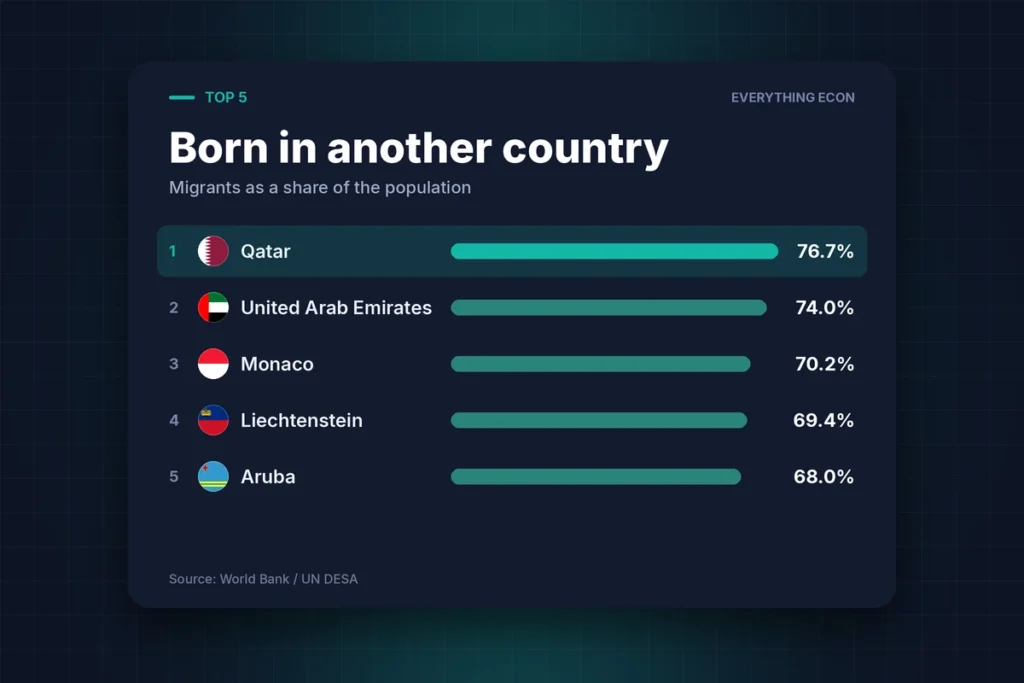
At a glance · Top 5
Migrants as a share of the population
- 1Qatar76.7%
- 2United Arab Emirates74.0%
- 3Monaco70.2%
- 4Liechtenstein69.4%
- 5Aruba68.0%
Source: World Bank / UN DESA
The Gulf and the tiny wealthy enclaves
The top of the list splits into two distinct groups. The first is the Gulf states, which import labour on a huge scale through what's known as the kafala system — a sponsorship model where employers bring in foreign workers, often for construction, domestic work, or services, and those workers vastly outnumber the local population. The United Arab Emirates sits at 74.0% foreign-born, Kuwait at 67.3%, Bahrain at 52.3%, Oman at 43.2%, and Saudi Arabia at 40.3%. These aren't temporary blips; they're the foundation of how Gulf economies function.
The second group is made up of tiny, wealthy enclaves where the maths works differently. Monaco (70.2%) and Liechtenstein (69.4%) aren't importing labour so much as being swamped by wealthy residents relocating to small, low-tax territories with vanishingly small native populations. Andorra (59.1%) and Luxembourg (51.2%) follow a similar pattern — when your country is small enough, it doesn't take many incomers to tip the balance.
Refugees, financial hubs, and everyday migration
Not every high figure comes from wealth. Jordan's 45.7% is driven overwhelmingly by hosting large numbers of Syrian and Palestinian refugees, a reminder that this metric captures displacement as much as opportunity. Singapore, by contrast, reached 48.7% foreign-born through its role as a financial and business hub — a striking figure next to neighbouring Indonesia, where just 0.2% of residents were born abroad.
Among larger, wealthier economies, the numbers are naturally lower but still notable. Switzerland sits around 31%, Australia hit 32% in 2025, and the UK and Germany have converged at nearly identical figures, both around 19% in 2024. These are countries that have absorbed steady migration for decades without ever approaching Gulf-style levels.
Where almost nobody was born elsewhere
At the bottom of the ranking are countries defined by isolation, size, or restricted movement. China and Madagascar sit at 0.1%, alongside Myanmar and the Philippines, also at 0.1%. Cuba records 0.0%. These are largely populous or historically closed nations where outward migration has long outpaced inward, and where policy, geography, or economic conditions have never made them a magnet for foreign arrivals.
The country at the very top
That leaves Qatar, the world's most foreign-born nation at 76.7%. Like its Gulf neighbours, Qatar's economy runs on imported labour under the kafala sponsorship system, but it takes the pattern further than anywhere else on Earth — meaning roughly three out of every four people in the country were born somewhere else entirely. It's a figure with no real parallel among large, permanent economies, and it captures just how completely a small nation's population can be reshaped by a single economic model.
Source: World Bank / UN DESA. Figures reflect the most recent available estimates, with Australia's figure dated to 2025 and the UK/Germany comparison to 2024.
Take one home
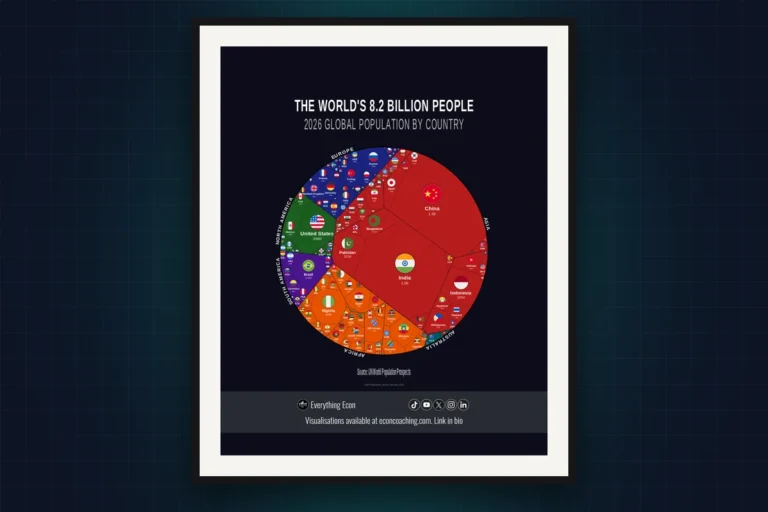
Every country drawn to scale, as an instant printable download or a museum-quality matte poster printed to order.
Get a new data story like this every week — join the newsletter.
Browse every visualisation on the visualisations page.