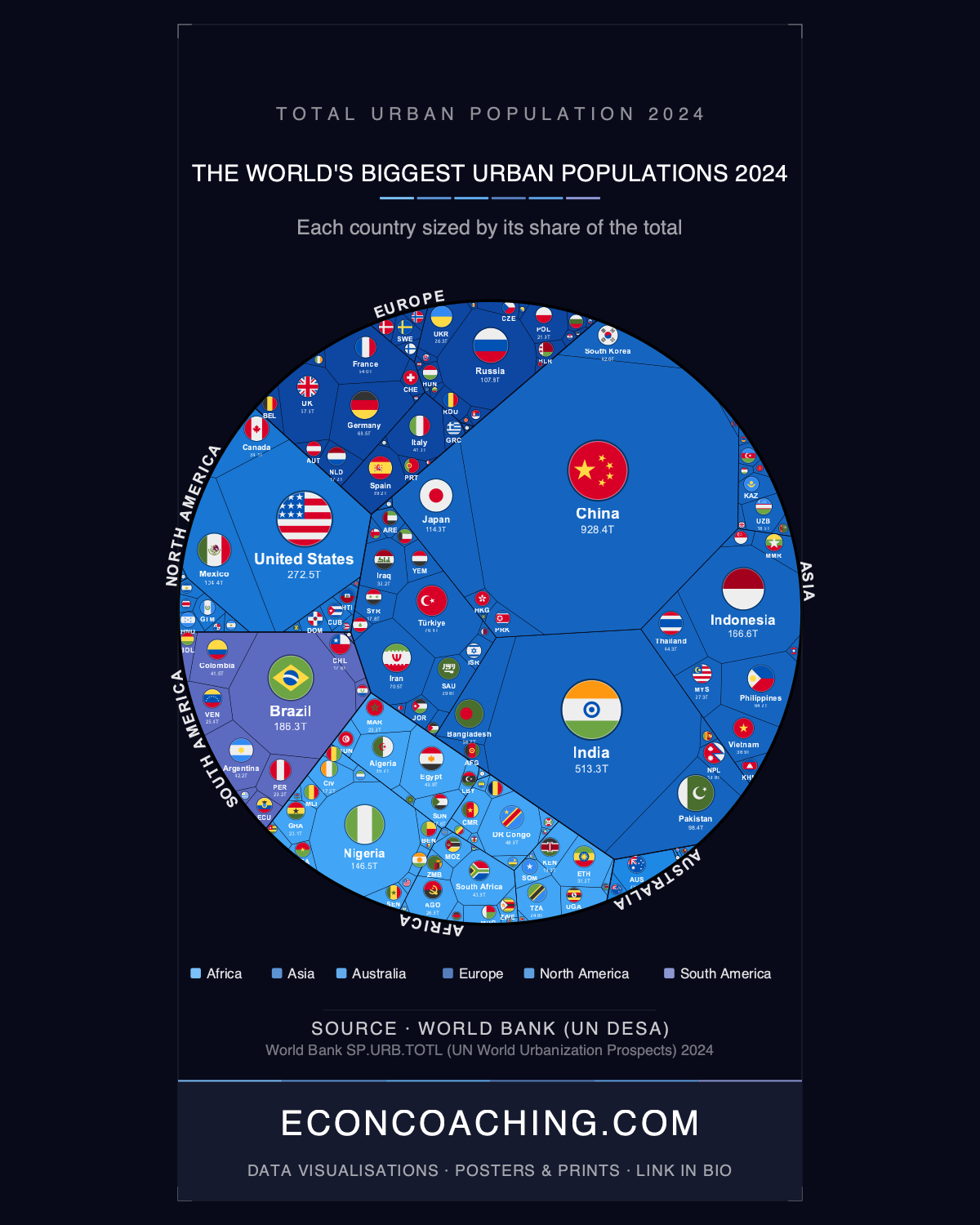
The treemap accompanying this article assigns cell area by population, not by geography — and the distortion is immediate. India's rectangle is nearly twice the size of the United States', yet India appears as a roughly equal-sized country on any political map. India holds 513 million urban residents in 2024, more than Germany, France, the UK, Italy, Spain, Poland, and the Netherlands combined, and yet only 35% of India's total population lives in cities. The urban transformation that produced the defining economic shifts of 20th-century America — the mid-century shift that built the suburbs, the interstates, and the industrial Midwest — still lies ahead of India, at a scale the world has never seen.
China: The Fastest Large-Scale Urban Transformation in Recorded History
China's block dominates the treemap as it dominates the data: 928.4 million urban residents, nearly one-in-five of every city dweller on Earth. In 1978, when economic reforms began, China's urbanization rate stood at 17.9%; by 2024 it had reached 67%. Roughly 772 million additional people moved to Chinese cities in 46 years — a compression of the 150-year industrial urbanization of Western Europe into less than half a century, confirmed by China's National Bureau of Statistics and tracked in the UN's World Urbanization Prospects 2025.
The headline figure requires qualification. China's official urban classification includes small county-level towns with limited services, and the 300 million-plus internal migrants who hold rural hukou — residency permits — are counted as urban residents despite often lacking access to urban schools, healthcare, and social insurance. That definitional gap complicates direct comparisons with countries that apply stricter metropolitan definitions. Even on a conservative count, China's urbanization has no peer in recorded history. The counterweight: more than 3,000 Chinese cities are now actively losing population as the workforce contracts. The next chapter of China's urban story is consolidation, not expansion.
India's 35%: The Gap Between Scale and Trajectory
India's 513 million urban residents already constitute the second-largest urban population on Earth, yet 65% of India's 1.44 billion people remain rural — far below the global average of 57.7% and starkly below the 82% urbanization rate of the United States. The UN projects India will add more urban residents by 2050 than any other country in history, contributing the largest single share of the 500-plus million new city dwellers expected across the seven countries — India, Nigeria, Pakistan, DR Congo, Egypt, Bangladesh, and Ethiopia — that together account for two-thirds of all projected global urban population growth through mid-century.
The challenge is not counting but absorption. India's existing cities already strain water, housing, and transit systems designed for smaller populations. Secondary cities — Pune, Surat, Jaipur, Lucknow — are growing faster than Mumbai and Delhi and hold fewer fiscal resources to manage the expansion. Whether India can urbanize at the speed the UN projects without replicating the informal settlement patterns visible in Lagos or Kinshasa is the central policy question in global urban economics for the next generation.
Asia's 54% and the Second Wave
Asia accounts for 54.3% of all urban residents on Earth — 2.54 billion people, more than the other five continents combined. The top ten countries by urban population include five Asian nations: China, India, Indonesia at 166.6 million, Japan at 114.3 million, and Pakistan at 98.4 million. Pakistan's position alone challenges standard economic geography: with 98.4 million urban residents, it counts more city dwellers than Germany (68.5 million) and France (54 million) individually — a fact rarely surfaced in mainstream economics commentary. Pakistan's urbanization rate remains below 40%, which means its urban population will continue growing rapidly as demographic pressure and rural-to-urban migration intensify. Bangladesh, Vietnam, and the Philippines are on similar trajectories, meaning the Asian share of global urban population — already dominant — will remain structurally elevated through 2050.
Africa's Growth Rate and Its Limits
Nigeria ranks sixth globally with 146.5 million urban residents growing at approximately 3.5% annually — the fastest regional urbanization rate on Earth. At that pace, Nigeria's urban population is projected to reach 264 million by 2050, exceeding the current urban population of the entire United States. The Democratic Republic of Congo, ranked 19th globally with 48.9 million urban residents, hosts Kinshasa at approximately 17 million in its metro area, expanding at roughly 4.4% per year — one of the fastest rates of any major city anywhere.
The mechanism behind these figures matters for the economic interpretation. Sub-Saharan Africa's urbanization is substantially driven by rural push factors — poverty, climate stress, conflict — rather than by job-creating industrial growth. Lagos and Kinshasa are absorbing migrants without the manufacturing base that historically converted urbanization into productivity gains. UN-Habitat's assessments confirm that a significant share of new urban residents across these cities are settling in informal areas without secure tenure, consistent water access, or formal employment. Africa holds only 14.9% of global urban population despite the continent's demographic weight; that share will rise sharply, but whether it translates into economic development or large-scale infrastructure stress depends on investment commitments not yet matched to the scale of the challenge.
The Physical Expansion the Rankings Don't Show
Global built-up land has expanded at almost twice the rate of population growth since 1975, with per-person urban land use rising from 44m² to 63m², according to the EU Joint Research Centre. Cities are physically spreading faster than they are adding residents, with direct consequences for transport costs, carbon emissions, and infrastructure maintenance. Brazil, ranked fourth globally with 186.3 million urban residents and an urbanization rate of 88% — higher than Germany at roughly 81% — illustrates the limits of urbanization as a development proxy. Latin America is the most urbanized developing region in the world, yet high city-dwelling rates coexist with deep inequality and extensive informal settlements across Brazil, Colombia, and Venezuela.
The number of megacities quadrupled from 8 in 1975 to 33 in 2025, with more than half located in Asia. The world crossed the 50% urban threshold for the first time in 2007; by 2024 that share stands at 57.7%, with the UN projecting 68% by 2050. The growth is structurally concentrated in countries that currently have the least urban infrastructure — which means housing, transit, and land-use decisions made in India, Nigeria, Pakistan, and Ethiopia over the next decade will determine the living conditions of more people than any equivalent policy choices being made in the already-urbanized West.
One chart like this in your inbox each week, explained in plain English — join the Everything Econ newsletter. Always free, and you can unsubscribe any time.
Take this one home
Get this visualisation as a download, wallpaper, or printed poster.
← Back to all visualisations & articles
Follow Everything Econ: YouTube · TikTok · X · Instagram · Facebook