
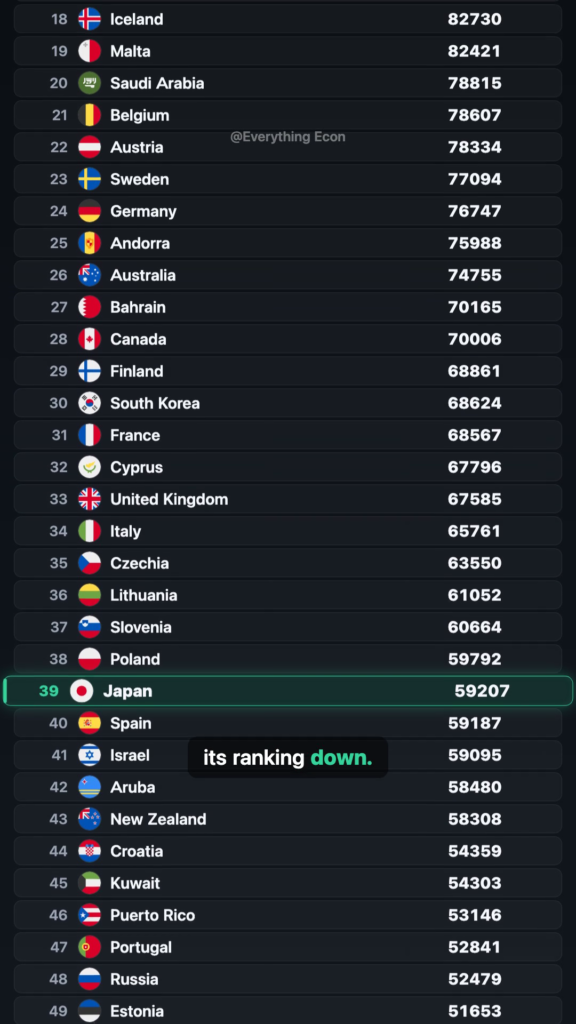
When economists want to compare how rich countries are, they don't just look at the total size of an economy — a big population can make a country's economy huge even if most people are poor. Instead, they divide a country's total economic output by its number of people, giving an average figure for how much each person would have if the wealth were shared evenly. This is what the International Monetary Fund's World Economic Outlook measures here, and the results throw up some real surprises. The gap between the top and bottom of this ranking is staggering: the richest place on the list has an average income more than 190 times higher than the poorest.
When the Numbers Lie
Not every high ranking tells a true story. Ireland sits third, with an average figure of $159,129, but much of that is an accounting trick rather than real prosperity. Large multinational companies book their profits through Ireland for tax reasons, inflating the country's official output without that money ever reaching ordinary Irish households. The economist Paul Krugman famously nicknamed this "leprechaun economics" after one year of corporate accounting shifts made Ireland's growth figures jump by double digits overnight. It's a useful reminder that these rankings measure what flows through a country's economy, not what its citizens actually take home.
Oil, Savings, and Sudden Booms
Further down the top fifteen, the drivers of wealth are more concrete. Norway, in sixth place at $115,548, has spent decades channelling oil revenue into a sovereign wealth fund that passed $2 trillion in 2025. That fund now owns a small stake — roughly 1.5% — in every publicly listed company in the world, and it works out to about $364,000 set aside for every single Norwegian citizen.
Guyana tells an even more dramatic story. Ranked eleventh at $95,477, it was the fastest-growing economy on the planet in 2024, expanding by 43.8% in a single year. Massive offshore oil discoveries turned it, almost overnight, into the world's largest oil producer relative to its population, pumping around 900,000 barrels a day by late 2025. The United States, in twelfth place at $94,430, stands out for a different reason: among countries with more than 10 million people, it's the richest on this list, showing that huge scale and high average wealth aren't always a trade-off.
The Bottom of the Table
At the other end, the picture is grim and heavily concentrated in Africa. The Central African Republic, South Sudan, Burundi and Mozambique all sit below $1,700, weighed down by conflict, weak infrastructure and, in South Sudan's case, a GDP that shrank by roughly 30% in just the 2024/25 financial year. The one outlier is Yemen, in 181st place at $1,596 — the only non-African country among the ten poorest, its economy hollowed out by years of war.
The Actual Winner
So who tops the table? It's Liechtenstein, the tiny Alpine microstate wedged between Switzerland and Austria, with an eye-watering average figure of $195,372. With a population of under 40,000, its wealth is concentrated in banking, precision manufacturing and low taxes — a small, specialised economy where a modest number of high-value industries can push the average sky-high, in much the same way Ireland's multinational profits distort its own figures. Singapore ($173,708) and Luxembourg ($156,719) follow similar patterns of small, highly specialised, trade-heavy economies punching far above their population size.
Source: IMF World Economic Outlook.
Get a new data story like this every week — join the newsletter.
Browse every visualisation on the visualisations page.