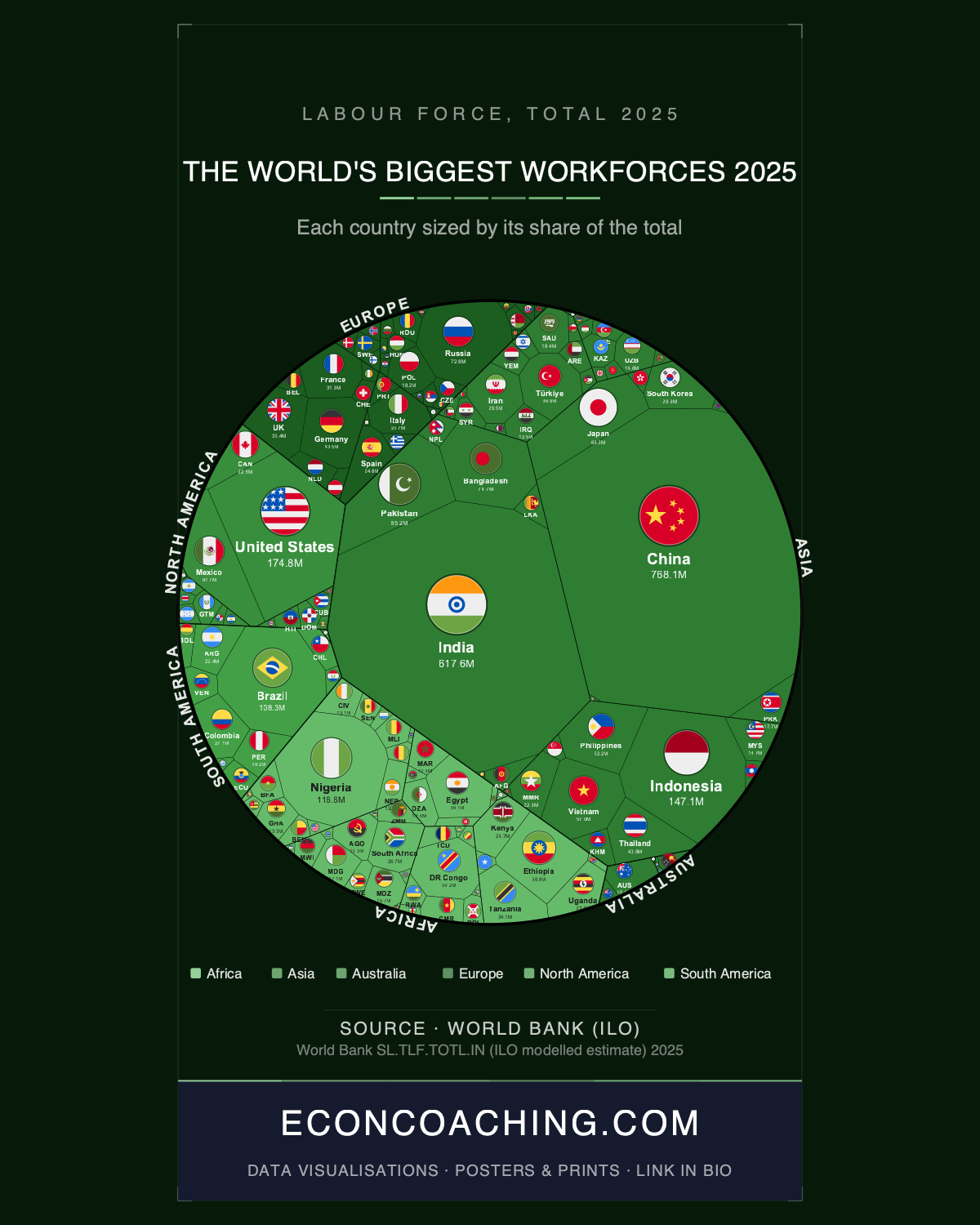
India's population aged 15 to 64 reached 994.7 million in 2025, overtaking China's 987.4 million for the first time on record. Yet on the treemap accompanying this article, sized by actual labour force rather than population, China's rectangle is still comfortably the largest in the world: 768.1 million workers against India's 617.6 million, a gap of more than 150 million people. The population crossover that made headlines this year has not translated into a labour-force crossover. China still fields more workers than any other country on Earth.
China's Lead Is Still the Largest, Even as It Narrows
China's 768.1 million workers amount to roughly 20.6% of the global labour force, tracked here across 163 countries totalling approximately 3.72 billion workers. That is still the single largest national share on the chart, ahead of India's 617.6 million by more than 150 million workers, a gap wider than the entire labour force of Indonesia, the world's fourth-largest at 147.1 million. China's dominance is not new. What has changed is the trajectory: China's share of the global labour force is projected to fall from roughly a fifth of the total today to about 18.3% by 2027, the first sustained contraction in China's share in the dataset's projection window.
A Population Milestone That Hasn't Reached the Labour Market
The reason the treemap still shows China ahead, despite India's population lead, is that population and labour force are not the same measurement. India's working-age population (15 to 64) overtaking China's in 2025, at 994.7 million against 987.4 million, describes how many people are of an age to work. India's labour force of 617.6 million describes how many are actually counted as working or seeking work. The difference between those two figures, roughly 377 million people, is the clearest illustration in this dataset of why a population milestone and an economic one can arrive years apart. China converts a larger share of its working-age population into an active labour force than India currently does, which is why China's headcount advantage persists even after losing the underlying population race.
A Near-Collision by 2027
The gap is not static. India's share of the global labour force is projected to rise from about 18% today to roughly 18.6% by 2027. Over the same period, China's share is projected to fall to about 18.3%. Those two lines, one rising and one falling, are on course to sit within half a percentage point of each other within two years, even though the current gap in raw headcount, over 150 million workers, remains large. The treemap captures 2025, a year in which China's cell is still bigger than India's. The projections attached to that same data suggest the picture will look markedly closer by 2027, without China's rectangle actually shrinking below India's yet.
The United States: Fewer Workers, Outsized Output
The United States ranks third in labour force size, at 174.8 million, just 4.69% of the world's workers. That is a fraction of China's or India's headcount, smaller than Indonesia's 147.1 million and not far ahead of Nigeria's 116.6 million. Yet the US generates roughly a quarter of global GDP. Placed next to China and India's scale on the treemap, the US cell looks modest. Placed next to its output, the same cell is doing far more economic work per worker than its size on the chart would suggest. The contrast between the US block and the China and India blocks is the clearest case in this dataset for why labour force size alone is a poor proxy for economic weight.
Nigeria's Place Among the Giants
Nigeria is the only African country in the global top ten, with a labour force of 116.6 million, 3.13% of the world total, ranking fifth overall. That places Nigeria ahead of Brazil (108.3 million), Pakistan (85.2 million), Bangladesh (74.7 million), Russia (72.8 million) and Japan (69.5 million) on this measure, all economies with far larger GDP figures and, in Japan's and Russia's cases, longer-established industrial bases. Nigeria's position in the top five by headcount, sitting directly beneath Indonesia's 147.1 million, is the treemap's clearest reminder that labour force rankings and GDP rankings sort countries in a different order entirely.
What the 2027 Trajectory Signals
The data points to a specific moment worth watching rather than a completed story: China's share falling to about 18.3% and India's rising to about 18.6% by 2027 would mark the first year India's labour force share overtakes China's, roughly two years after India's working-age population did the same. Until that happens, every comparison between the two countries has to hold both facts at once, India's demographic lead and China's labour-force lead, rather than treating the population milestone as though it already settled the question.
For more data-driven analysis of global economics and the trends reshaping the world economy, visit econcoaching.com.
Take this one home
Get this visualisation as a download, wallpaper, or printed poster.
← Back to all visualisations & articles
Follow Everything Econ: YouTube · TikTok · X · Instagram · Facebook