Petrol prices vary wildly around the world, and the gap has nothing to do with how much oil a country actually produces. Some of the world's biggest oil producers sell petrol for pennies a litre, while wealthy, oil-poor nations charge several dollars for the same amount. This ranking, based on Trading Economics data, lines up 95 countries by the retail price of a litre of petrol in US dollars — and the spread runs from just one cent to more than four dollars, a difference driven almost entirely by government policy rather than the cost of the fuel itself.
At a glance · Top 5
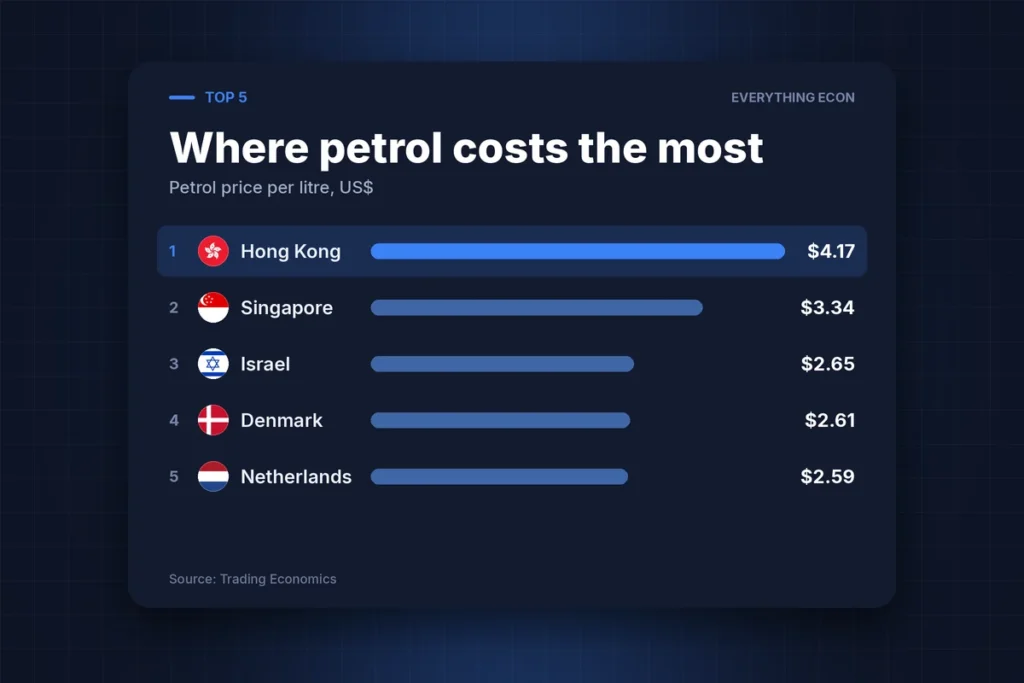
Petrol price per litre, US$
- 1Hong Kong$4.17
- 2Singapore$3.34
- 3Israel$2.65
- 4Denmark$2.61
- 5Netherlands$2.59
Source: Trading Economics
The most expensive places to fill up
Hong Kong sits at the very top by a wide margin, at $4.17 a litre, but the rest of the top ten is a tightly packed cluster of wealthy, land-scarce, or import-dependent economies. Singapore follows at $3.34, then Israel at $2.65, Denmark at $2.61, and the Netherlands at $2.59. Germany, Finland, Italy, France and Switzerland round out the top ten, all sitting between roughly $2.29 and $2.49. What links almost all of these countries is that they import their oil rather than pump it themselves, and their governments layer heavy taxes on top of the base fuel price — often deliberately, to discourage driving, cut congestion, or fund public transport and environmental goals.
A European story, with some sharp recent moves
Europe is the clearest regional pattern in the data: across 39 European countries, the average price is $2.00 a litre, reflecting a continent-wide habit of taxing fuel heavily as both a revenue source and a climate lever. But averages hide some dramatic recent swings. Budapest, Vienna and Zurich have each seen pump prices jump more than 40% since 2020, largely because the war in Ukraine disrupted European energy supplies and pushed costs up sharply. Russia itself has faced its own price pressures, with petrol costs climbing in late 2024 and early 2025 after drone strikes damaged domestic refineries — a reminder that even oil-producing countries aren't immune to supply shocks. Elsewhere, Saudi Arabia's capital, Riyadh, recorded the fastest petrol price increase of 69 cities studied worldwide, up nearly 49% in five years, while Japan's petrol prices have hit 15-year highs as the government winds down subsidies that had kept costs artificially low.
Why the bottom looks so different
At the other end of the table, prices fall off a cliff. Malaysia charges $0.49 a litre, Egypt $0.44, Iran $0.36, and Kuwait $0.28. These are countries that either produce their own oil or choose to subsidise fuel heavily as a matter of policy, keeping prices low for citizens even if it costs the government money. Venezuela is the extreme case: petrol there costs just $0.01 a litre, with official 95-octane fuel priced around $0.04 in late 2025 — a legacy of the country's vast oil reserves and a long-standing policy of near-free fuel for its population, even amid economic turmoil.
Back at the top, Hong Kong's $4.17 price tag isn't an accident of geography — it's policy by design. The territory imports all of its fuel and adds a fixed tax of roughly HK$6.06 per litre specifically to discourage car use and push residents toward its extensive public transport network. Singapore, close behind at $3.34, follows a similar logic: with almost no land to spare and no domestic oil production, the government uses vehicle-control taxes to manage congestion, and its 2025 budget included no relief on petrol duty, so prices there remain structurally high rather than a temporary spike.
Data source: Trading Economics, 2025–2026.
Get a new data story like this every week — join the newsletter.
Browse every visualisation on the visualisations page.
Take one home
Every country drawn to scale, as an instant printable download or a museum-quality matte poster printed to order.