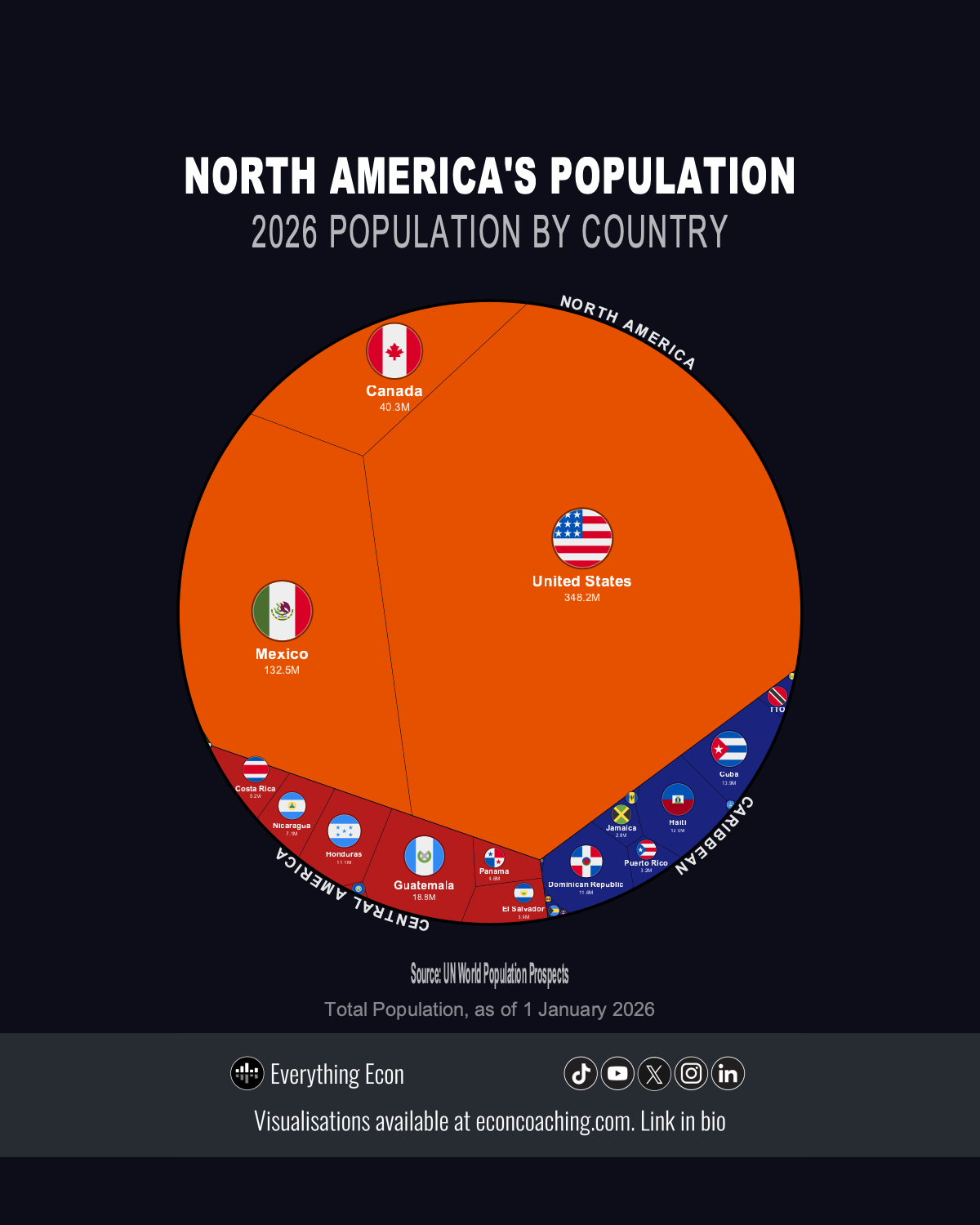
The treemap accompanying this article assigns cell area by population, not by land mass. The result is that the United States fills more than half the entire chart. That is not a visual distortion — it is an accurate representation of a single data point: the US holds 348.2 million people, or 56.35% of North America's total 617.9 million. Add Mexico's 132.5 million, and two countries account for 77.8% of the entire continent, leaving all remaining 22 countries and territories sharing just 22.2%. North America is not a continent of roughly comparable nations. It is a continent defined by extreme demographic concentration at the top and extreme fragmentation everywhere else.
The Concentration at the Top — and the Vanishing Bottom
The US alone outnumbers the next 23 North American countries combined. Canada, ranked third with 40.3 million people, sits at roughly 6.5% of the continental total — and the 21 countries below it collectively barely match that figure. Guatemala, ranked fourth at 18.8 million, is the last country with a cell large enough to read comfortably in the treemap. Below that, Haiti (12.0 million), the Dominican Republic (11.6 million), Honduras (11.1 million), Cuba (10.9 million), Nicaragua (7.1 million), and El Salvador (6.4 million) occupy increasingly compressed tiles. The visual hierarchy reflects a real structural fact: outside the US-Mexico core, North America is a mosaic of small and mid-sized economies whose combined demographic weight barely registers at continental scale.
Two Demographic Trajectories — Miles Apart
Within that compressed lower half of the chart, the most dramatic contrast in the Western Hemisphere plays out across the Caribbean and Central America. Guatemala has grown from approximately 3.1 million people in 1950 to 18.8 million in 2026 — a more than sixfold increase, representing 345.8% growth between 1960 and 2024, more than double the worldwide average of 168.5% over the same period. Its median age is 23.8 years, and 35% of its population is under 15. That youth cohort guarantees continued population expansion through demographic momentum alone for at least the next two to three decades, independent of any change in fertility rates. The economic implications are double-edged: a large, young labour force represents potential output, but Guatemala's education, healthcare, and employment systems are already under severe strain absorbing this growth.
Cuba tells the opposite story. Ranked eighth in North America with an official population of 10.9 million, Cuba recorded only 71,358 births against 128,098 deaths in 2024 — its lowest birth rate in six decades — and lost more than 300,000 residents in a single year. Its median age of 42.2 years is the highest on the American continent, and 25.7% of its population is already aged 60 or older. Cuba's fertility rate has been below replacement level since 1978, meaning the current crisis is the endpoint of nearly five decades of structural decline, not a sudden shock. Mass emigration — over 860,000 Cubans arrived in the US alone between 2021 and mid-2024 — has dramatically accelerated the collapse. Cuba's National Office of Statistics and Information (ONEI) acknowledged in May 2025 that the island will continue losing population. Independent researchers now estimate the actual resident population may have fallen as low as 8.6 million, suggesting the 10.9 million figure in this chart may significantly overstate Cuba's current demographic reality. Puerto Rico reinforces the same regional decline pattern: its population has shrunk nearly every year since 2005, it has lost 11.8% of its residents since 2010, and between July 2024 and July 2025 it recorded 32,857 deaths against only 17,950 births — deaths nearly double births for the ninth consecutive year since natural decrease began in 2016.
Immigration as the Continent's Primary Growth Engine — and Its Vulnerabilities
Canada's 40.3 million population is growing almost entirely through immigration: Statistics Canada confirms that natural increase — births minus deaths — accounts for less than 3% of population growth, with 97.3% driven by new arrivals. In 2022–2023, Immigration, Refugees and Citizenship Canada (IRCC) recorded a record intake of approximately 1.1 million people in a single year, a growth rate not seen since Canada's Baby Boom era. That surge has since reversed sharply. Q1 2025 recorded the smallest number of immigrants admitted in a first quarter in four years, and Ontario, British Columbia, and Quebec — Canada's three most populous provinces — all posted rare population declines in early 2025. A growth model built on near-total dependence on immigration is inherently exposed to policy shifts and economic cycles.
The US faces a structurally similar vulnerability. The US Census Bureau's Vintage 2025 estimates, released in January 2026, recorded a 53.8% single-year drop in net international migration — from 2.7 million between July 2023 and July 2024 to 1.3 million between July 2024 and July 2025. Net migration is now projected to fall to approximately 321,000 by mid-2026, a near-90% collapse from its 2.7 million peak. The immigration-led growth model that has sustained US population gains for decades is under direct pressure from current federal policy.
Haiti and the Displacement Pressure Beneath the Surface
Haiti, ranked fifth in North America with 12 million people, is not primarily a story of population growth — it is a story of population under acute stress. As of late 2025, the International Organization for Migration (IOM) estimates over 1.4 million Haitians are internally displaced, representing roughly 12% of the national population, following a 10% increase since July 2025 alone. Gang violence now controls over 90% of Port-au-Prince. The displacement flows this generates are feeding northward migration pressure across the Caribbean and into Central America, adding complexity to the immigration dynamics already reshaping both the US and Canadian demographic outlooks.
North America as a whole adds an estimated 16,722 people per day in 2026, driven primarily by natural increase — 26,144 births against 12,154 deaths daily — for a projected annual gain of approximately 6.1 million. The continent holds roughly 7.5% of the world's population across 16.3% of its land area. But the continent-level aggregate masks what the treemap makes immediately visible: a top-heavy structure where two countries define the demographic story, a handful of mid-sized nations are growing or shrinking at rates that will reshape the regional labour pool within a generation, and the immigration systems that have driven the growth of the continent's two largest economies are simultaneously decelerating. That combination of structural concentration and diverging trajectories at the margins is the defining feature of North American demography in 2026.
One chart like this in your inbox each week, explained in plain English — join the Everything Econ newsletter. Always free, and you can unsubscribe any time.
Take this one home
Get this visualisation as a download, wallpaper, or printed poster.
← Back to all visualisations & articles
Follow Everything Econ: YouTube · TikTok · X · Instagram · Facebook