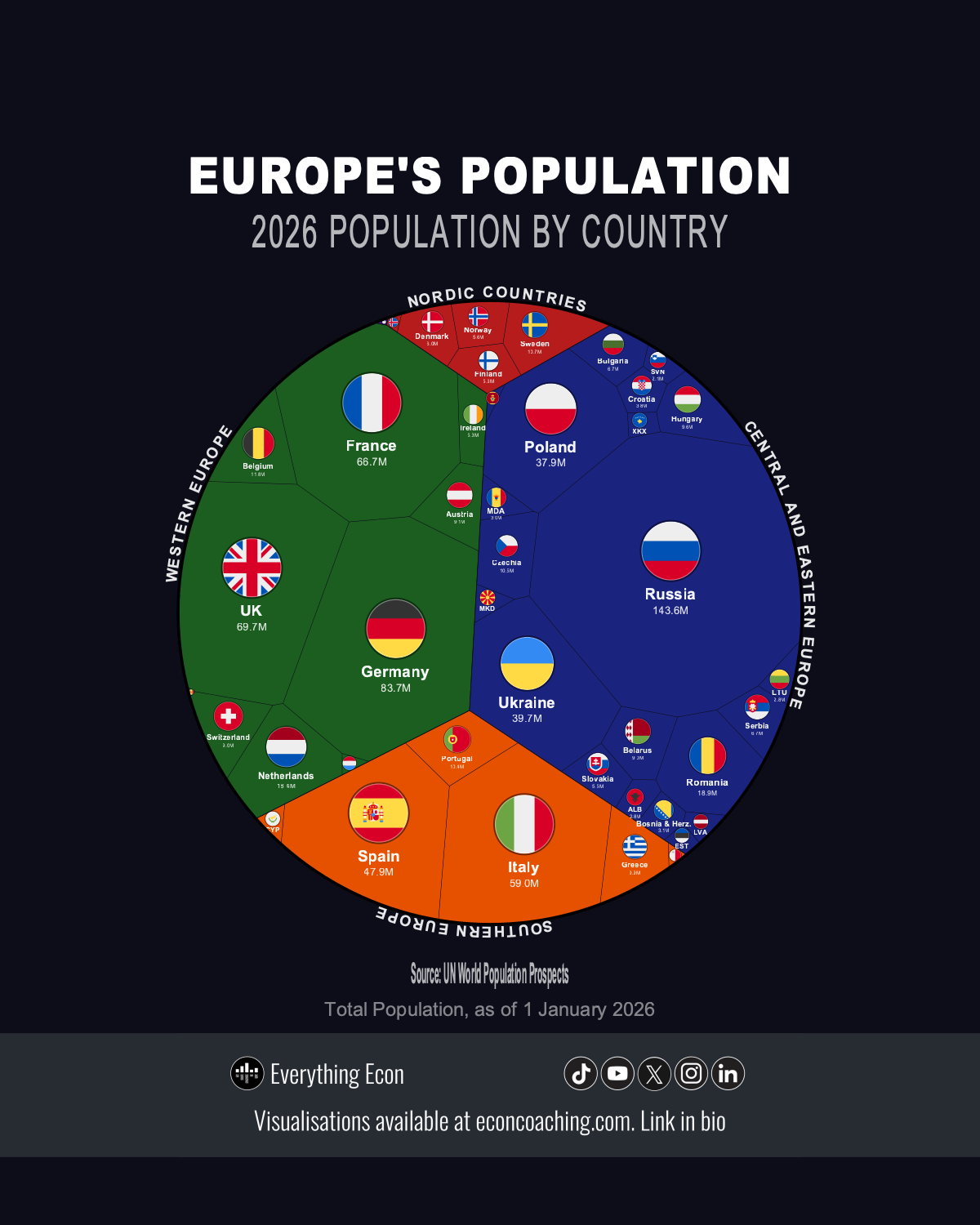
The treemap accompanying this article assigns Russia a cell larger than Germany, the UK, France, and Italy. That proportion is accurate — Russia's 143.6 million people outnumbers all of those four countries — but the visual carries an irony that the raw numbers confirm: the biggest cell on the chart belongs to a country whose population has been falling for three decades and is now declining faster than at any point since the Soviet collapse.
Eurostat released its EUROPOP2025 long-range projections in April 2026, and fresh data on Russia's record-low birth figures and Ukraine's ongoing demographic collapse have followed within weeks. Europe's population map is not just a snapshot of who is large today — it is a record of who is shrinking, and how fast.
Russia: The Largest Country on the Chart Is in Demographic Freefall
Russia at 143.6 million ranks first in Europe by a wide margin, nearly 60 million ahead of Germany in second place. That lead is narrowing. Russia's population peaked at 149 million in 1994, following the Soviet collapse, and has never recovered. In 2024, Russia recorded only 1.222 million births — the lowest annual total since 1999 and down by roughly a third from the 2014 peak. Deaths outnumbered births nationwide by 1.6 to one. In 2025, Russian demographer Alexei Raksha reported that the monthly birth rate had hit a 200-year low. The UN's World Population Prospects 2024 projects that Russia's population could fall by 25 to 50 percent by 2100. Since mid-2024, Russia has stopped publishing key demographic indicators including birth rates, death rates, and official total population figures — a suppression of data that analysts interpret as an attempt to obscure the scale of the crisis rather than manage it.
Ukraine: War Compressing a Long Decline Into a Single Decade
Ukraine ranks seventh at 39.7 million, but that figure almost certainly overstates the country's functional population. Since Russia's full-scale invasion in February 2022, Ukraine has lost an estimated 10 million residents through emigration, casualties, and a catastrophic fall in births. Ukraine's fertility rate has dropped to approximately one child per woman — among the lowest in Europe — and deaths outpaced births in 2025 by nearly three to one. Ukraine's population has been contracting since 1993, when it held over 52 million people at its post-Soviet peak; the war has compressed roughly two decades of projected decline into less than three years. The Centre for Economic Strategy in Kyiv estimates that over 6 million Ukrainians remain as refugees in Europe, and only 43 percent plan to return home, down from 74 percent two years ago. That human capital has not vanished from the European economy — it has redistributed into Germany, Poland, and other EU states — but it represents a structural loss to Ukraine regardless of where those people ultimately settle.
Eastern Europe's Broader Hollowing Out
The eastern half of the continent's ranking tells a consistent story of depopulation. Poland at 37.9 million is the eighth-largest country in Europe, but Eurostat projects it will lose 31.6 percent of its population by 2100, one of the three steepest declines in the EU alongside Latvia at minus 33.9 percent and Lithuania at minus 33.4 percent. Latvia's trajectory illustrates the mechanism: it joined the EU in 2004 and immediately lost a large share of its young working-age population to economic migration westward, a pattern replicated across the Baltic states, Bulgaria, and Romania. Over 35 years, Latvia has shed roughly 780,000 people — approximately one-fifth of its peak population — through emigration and negative natural change. Romania, ninth on the chart at 18.9 million, faces similar pressures from the same structural combination of low birth rates and sustained outward migration.
Western Europe: Immigration as the Operative Variable
Germany at 83.7 million sits in second place and is projected to decline to 74.7 million by 2100 — a significant fall, but far shallower than Eastern Europe's losses. France at 66.7 million and the UK at 69.7 million have held relatively stable. The difference is net migration. Since 2012, the EU has consistently recorded more deaths than births, and any overall population growth has been entirely dependent on positive net migration. The EU's population of roughly 450 million in 2025 has actually grown since the COVID dip of 2020 to 2021, driven by record migration inflows. That makes immigration not a theoretical future option but the active mechanism keeping the continent's largest economies from contraction now. Germany, France, the UK, the Netherlands, and the Nordic countries are all examples where migration has offset natural population decline in measurable terms.
Spain's trajectory complicates any simple east-west framing. Currently sixth at 47.9 million, Spain is projected to grow slightly by 2100 and to overtake Italy to become Europe's third most populous country — a striking outcome for a Southern European economy that suffered one of the continent's worst debt crises after 2008. Spain's relative demographic resilience reflects immigration patterns and regional birth-rate variation rather than any locked-in geographic or economic determinism.
The Economic Weight of the Decline
Europe's 43 countries total 745 million people in 2026. Eurostat's EUROPOP2025 projects the EU's population — roughly 450 million today — will fall 11.7 percent to 399 million by 2100. The EU's working-age population share is expected to drop from 58 percent in 2025 to 50 percent by 2100, while the share aged 80 and over is projected to nearly triple from 6 to 16 percent. The EU Joint Research Centre estimates the bloc will lose between 1 and 2 million workers annually in coming decades. Both the Draghi and Letta reports identified this labour force contraction as the EU's central long-run economic challenge, above energy costs, competitiveness gaps, and capital market fragmentation.
Half of all cities and municipalities across Europe already have fewer residents than 60 years ago, even as the continent's total population grew over that period. What EUROPOP2025 projects is not a new problem arriving — it is an existing structural shift moving into a steeper phase.
One chart like this in your inbox each week, explained in plain English — join the Everything Econ newsletter. Always free, and you can unsubscribe any time.
Take this one home
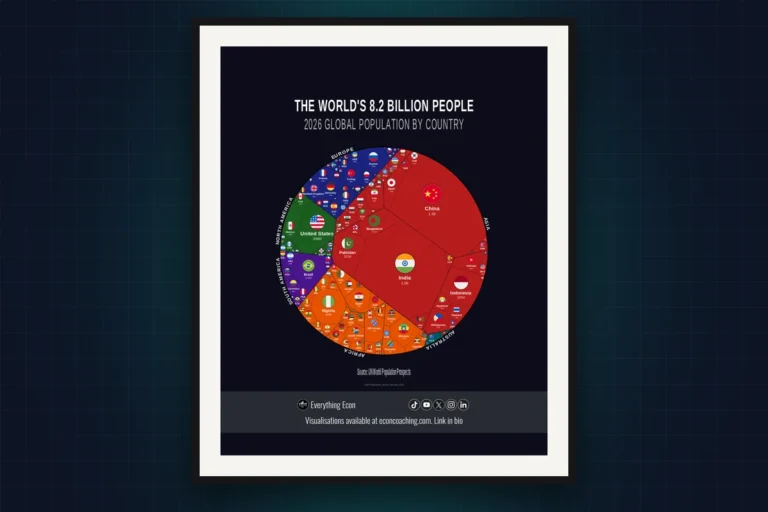
Get this visualisation as a download, wallpaper, or printed poster.
← Back to all visualisations & articles
Follow Everything Econ: YouTube · TikTok · X · Instagram · Facebook