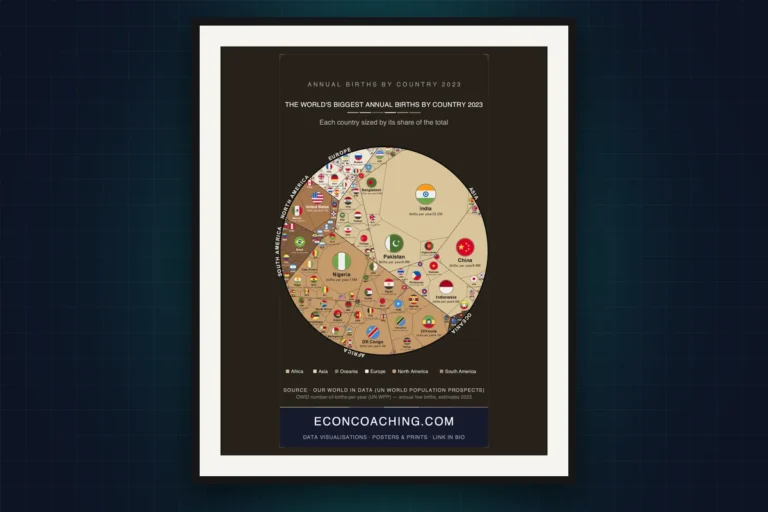
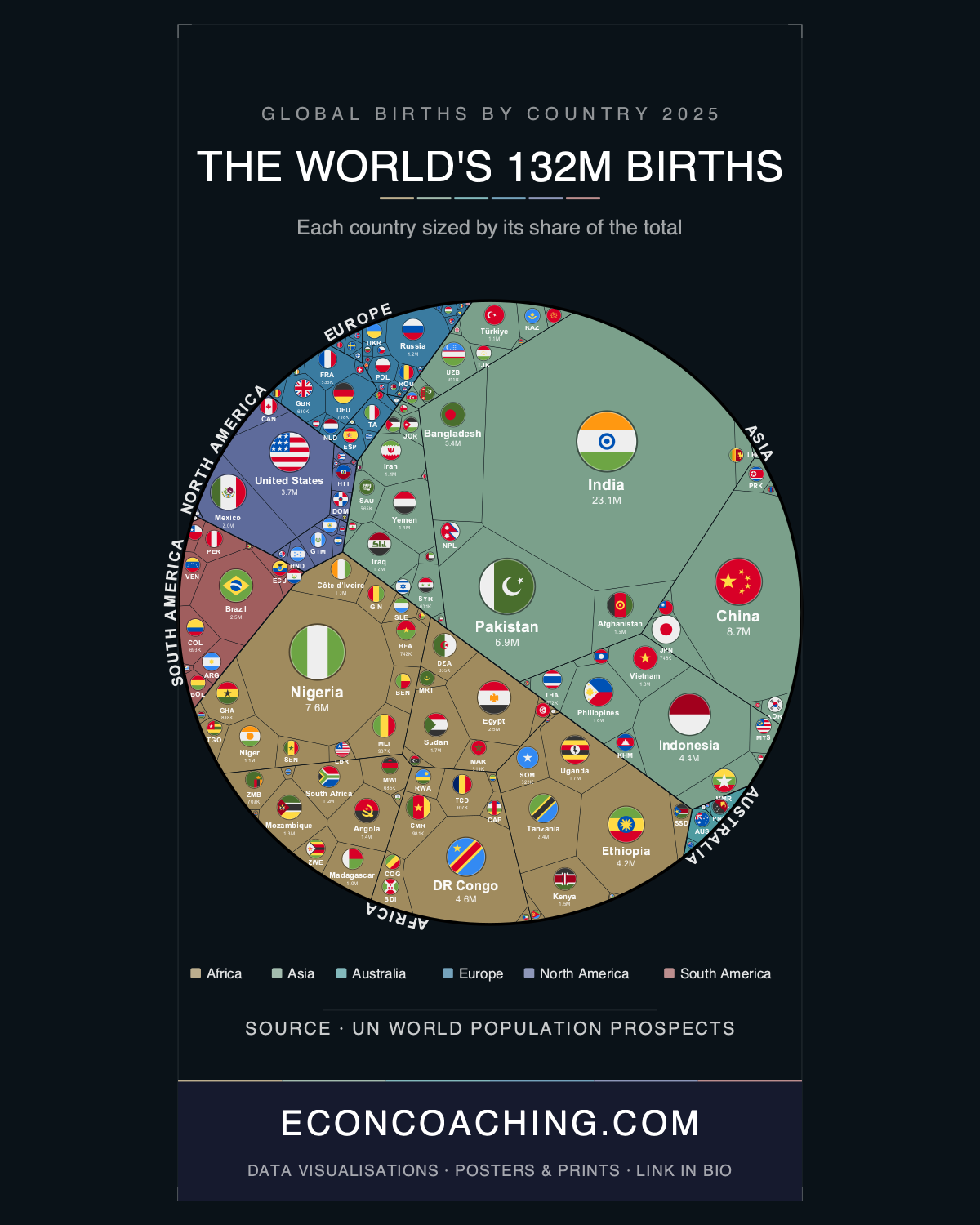
Nigeria produced roughly 7.6 million births in 2025 — more than the entire continent of Europe, which recorded approximately 6.2 million across dozens of countries with a combined population nearly three times larger. That single comparison, made visible in the treemap accompanying this article, where cell area is proportional to births rather than land mass, compresses the central story of global demography in 2025 into one disorienting image. The countries that dominate the map are not the ones that dominate economic output, and the gap between those two geographies is widening.
India Leads the World, but Its Peak May Already Be Behind It
India accounts for 23.07 million births in 2025 — 17.45% of all global births, or nearly one in every six babies born on Earth. Its birth total is more than double China's and more than triple the United States'. According to the UN World Population Prospects 2024 Revision, India's dominance in birth counts reflects the sheer scale of its existing population base. But the UNFPA's 2025 State of World Population Report confirmed that India's total fertility rate has now fallen to 1.9 births per woman, below the replacement threshold of 2.1. India is simultaneously the world's largest birth contributor and a country whose annual birth count will decline over the coming decades as its fertility rate compounds downward. The demographic dividend is real but time-limited, and the window for converting it into sustained productivity gains through education and labour market investment is measurably narrower than it appeared a decade ago.
China's Birth Collapse Has No Modern Precedent
China recorded 7.92 million births in 2025, down 17% from 9.54 million in 2024 — the lowest figure since 1949, confirmed by China's National Bureau of Statistics in January 2026. When the one-child policy was repealed in 2016, officials projected a rebound to approximately 14.33 million annual births; the 2025 actual figure falls short of that projection by nearly 45%. To find a comparable birth total in Chinese history, you have to go back to approximately 1738, when China's total population was around 150 million rather than today's 1.4 billion. Some demographers, including Yi Fuxian, have warned for years that China's demographic hole was deeper than official figures acknowledged. A partial structural explanation for the single-year 17% drop is the Year of the Snake in the Chinese zodiac, which is historically associated with lower birth preferences — but zodiac effects have never come close to explaining a decline of this magnitude, and the multi-year trend is unambiguous regardless of any one-year distortion.
South Korea and the Failure of Pro-Natalist Spending
South Korea's total fertility rate reached a world-record low of 0.72 in 2023, according to Statistics Korea — meaning the current generation of Koreans will produce only about 36 children for every 100 adults. South Korea has spent over $270 billion on pro-natalist policies since 2008 with no measurable reversal. The Bank of Korea has modelled scenarios in which the country's working-age population contracts so severely that growth becomes structurally difficult to sustain regardless of productivity policy. South Korea in the 1960s had a fertility rate above 6.0, higher than many Sub-Saharan African countries today; its collapse to 0.72 within a single lifetime is the fastest fertility decline ever recorded for a large economy. The broader point is that 71% of the world's population now lives in countries with fertility rates below replacement level, up from a global average of roughly 5 births per woman in the 1960s — a decline with no historical parallel.
Africa and South Asia Are Absorbing the Global Birth Share
Africa's share of global births has risen from approximately 12% in 1950 to 35.5% in 2025, and UN projections put that figure approaching 48% by 2100. Nigeria alone, ranked third globally with 7.6 million births, is projected to surpass the United States as the world's third most populous country before 2050, with annual births rising from 7.6 million today to an estimated 8.1 million by 2050. DR Congo, ranked fifth with 4.56 million births, produces more babies than the entire United States despite a GDP roughly 1/200th the size. Pakistan, at 6.9 million births, exceeds all of Europe combined — a continent with more than ten times Pakistan's economic output. These comparisons are not straightforward measures of demographic strength: Nigeria and DR Congo also rank among the countries with the highest infant and child mortality rates globally, meaning a significant share of those births do not translate into surviving productive citizens. Africa's rising birth share also comes against a backdrop of declining fertility rates even in Sub-Saharan Africa — UN projections to 2100 assume continued improvements in child mortality and female education that are not guaranteed and would, if they materialise, accelerate the fertility decline rather than sustain high birth counts indefinitely.
Asia's Shrinking Share and What It Means for Economic Geography
Asia still accounts for 49.3% of global births in 2025, but that share has fallen sharply from 62% in 1950, driven almost entirely by East Asia's fertility collapse. The practical consequence is a redistribution of where future workers, consumers, and taxpayers will be born — with South Asia and Sub-Saharan Africa absorbing the share that East Asia is releasing. Europe's 6.2 million annual births, spread across 4.7% of the global total, represent a continent whose demographic weight in global output, consumer demand, and labour supply will continue to diminish in relative terms even as its per-capita productivity remains high.
The structural implication of the 2025 birth data is a global economy in which the centres of labour supply growth and consumer market expansion over the next 30 to 50 years are concentrated in regions — Nigeria, Ethiopia, DR Congo, Pakistan, India — where institutional capacity, infrastructure investment, and human capital development will determine whether demographic scale converts into economic weight or compounds existing fragility. That translation is the central policy and investment question in global economics for the coming generation.
One chart like this in your inbox each week, explained in plain English — join the Everything Econ newsletter. Always free, and you can unsubscribe any time.
Get this visualisation
Take the World Births 2025 treemap home — as a premium print, an instant printable download, or a phone wallpaper pack.



← Back to all visualisations & articles
Follow Everything Econ: YouTube · TikTok · X · Instagram · Facebook