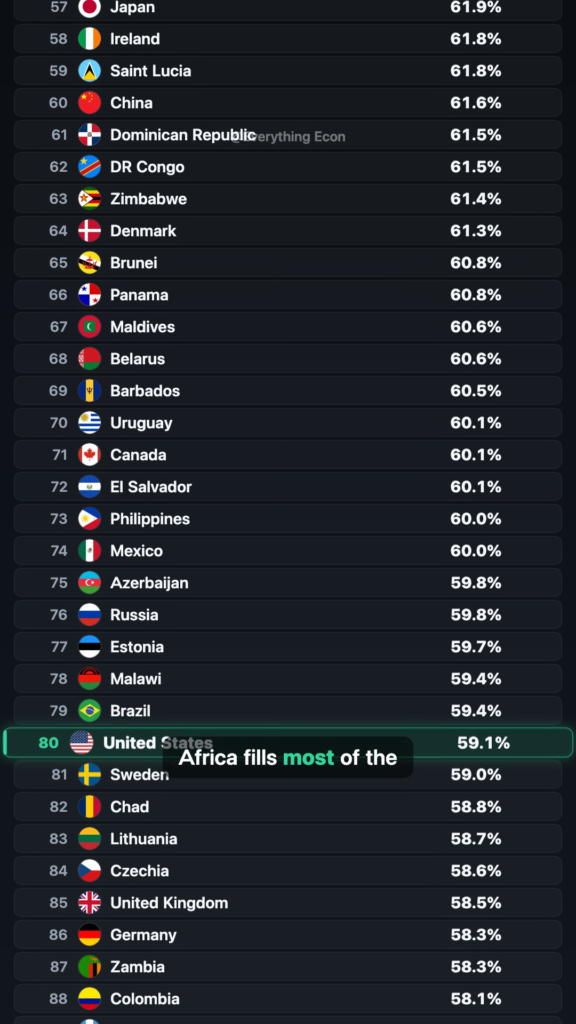
What counts as "having a job" turns out to be a messy question. This ranking looks at the share of working-age adults who are employed — whether that's a formal salary, a street stall, a subsistence farm, or a state-assigned post. It says nothing about pay, safety, or whether the work was chosen freely. That gap between a high number and a good outcome is the whole story of this list.
The top isn't where you'd expect
Qatar leads the world at 86.9% employment, but the figure is almost entirely explained by one thing: migrant workers make up 94% of its labour market under the kafala sponsorship system, which ties a worker's legal status to their employer. It's less a picture of a booming domestic job market than of an economy built almost wholly on imported labour.
The rest of the top 15 is dominated by countries where "employed" often means working to survive rather than clocking in at an office. Madagascar sits second at 82.9%, driven by subsistence farming and street vending rather than job quality. Tanzania follows at 82.4%, again mostly informal work, and Uganda posts 77.8%, with 93-95% of its workforce informally employed — no contracts, no benefits, no safety net. Cambodia (82.2%), Nigeria (80.0%) and Niger (79.4%) round out a cluster of lower-income countries where nearly everyone works because nobody can afford not to.
North Korea is the outlier that proves the point about what this number can hide. It reports 79.2% employment, but that figure comes from compulsory state job assignment — citizens don't choose their work, the state allocates it. An estimated 1 in 10 North Koreans is thought to be in forced labour, a detail no employment percentage can capture.
Two different reasons to rank low
The bottom of the table splits into two very different stories. Jordan (33.4%) and Afghanistan (32.5%) are low largely because of how few women work: in Jordan, 49% of men are employed versus just 10% of women, and in Afghanistan, Taliban restrictions have pushed female labour participation down to 5.1%. These are countries where plenty of work exists but social and political barriers shut most women out of it.
Syria (31.9%) tells a different story — one of destruction rather than exclusion. Fourteen years of civil war gutted the formal economy, especially women's employment, leaving the labour market a fraction of what it once was.
Then there's Sao Tome and Principe, which finishes dead last worldwide at 21.2%. Oddly, this small island nation also has one of Africa's lowest youth unemployment rates — not because jobs are plentiful, but because so few young people are even looking for work in the first place. When people aren't counted as part of the labour force at all, the unemployment rate can look good while the employment rate tells the real story.
The region that stands apart
The United Arab Emirates ranks 10th globally at 76.9%, and like Qatar, the explanation is structural rather than economic dynamism: an overwhelmingly foreign, non-citizen workforce does the bulk of the country's work. Together, Qatar and the UAE show how Gulf economies can post employment rates that rival or beat much poorer nations, simply because their citizen populations are small and their imported workforces are enormous.
So the country with the single highest share of working-age adults in a job is Qatar, at 86.9% — not because it has conquered unemployment in any conventional sense, but because its economy runs on a vast, largely temporary foreign workforce with few alternatives but to work.
What this ranking really shows is that a high employment rate can mean prosperity, desperation, or state control, and a low one can mean exclusion, devastation, or simply a smaller labour force. The number alone never tells you which.
Source: World Bank / ILO.
Get a new data story like this every week — join the newsletter.
Browse every visualisation on the visualisations page.