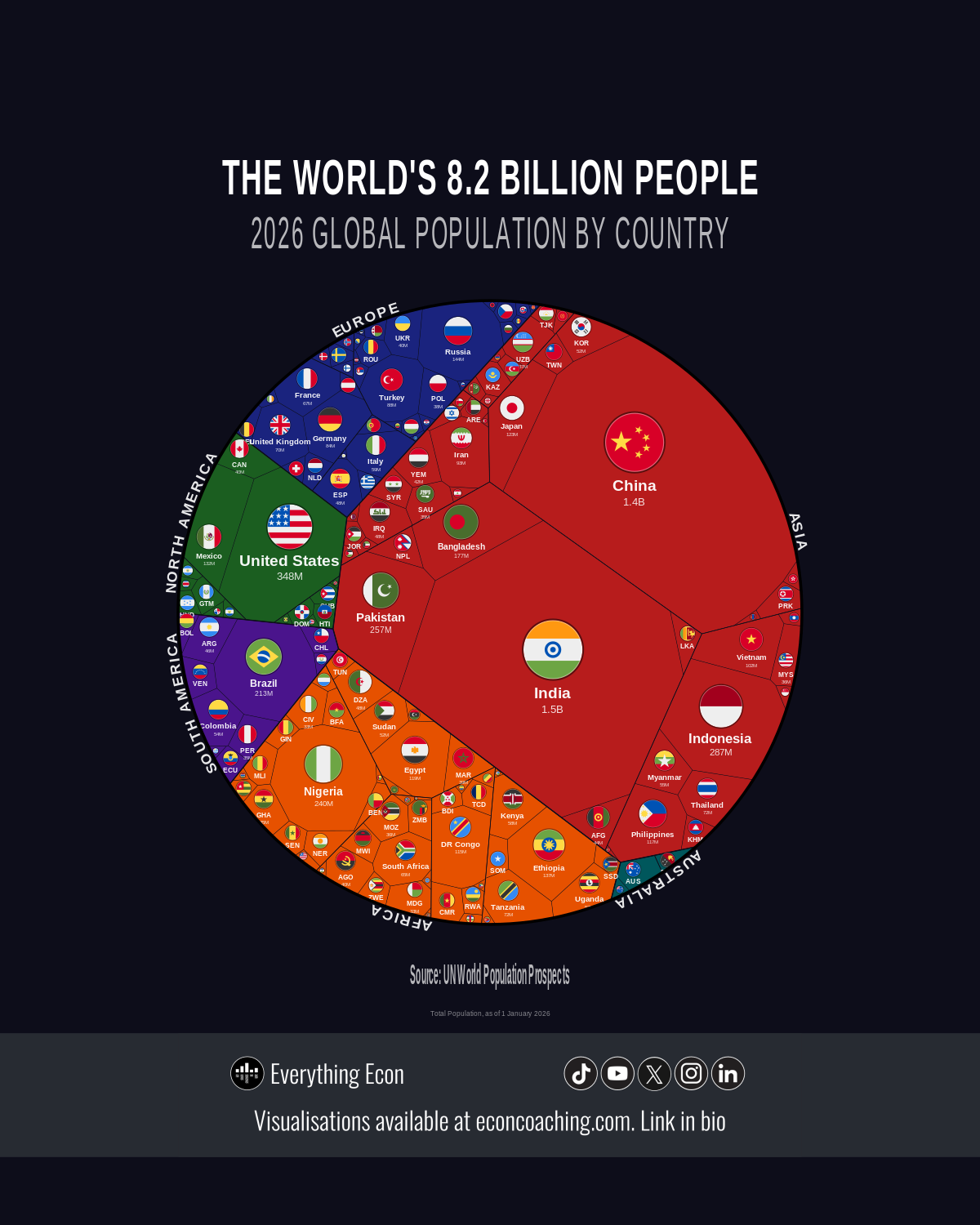
The treemap accompanying this article resizes every country by population, not land area, and the result overturns nearly every geographic intuition. Australia — a continent — nearly vanishes. Ethiopia’s cell is larger than Japan’s. India dominates the upper half of the chart with 1.47 billion people, while all of Europe combined occupies less space than the Indian subcontinent. That is the 2026 demographic map of the world, and it bears almost no resemblance to the one most readers grew up with.
India and China: The Same Starting Point, Radically Different Trajectories
India officially surpassed China as the world’s most populous country in April 2023, ending a ranking that UN records trace back to at least 1950. By 2026, India leads by roughly 56 million people — 1.470 billion against China’s 1.414 billion. The gap is widening because China’s population is now in structural decline. It peaked at approximately 1.426 billion in 2022 and UN projections under the World Population Prospects 2024 Revision indicate it could fall below 1 billion before 2100, a drop of more than 400 million from its peak.
The divergence traces directly to policy. In 1971, China and India had nearly identical total fertility rates of just under six births per woman. China’s one-child policy, enforced from 1980 to 2015, drove fertility down sharply and produced today’s aging, shrinking population. India never followed that path, and its working-age population is still expanding. Those long-run projections for China carry real uncertainty — Beijing has been aggressively promoting pro-natalist policies since abolishing birth limits, and the actual fertility response remains unknown — but the structural momentum of an aging population is not reversed quickly regardless of policy.
East Asia’s Accelerating Contraction
Japan’s 2025 National Census, released in May 2026, confirmed a drop of approximately 3.1 million people over five years — a 2.5% decline and the fastest pace of population loss ever recorded there. Japan has now lost roughly 5 million people since its peak of 128 million in 2010, falling to rank 12 globally, behind Ethiopia. South Korea’s trajectory is even more compressed: it crossed into “super-aged” status (20% of population aged 65 or older) at the end of 2024, reaching that threshold in approximately seven years — compared to eleven years for Japan and nineteen years for Europe. The UN projects South Korea’s population will fall from roughly 52 million today to just 22 million by 2100.
Population decline in these countries is not purely a crisis. Productivity gains from automation and AI, combined with selective immigration, may offset workforce shrinkage over the medium term, and lower population density eases housing and environmental pressures. But for sovereign debt sustainability — Japan’s debt-to-GDP ratio already exceeds 260% — a shrinking tax base is a structural constraint that technology alone cannot resolve.
Africa’s Arithmetic Is Already Reshaping the Rankings
Ethiopia at rank 10 with 137.2 million people has displaced Japan at rank 12 with 122.8 million — a shift that would have seemed implausible two decades ago, when Ethiopia’s population was under 75 million. Nigeria at rank 6 holds approximately 240 million people and a median age of just 18.3 years, and is projected to surpass the United States to become the world’s third most populous country shortly before 2050. The Democratic Republic of the Congo, currently rank 15 at roughly 114.6 million, has a median age of 15.9 years and a total fertility rate of approximately six children per woman — nearly three times the global average of 2.3 — and is projected to reach 436 million by 2100, a 271% increase.
Africa accounts for 19.0% of world population in 2026, up from roughly 9% in 1950. By 2100, projections suggest one in three people on Earth will be African. Half of all projected population growth between now and 2050 is expected to concentrate in just nine countries, seven of which are in Africa or South Asia. Europe, by contrast, held roughly 22% of world population in 1950; that share has fallen to 10.1% and continues declining. That demographic mass is not automatically convertible into economic output. Africa’s youth bulge becomes a dividend only with substantial investment in education, healthcare, and formal job creation — without those, rapid population growth can increase unemployment and strain public institutions rather than fuel growth. The DRC’s current infrastructure and governance capacity are nowhere near the scale required to absorb a near-tripling of its population productively.
South Asia’s Aggregate Scale Is Underappreciated
Pakistan ranks fifth globally at 257.2 million, Bangladesh eighth at 176.8 million. South Asia — India, Pakistan, and Bangladesh alone — accounts for over 1.9 billion people, more than the entire population of Africa. This concentration of demographic weight in a single region has direct implications for global labour markets, agricultural commodity demand, and manufacturing capacity. Both Pakistan and Bangladesh are lower-income economies relative to their population size, and Bangladesh’s GDP per capita remains well below the global average despite significant export-led growth in textiles, which is a reminder that raw population rank is not a proxy for current economic power. China’s GDP per capita far exceeds India’s despite having 56 million fewer people. But at twenty- to thirty-year planning horizons, labour force scale and consumer market growth follow population, and South Asia’s numbers are unambiguous.
A Slowing World, Unevenly Distributed
World population is growing at approximately 0.84% per year in 2026, down from 0.97% in 2020 and less than half the peak rate of roughly 2.3% recorded in the 1960s. The world doubled from 3 billion to 6 billion in forty years; at current growth rates, the next doubling would take over two centuries. The era of explosive global population growth is ending. What is not ending is the redistribution of existing and near-term population toward Sub-Saharan Africa and South Asia, and away from East Asia and Europe — a shift that will define labour market structures, infrastructure investment requirements, and geopolitical weight for the remainder of this century.
One chart like this in your inbox each week, explained in plain English — join the Everything Econ newsletter. Always free, and you can unsubscribe any time.
Take this one home
Get this visualisation as a download, wallpaper, or printed poster.
← Back to all visualisations & articles
Follow Everything Econ: YouTube · TikTok · X · Instagram · Facebook