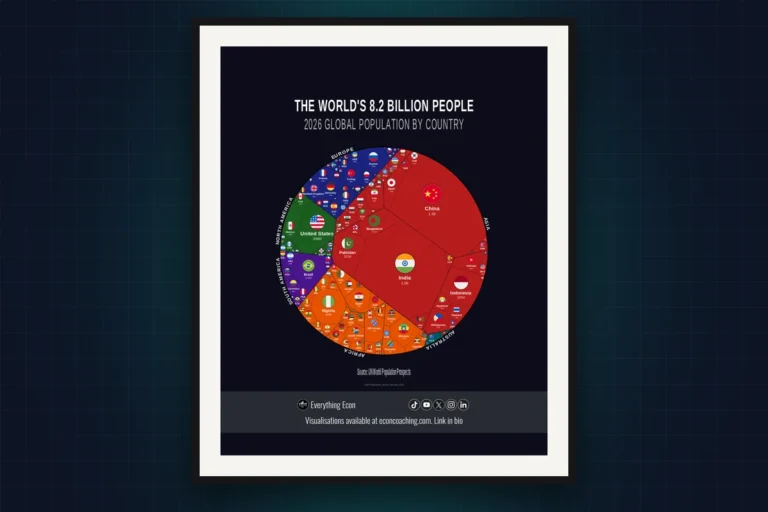
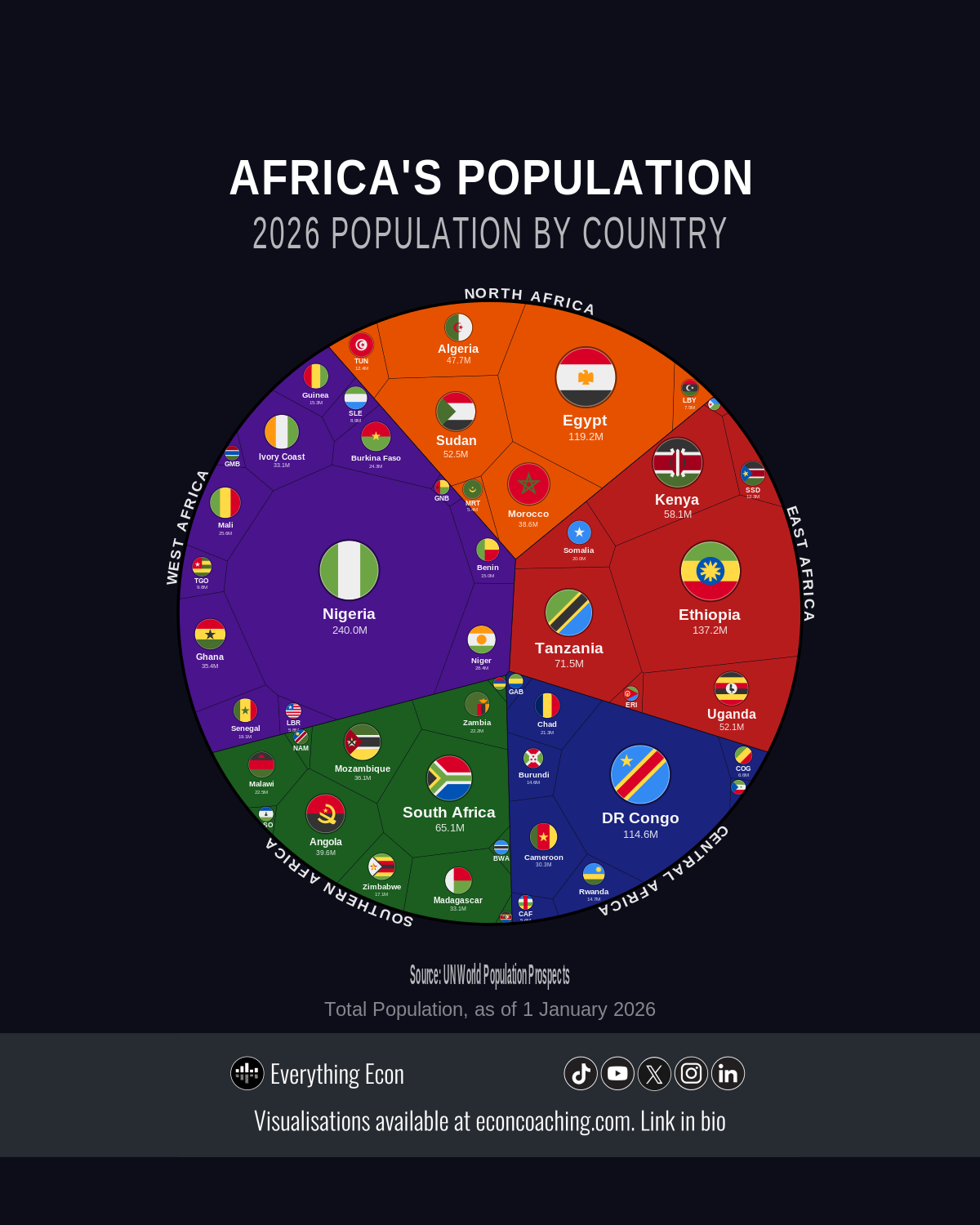
Nigeria’s 239.97 million people occupy more space in the treemap accompanying this article than Ethiopia and Egypt combined. That visual fact captures something a political map cannot: Africa’s population is not evenly distributed across its 50-plus countries — it is heavily concentrated at the top, with a small group of nations accounting for a disproportionate share of the continent’s 1.56 billion people, and the internal ranking is actively shifting in ways that matter for economists, policymakers, and investors.
Nigeria Stands Alone, but Its Lead Is Not an Economic Advantage
Nigeria’s 239.97 million people represent 15.35% of Africa’s entire population — a share nearly as large as Ethiopia (#2, 137.18M) and Egypt (#3, 119.23M) combined. Nigeria adds roughly 6.4 million people per year, more than the total population of many African countries. Between 2015 and 2023, Nigeria’s population grew at an average of 2.3% annually, outpacing the country’s average economic growth of 1.5% over the same period, which pushed GDP per capita back toward 2010 levels. Despite holding Africa’s largest GDP in absolute terms, Nigeria ranked only 20th on the continent by GDP per capita (PPP) in 2023. Population scale without commensurate productivity growth does not generate wealth — it dilutes it. Nigeria’s trajectory illustrates that demographic weight and economic strength are not the same variable.
The Silent Reshuffling: DR Congo Closing on Ethiopia
DR Congo currently sits fourth in Africa at 114.63 million, behind Ethiopia’s 137.18 million by roughly 22.5 million people. That gap is closing faster than most analyses acknowledge. Central Africa is the fastest-growing sub-region on the continent at close to 3% per year, driven primarily by the DRC, which adds over 3 million people annually. The UN’s World Population Prospects 2024 Revision projects DRC will double its population by 2045 and overtake Ethiopia to become Africa’s second most populous country by 2050, behind only Nigeria. According to Pew Research, DR Congo is one of just six countries expected to drive more than half of all global population growth this century — the only non-African country in that group is India. The DRC’s median age is 15.9 years, and 46% of its population is under age 15. On the current development trajectory, income per capita in the DRC by 2050 is projected to be roughly the same as it was in the 1970s — meaning demographic mass is accumulating without a parallel accumulation of human capital or institutional capacity.
Niger: A Demographic Structure Unlike Anything Else on the Continent
Niger ranks 18th in Africa by population at 28.4 million, but no demographic indicator in the dataset is more extreme. Its median age is 15.7 years — the lowest of any country on earth — meaning half of Niger’s population are children or teenagers. Its crude birth rate in 2024 was 46.6 births per 1,000 people, the highest of any African country and nearly three times South Africa’s rate. Niger’s population has grown by approximately 975% since 1950, yet its median age has barely shifted — rising just 0.4 years since 1970. That near-stasis in age structure, despite massive population growth, reflects one of the most persistent high-fertility demographic patterns in recorded history. Whether this produces a demographic dividend depends almost entirely on whether education, formal employment, and healthcare infrastructure can scale proportionally — conditions that are currently absent at the required level. The outcome is not predetermined, but the structural conditions for converting Niger’s youth bulge into economic growth are weaker today than they were in the East Asian economies that achieved that conversion in the 20th century.
Africa’s Two Demographic Speeds
Africa’s median age of 19.7 years is the youngest of any continent, compared to Asia’s 32 years and Europe’s 43.1 years. But that aggregate conceals a sharp divide within the continent. North Africa — Egypt (119.23M), Algeria (47.74M), Morocco — and Southern Africa, anchored by South Africa (65.11M), are growing below 2% per year and are approaching replacement-level fertility before 2050. These are also the wealthiest sub-regions by per capita income. Central and West Africa — where Niger, DRC, Mali, and Uganda sit — are growing above 3% per year with fertility rates that remain structurally high. The continent’s demographic explosion is concentrated in its poorest sub-regions, not distributed evenly. Rwanda and Burundi, both in Central Africa, already carry population densities of roughly 500 people per km² despite populations of only 14.7M and 14.6M respectively — land pressure at that density, in economies with limited industrial bases, translates into competition for agricultural resources that has historically contributed to instability.
Africa’s Share of Global Population Is Approaching a Structural Threshold
Africa’s total population stood at approximately 140 million in 1900. It crossed 1 billion in 2007 and now exceeds 1.56 billion. Africa’s share of global population has grown from 9.1% in 1950 to approximately 18.83% in 2025, and is projected to reach nearly 37.5% by 2100 — at that point, more than one in three people on Earth will be African. Africa’s population has increased by 595% since 1950, more than double South America’s 294% growth over the same period, making it the fastest-growing continent since 1972. The UN’s medium-fertility projection and the IHME’s models diverge by up to 0.7 billion people by 2100 for sub-Saharan Africa alone, reflecting genuine uncertainty about how quickly fertility rates will decline in high-TFR countries. That uncertainty matters enormously for infrastructure planning, food systems, and climate adaptation investment — the range of outcomes is wide enough that planning for a single trajectory would be a significant policy error.
The internal demographic order of Africa is changing measurably and quickly, with DR Congo’s projected rise to second place by 2050 the clearest single data point — but the more consequential question is whether the institutions, investment, and policy frameworks that convert population growth into sustained development can scale as fast as the populations themselves.
One chart like this in your inbox each week, explained in plain English — join the Everything Econ newsletter. Always free, and you can unsubscribe any time.
Take this one home
Get this visualisation as a download, wallpaper, or printed poster.
← Back to all visualisations & articles
Follow Everything Econ: YouTube · TikTok · X · Instagram · Facebook