
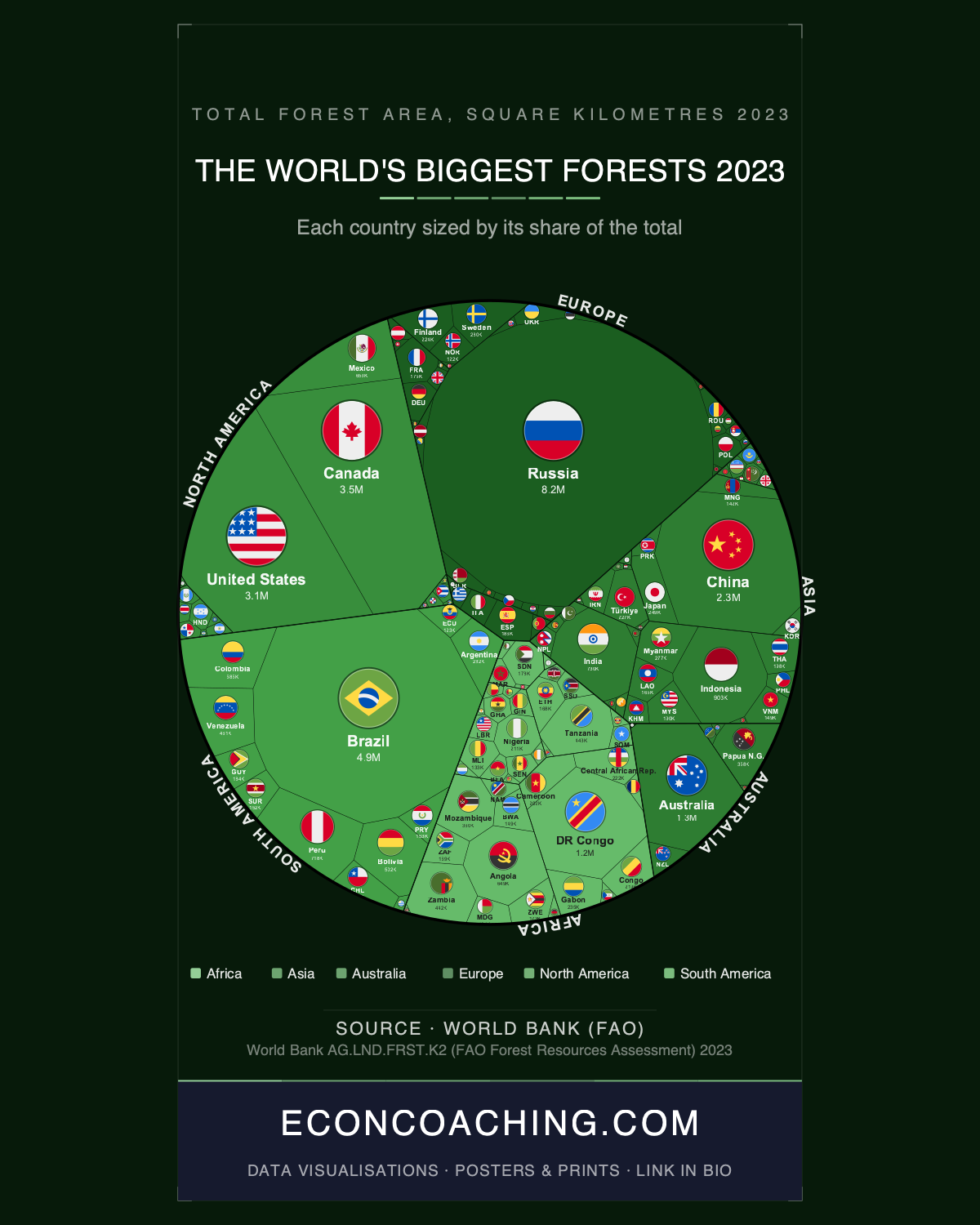
Russia's forest block in the treemap accompanying this article is so large it distorts everything around it. At 8.15 million square kilometres — 20.2% of all forest on Earth — Russia's taiga alone exceeds the combined forest area of Canada, the United States, and China. Five countries together — Russia, Brazil, Canada, the United States, and China — control 54.3% of the world's forests, and the decisions made in Moscow, Brasília, Ottawa, Washington, and Beijing are, in aggregate, the dominant variable in whether global forest cover expands or contracts over the next decade.
Russia's Taiga: An Asset Turning Into a Liability
Russia's 8.15 million km² of forest is the single largest contiguous forest ecosystem on Earth. The Siberian portion alone spans eleven time zones, exceeds the entire Amazon basin in area, and holds more than 55% of the world's conifers. More importantly, Russia's forests store an estimated 30–40% of all carbon held on land — more than all tropical forests combined — with much of it locked not in trees but in peat and permafrost beneath them.
That asset classification is increasingly uncertain. Since 2000, Russia has lost 45 million hectares of forest cover, approximately 80% of it from wildfires. As permafrost thaws and fire seasons lengthen under warming temperatures, portions of the taiga are shifting from net carbon sink to net carbon source, releasing sequestered peat carbon that took millennia to accumulate. Russia's forest dominance in the treemap is real, but the climate value of that dominance is eroding faster than the headline area figures suggest.
Brazil's Partial Progress and the Cerrado Problem
Brazil holds 4.93 million km² of forest — 12.22% of the global total, the only country besides Russia with more than 10%. Under President Lula da Silva, Amazon deforestation fell nearly 50% in 2023 to 5,153 square kilometres, the lowest level since 2018, according to INPE. That reversal from the 75% above-average deforestation rates recorded during the Bolsonaro administration is real policy progress.
The aggregate forest-loss figure tells a different story. Brazil still lost 1.14 million hectares of tropical primary forest in 2023 — more than every other country combined. The Amazon headline also masked accelerating destruction of the Cerrado savanna, which lost over 7,800 square kilometres of native vegetation in 2023, the highest since monitoring began in 2018. Forest metrics confined to the Amazon systematically undercount Brazil's total land-use change. The broader risk embedded in Brazil's position is geopolitical: if a future administration reverses Lula's enforcement posture, one country's domestic politics could negate several years of global conservation effort.
China's Afforestation Record and Its Limits
China at 2.26 million km² occupies the fifth position in the treemap — smaller than Canada and the United States, but the fastest-growing large forest block on the chart. Forest cover rose from 16.6% of China's land area in 2000 to over 24% by 2023, driven by the Three-North Shelterbelt Program, which has planted 66 billion trees since 1978 along a 4,500-kilometre belt bordering the Gobi and Taklamakan deserts, raising forest cover in target regions from 5% to 14% and measurably reducing dust storms affecting Beijing. In 2023 alone, China planted nearly 4 million hectares, accounting for roughly a quarter of all new forests planted globally over the past decade.
The counterpoint from Global Forest Watch matters here: China also lost 12.1 million hectares of tree cover between 2001 and 2023, even as its planted area expanded. A significant share of China's new forest is monoculture plantation — structurally simpler, lower in biodiversity, and storing far less carbon per hectare than the natural forest it sometimes replaces. China's treemap rectangle is growing, but its ecological value per square kilometre is not equivalent to Brazil's primary Amazon forest or Russia's old-growth taiga.
The Accelerating Crises in DRC and Bolivia
Below the top five, the treemap's smaller blocks carry disproportionate climate significance. The Democratic Republic of Congo holds 1.23 million km² of forest — 3.05% of the global total and 60% of the Congo Basin rainforest, the world's second largest tropical forest after the Amazon. In 2023, DRC lost over 1 million hectares of tree cover, one of the highest deforestation rates on the planet. In 2024, Congo Basin forest loss rose a further 14.2% year-on-year, and DRC's primary forest is now the second largest in the world after Brazil's — a position it holds partly because Brazil's Amazon is shrinking. COMIFAC has identified smallholder agriculture and charcoal production tied to displacement from armed conflict as the primary drivers, structural pressures that enforcement crackdowns alone cannot resolve.
Bolivia, ranked 14th globally at 1.24% of world forest area, lost 0.49 million hectares of tropical primary forest in 2023 — a 25% jump from 2022 — vaulting it to third globally in primary forest loss behind only Brazil and DRC. That trajectory has attracted little of the international attention directed at the Amazon, despite representing one of the sharpest single-year acceleration in deforestation rates recorded anywhere in 2023.
The Global Arithmetic and What 2023 Represents
Globally, tropical primary forest loss totalled 3.7 million hectares in 2023 — the equivalent of nearly ten football fields per minute — generating 2.4 gigatons of CO₂ emissions, almost half of the United States' entire annual fossil fuel output. Against that scale, China's afforestation gains and Brazil's Amazon enforcement represent meaningful but insufficient offsets. Global forest area has been declining since FAO began tracking it systematically in 1990, when total cover stood at roughly 4.28 billion hectares. The net rate of loss has slowed, but tropical primary forest — the most carbon-dense and biodiverse category — continues to disappear faster than planted forest anywhere accumulates equivalent ecological value.
The concentration of 54% of global forest in five countries creates both leverage and vulnerability. Sustained political will in Russia, Brazil, Canada, the United States, and China is the single most powerful variable in whether the 30×30 commitments of the Kunming-Montreal Biodiversity Framework translate into measurable outcomes before 2030, or remain targets on paper.
One chart like this in your inbox each week, explained in plain English — join the Everything Econ newsletter. Always free, and you can unsubscribe any time.
Take this one home
Get this visualisation as a download, wallpaper, or printed poster.
← Back to all visualisations & articles
Follow Everything Econ: YouTube · TikTok · X · Instagram · Facebook