How many children does the average woman have in her lifetime? That single number, known as the fertility rate, tells us a great deal about a country's health, economy, and future. A rate of 2.1 is considered the "replacement level" — the point at which a population holds steady without relying on immigration. Today, that benchmark divides the world sharply in two. According to the World Bank, the global average stood at 2.2 in 2024, down from 5.0 in the 1960s. And 131 of 237 countries — 55% of them — already sit below replacement, a group that together holds 68% of the world's people.
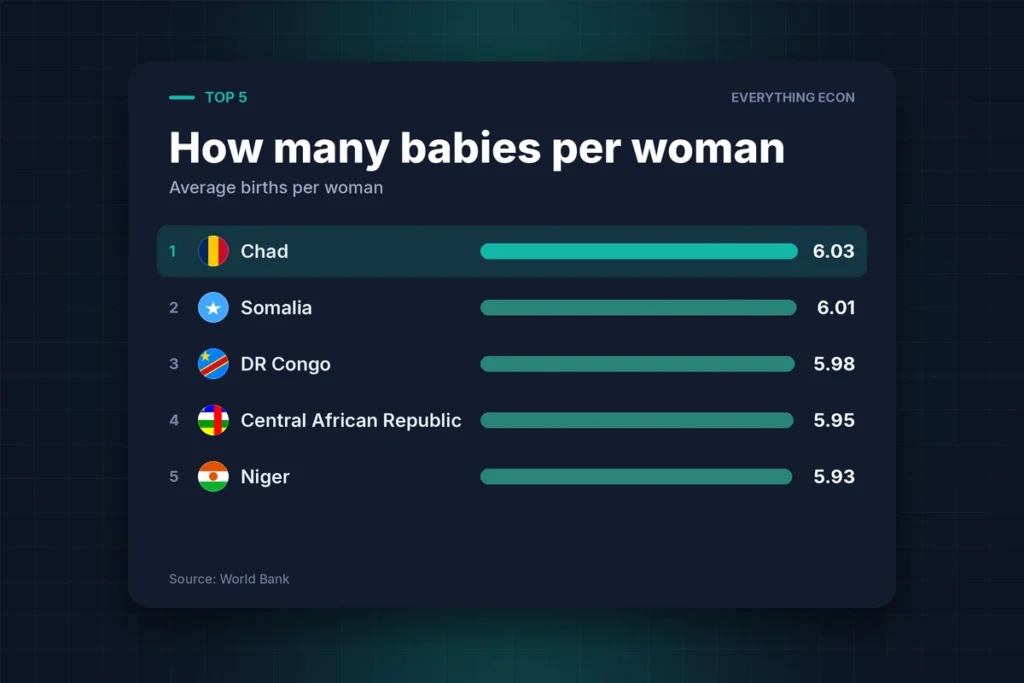
At a glance · Top 5
Average births per woman
- 1Chad6.03
- 2Somalia6.01
- 3DR Congo5.98
- 4Central African Republic5.95
- 5Niger5.93
Source: World Bank
A World of Two Halves
At the bottom of the ranking, the numbers are startling. Macao records just 0.58 children per woman — roughly one child for every two women of childbearing age. South Korea follows at 0.75, Hong Kong at 0.84, and Puerto Rico at 0.92. Singapore closes the bottom five at 0.97. These are among the wealthiest, most urbanised places on Earth, and that is not a coincidence. When education and career opportunities expand — particularly for women — and when housing becomes expensive and city life costly, families tend to shrink. China tells a similar story: despite scrapping its one-child policy in 2015 and later allowing three children, its fertility rate has crashed to approximately 1.0 in 2025. Even a brief spike in 2024, widely attributed to parents wanting babies born in the auspicious Year of the Dragon, did little to change the trend. India, now the world's most populous country, fell below replacement for the first time in 2024 at 1.9, with women in cities averaging just 1.5.
War, too, can collapse a birth rate. Ukraine's fertility fell from 1.22 in 2021 to just 1.00 in 2025 — a direct result of Russia's full-scale invasion and the departure of roughly seven million people, most of them women and children.
Why Sub-Saharan Africa Sits at the Top
The upper end of the ranking is dominated entirely by sub-Saharan Africa and a handful of neighbouring countries. Somalia (6.01), DR Congo (5.98), the Central African Republic (5.95), Niger (5.93), Mali (5.51), Angola (5.05), and Nigeria (4.38) all feature in the top fifteen. The reasons are interconnected: high rates of child mortality mean families have more children as a safeguard against losing some; subsistence farming makes large households economically useful, with more children meaning more hands to work the land; and in many communities, having many children carries deep cultural and social status. When girls marry young and rarely finish school, those patterns persist across generations.
Niger illustrates the consequences at scale. With a fertility rate of 5.93, its population is projected to nearly triple — from 23 million in 2019 to roughly 70 million by 2050 — placing enormous pressure on food, water, and public services in one of the world's poorest countries.
The Country at the Very Top
Leading the entire ranking is Chad, at 6.03 children per woman. Behind that figure lies a set of interlocking realities: 61% of girls in Chad are married before the age of 18, and only 36% complete primary school. With so little access to education and so few choices available, high fertility is less a preference than a product of circumstance. Changing that trajectory requires far more than family planning alone — it means girls staying in school, women gaining economic independence, and infant mortality continuing to fall.
Data: World Bank, latest available figures.
Get a new data story like this every week — join the newsletter.
Browse every visualisation on the visualisations page.
Take one home
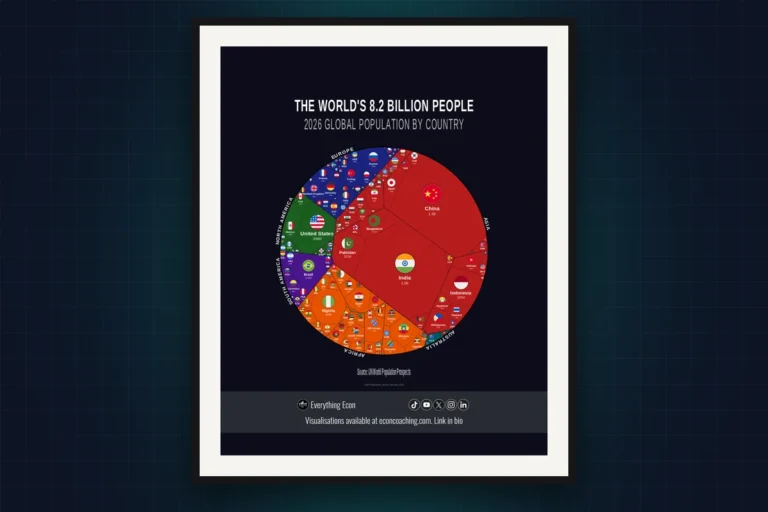
Every country drawn to scale, as an instant printable download or a museum-quality matte poster printed to order.