
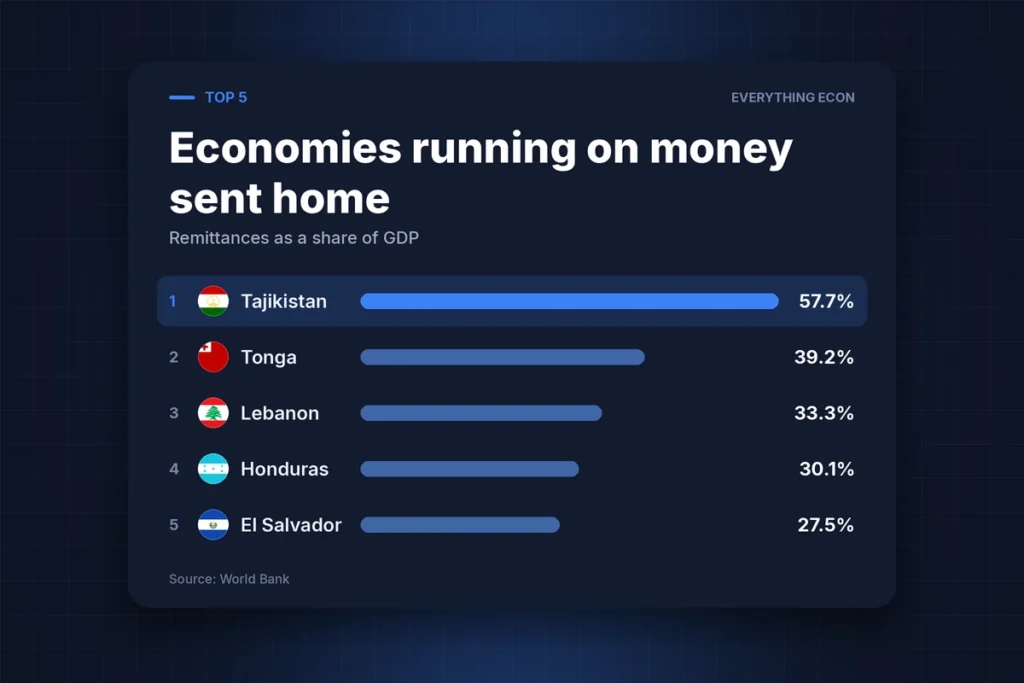
Every year, migrant workers around the world send money home to their families — a payment known as a remittance. For most countries, these transfers are a small, welcome top-up to the economy. But for a handful of nations, they are the engine room. This ranking measures remittances as a share of GDP, showing how much of each country's entire economic output is really just money earned abroad and sent back. At the top, that share exceeds a third. At the bottom, in a group of wealthy, oil-rich or large economies, it rounds to zero.
At a glance · Top 5
Remittances as a share of GDP
- 1Tajikistan57.7%
- 2Tonga39.2%
- 3Lebanon33.3%
- 4Honduras30.1%
- 5El Salvador27.5%
Source: World Bank
The extreme cases
Tonga, in the Pacific, sits in second place at 39.2% of GDP — a small island nation kept afloat largely by its diaspora. Lebanon is third at 33.3%, but its story is different: this is a country in economic crisis. Lebanon's economy collapsed in 2019, and remittances — even though they actually fell by 13.4% in 2024, to $5.8 billion — have been one of the few things keeping households and the wider economy functioning since. Central America also features heavily: Honduras (30.1%), El Salvador (27.5%) and Nicaragua (26.6%) all rely on money sent home by citizens working in the United States.
A regional pattern: labour exported, cash returned
Look down the top 15 and a pattern emerges. These are mostly small or lower-income countries that export labour to wealthier neighbours and receive money back in return. Nepal (26.0%) sends workers largely to Gulf countries — 69% of its remittances come from there — and that inflow reached 28.6% of GDP in the 2024-25 financial year, more than five times the global average. Central Asian countries like Kyrgyzstan (17.6%) depend on migrant labour in Russia and the European Union. The Balkans appear too, with Kosovo (17.3%) reflecting decades of labour migration abroad due to limited industry at home. And a cluster of African nations — Gambia (22.0%), Liberia (21.3%), Lesotho (20.7%), Comoros (20.8%) — shows the same reliance is common across Sub-Saharan Africa.
Why the bottom of the list looks so different
At the other end, the United States, Chile, Saudi Arabia, Kuwait and Papua New Guinea all register 0.0%. This isn't because no money moves in or out of these places — some of them, like Saudi Arabia and Kuwait, are major sources of remittances sent by foreign workers, not recipients of them. Others, like the United States, simply have such large domestic economies that any remittances received are too small a slice of GDP to register. It's a reminder that this ranking measures dependence, not the absolute size of money flows — India took in a record $129.1 billion in remittances in 2024, more than any country in history, yet because its economy is so vast, that sum barely moves the needle as a share of GDP.
The country running most on money from abroad
That brings us to Tajikistan, in first place at 57.7% — meaning more than half of everything the country produces in economic terms is effectively matched by money sent home from workers overseas, overwhelmingly in Russia. This dependence has been rising sharply: it stood at around 39% of GDP in 2023 but climbed to somewhere between 45% and 49% in 2024 alone, as more Tajik citizens sought work in Russia. It leaves Tajikistan's economy unusually exposed — a slowdown in Russia's job market, or a change in migration policy there, would ripple through Tajik households almost immediately.
Source: World Bank, 2024 data.
Take one home
Every country drawn to scale, as an instant printable download or a museum-quality matte poster printed to order.
Get a new data story like this every week — join the newsletter.
Browse every visualisation on the visualisations page.
Keep exploring
 Economy · GraphicWho Holds America’s Debt? The $9.25tn Owned Abroad407K views3 min read
 Economy · RankingThe Countries Where an Extra Three Decades of Life Comes as Standard293K views3 min read
 Economy · RankingThe Countries Where Money Is Growing Fastest — and Where It’s Vanishing279K views3 min read