Every year, economists measure how much a country's income grows per person, which strips out population changes so you can see whether the average person is actually getting richer, not just whether the country as a whole has more people earning money. It's one of the cleanest ways to judge whether an economy is truly improving for its people. In 2025, the range is stark: some nations are seeing their incomes grow by double digits, while others are watching their economies shrink by nearly a tenth every year.
At a glance · Top 5
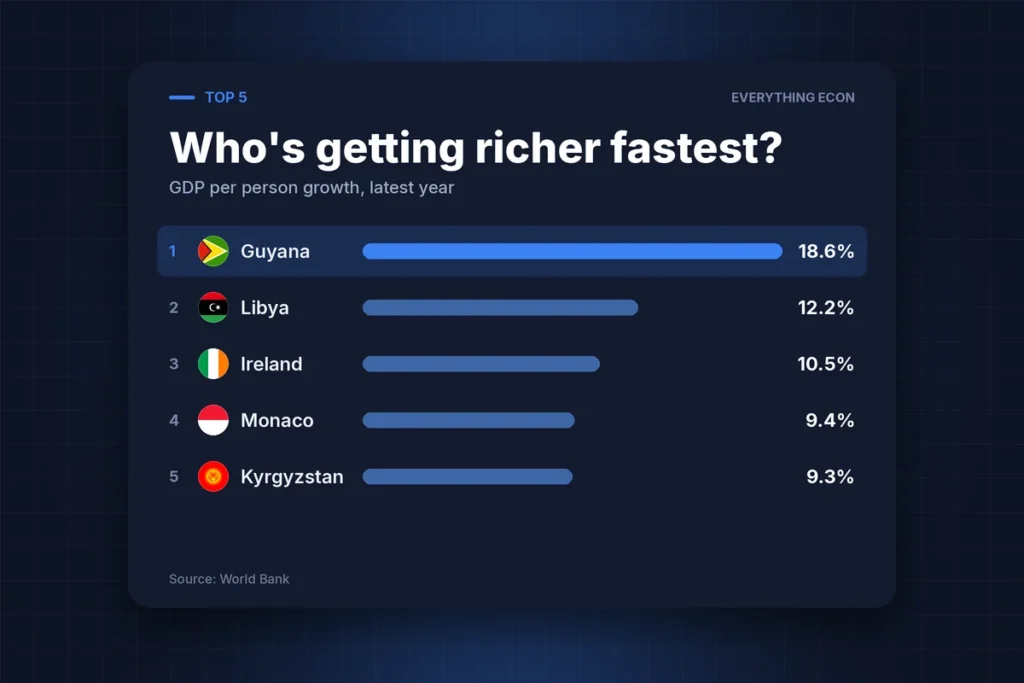
GDP per person growth, latest year
- 1Guyana18.6%
- 2Libya12.2%
- 3Ireland10.5%
- 4Monaco9.4%
- 5Kyrgyzstan9.3%
Source: World Bank
The oil-and-relocation effect
Several of the fastest-growing economies owe their success to one thing: oil. Guyana, at the very top with 18.6% growth, has been transformed by ExxonMobil's offshore drilling, which has pushed output from 391,000 to 616,000 barrels a day since 2022. That single project has driven Guyana's economy to grow by roughly 47% a year on average since then — an extraordinary pace with few historical parallels. Libya, in second place at 12.2%, is also riding an oil rebound.
Elsewhere, growth is being driven by a very different force: companies moving factories out of China. Vietnam (7.4%) and India (6.6%) are both major beneficiaries of this shift, as manufacturers look for cheaper or more reliable alternatives. Notably, India is now growing faster than China itself, which is expanding at 4.8%.
Not every riser is behaving the way the numbers suggest, though. Ireland's headline figure of 10.5% is largely an illusion. Multinational companies book profits through Ireland for tax reasons, inflating its official economic output to €510 billion in 2023 — but a measure that strips out those foreign profits put the real figure at just €291 billion. The lesson: a big number doesn't always mean people are living better.
Collapse at the bottom
At the other end of the table, the story is one of breakdown rather than ordinary economic slowdown. Equatorial Guinea, down 8.1%, has seen its income per person collapse from $19,850 in 2008 to $7,182 in 2022, as its oil fields run dry with no new discoveries to replace them. Lebanon (-7.6%) has suffered one of the worst economic collapses anywhere since the 1850s, with average incomes crashing from around $8,000 in 2018 to under $3,000 by 2021, following a currency crisis and banking meltdown.
Iraq (-4.2%), Syria (-3.9%) and Haiti (-3.8%) round out the bottom five. Unlike Equatorial Guinea or Lebanon, these are not failures of markets or resource depletion — they're the result of conflict and the breakdown of state authority, which makes any kind of sustained economic activity difficult.
Regional patterns and a currency turnaround
Zoom out, and South America posts the strongest regional average, at 3.5%, almost entirely thanks to Guyana's oil boom lifting the whole region's number. Europe (2.1%) and North America (1.8%) sit at the bottom of the regional table — not because anything is going wrong, but because these are older, wealthier economies with slower-growing populations and fewer easy gains left to make.
One surprise in the top fifteen: Zimbabwe, growing at 6.1% despite a history of runaway inflation. Its new gold-backed currency, the ZiG, has pushed inflation down to single digits for the first time in almost 30 years, giving its economy some rare stability.
The country on top
That brings us back to Guyana, the runaway leader at 18.6%. It's a reminder of how transformative a single natural resource discovery can be for a small country — Guyana's population is under a million, so a surge in oil revenue shows up enormously in the per-person figures. Whether that growth translates into lasting prosperity, rather than a temporary boom, is the question facing Guyana in the years ahead.
Source: World Bank, 2025 data.
Take one home
Every country drawn to scale, as an instant printable download or a museum-quality matte poster printed to order.
Get a new data story like this every week — join the newsletter.
Browse every visualisation on the visualisations page.