
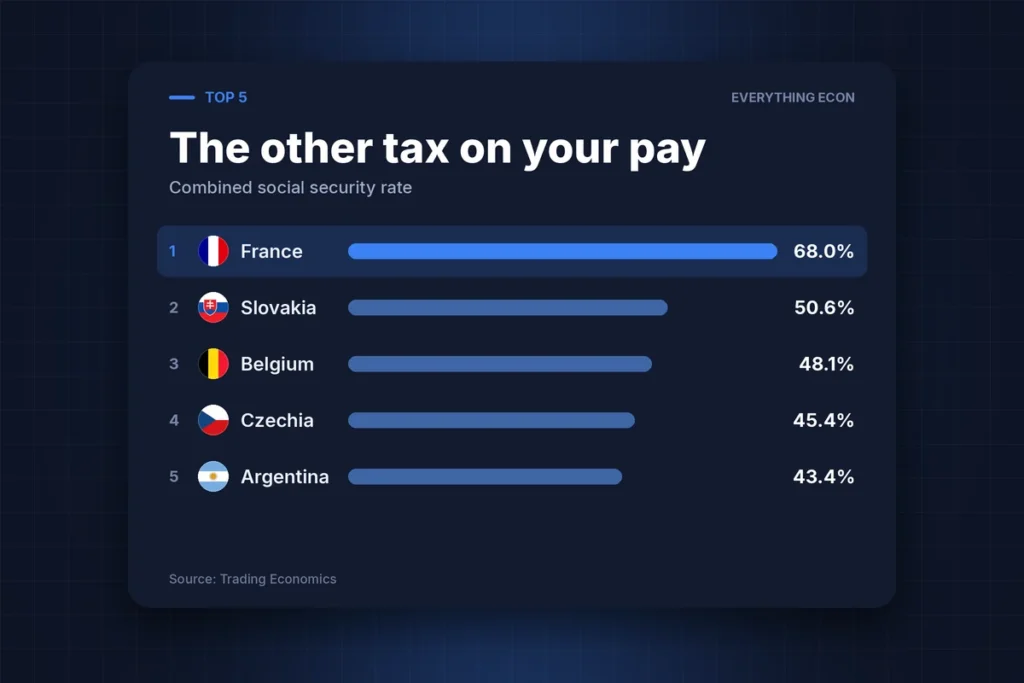
When people talk about how much tax they pay, they usually mean income tax. But in most countries, there's a second, quieter deduction sitting alongside it: social contributions. These are payments — split between employers and employees — that fund pensions, healthcare, unemployment cover and other welfare programmes. Unlike income tax, a big chunk of this is often paid by the employer before an employee's wage even reaches them, which is why it barely registers in everyday conversation despite being, in some countries, a bigger burden on labour than income tax itself. The gap between countries is enormous: some charge nearly 70% on top of wages to fund the welfare state, while others charge nothing at all.
At a glance · Top 5
Combined social security rate
- 1France68.0%
- 2Slovakia50.6%
- 3Belgium48.1%
- 4Czechia45.4%
- 5Argentina43.4%
Source: Trading Economics
Europe's heavy lifters
Europe dominates the top of this ranking, and the pattern is consistent: generous, pay-as-you-go pension and healthcare systems funded directly through payroll rather than general taxation. Slovakia (50.6%), Belgium (48.1%) and Czechia (45.4%) all sit close together near the top, followed by Italy (40.0%), Austria (39.0%) and Germany (38.7%). These aren't fringe economies — they're some of the continent's largest — which shows just how normalised high payroll contributions are as a way of paying for cradle-to-grave welfare.
Germany's rate is worth pausing on because China sits at exactly the same level, 38.7%. Two very different economic systems have arrived at the same number, though for different reasons: Germany's reflects decades of built-up social insurance, while China has actually been cutting its rate. In 2019 it lowered the employer pension contribution from 20% to 16%, saving Chinese businesses an estimated $253 billion, and it still ranks among the highest-cost countries in the world for payroll-based welfare.
Regional patterns, and the countries that opt out entirely
South America keeps pace with Europe more than most people would expect. Argentina (43.4%) and Brazil (42.8%) push the region's average close to European levels, driven by similarly structured public pension and health systems. Africa sits at the opposite extreme: South Africa (2.0%) and Mozambique (7.0%) pull the continent's average down to just 18.9%, reflecting welfare systems that are far less built out through formal payroll insurance.
Two countries tie for last place at 0%, but for opposite reasons. Denmark charges no social contributions because it funds its welfare state through high income taxes and VAT instead — the money still gets collected, just through a different channel. Qatar charges nothing because its oil and gas wealth funds the state directly, removing the need for payroll-based insurance altogether.
It's also worth noting where the US, UK and Japan sit. The US comes in at a combined 15.3% (split evenly between employer and employee through the FICA system), the UK sits at roughly 23% for 2026, and Japan sits even lower at about 14.7% despite having one of the world's oldest populations — a reminder that a high contribution rate isn't automatically linked to how much a country needs to support ageing citizens.
France tops the table
At the very top sits France, at a striking 68.0% — more than double Germany's rate and over four times the UK's. This is driven overwhelmingly by employer contributions that fund France's pay-as-you-go pension system and universal healthcare. Workers rarely see this cost directly, since employers pay the bulk of it, but it's baked into every hiring decision and wage negotiation in the country. It's one reason French labour costs are consistently among the highest in Europe, even when take-home pay doesn't feel especially generous by comparison.
Source: Trading Economics, 2026.
Get a new data story like this every week — join the newsletter.
Browse every visualisation on the visualisations page.
Keep exploring
 Economy · GraphicWho Holds America’s Debt? The $9.25tn Owned Abroad407K views3 min read
 Economy · RankingThe Countries Where an Extra Three Decades of Life Comes as Standard293K views3 min read
 Economy · RankingThe Countries Where Money Is Growing Fastest — and Where It’s Vanishing279K views3 min read