Net migration measures the balance between people arriving in a country and people leaving it in a single year. A positive number means more people moved in than moved out; a negative number means the reverse. It sounds like a simple scoreboard of winners and losers, but this year's ranking, built on World Bank data, tells a messier story: some of the countries at the top aren't magnets for opportunity so much as they are recovering from crisis, while some at the bottom are simply exporting workers who send money home.
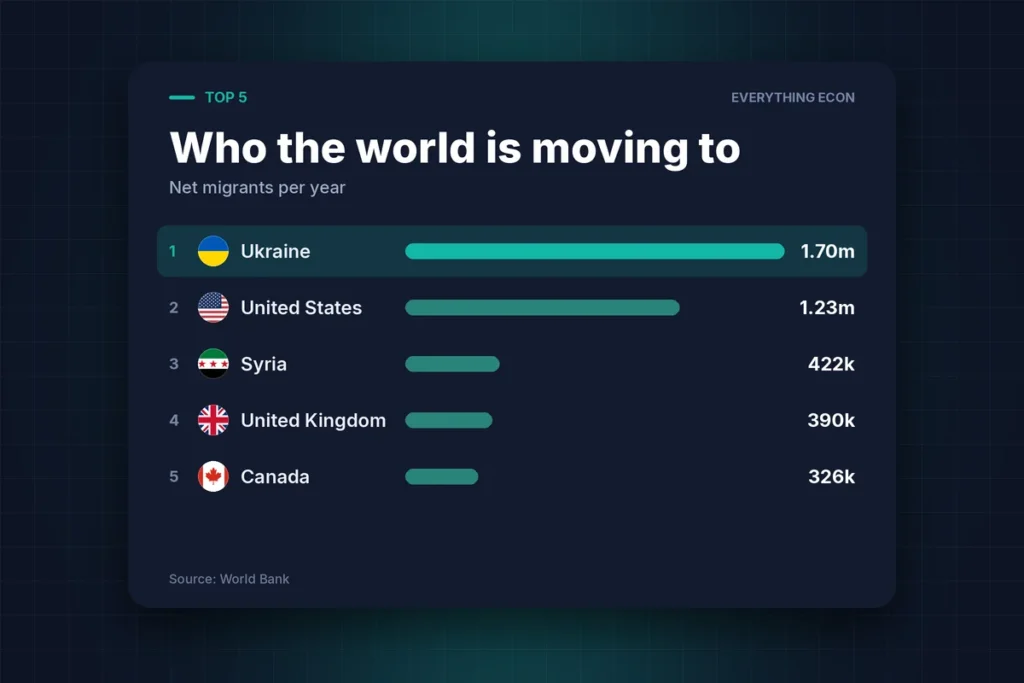
At a glance · Top 5
Net migrants per year
- 1Ukraine1.70m
- 2United States1.23m
- 3Syria422k
- 4United Kingdom390k
- 5Canada326k
Source: World Bank
The top of the table isn't what it looks like
The country with the single biggest net inflow — over 1.7 million people — is Ukraine, which sits at the very top of this ranking. That is not a sign of a booming, attractive economy. It reflects how millions of Ukrainians displaced by the war are being reclassified as they return or settle, alongside 5.7 million refugees who remain abroad. It's an accounting shift as much as a migration story.
Syria shows a similar pattern lower down the top tier, with a net inflow of 421,693. After Bashar al-Assad's government fell in December 2024, roughly 1 million Syrians went home. But 4.7 million Syrian refugees are still living abroad, so the positive number captures a partial recovery, not a finished one. Sudan is stranger still: it posts a net inflow of 291,469 while hosting the world's largest displacement crisis, with 7.7 million people uprooted inside its own borders. These three countries top the ranking for reasons tied to war and its aftermath, not prosperity.
Where migration works more like a labour market
Elsewhere in the top 15, the story is straightforwardly economic. The United Arab Emirates gained 158,634 people, and migrant workers now make up 88% of its population — the highest foreign-born share of any country on Earth. Saudi Arabia gained 119,738, helped by 530,256 Pakistanis who moved there in 2025 alone, a 17% jump on the year before. Japan's gain of 140,579 marks a genuine policy shift: after years of resisting immigration, Japan now has a record 2.57 million foreign workers, a number that has risen for 13 straight years running.
Why the bottom looks so lopsided
At the very bottom, Pakistan lost 1,235,336 people on net, the worst figure anywhere, after a record 727,381 workers left for jobs abroad in 2024 — many of them the same people showing up in Saudi Arabia's gains. India lost 495,753, despite strong economic growth at home, because it already has a diaspora of more than 17 million people, and that established network keeps pulling new emigrants out through job and family ties. Pakistan, India, Bangladesh and Nepal filling out the bottom of the table reflects countries with large, young populations sending workers to wealthier economies rather than a story of decline.
Germany (-334,072) is the odd one out among these bottom-dwellers. It isn't losing people because life there is unattractive; the figure includes Ukrainian refugees who arrived after 2022 now being counted as leaving, alongside more than a million Ukrainian refugees Germany still hosts. Poland, hosting a similarly large Ukrainian refugee population, shows the same effect at -330,820.
The takeaway
Ukraine's position at the number-one spot is the clearest example of why this ranking needs reading carefully rather than taken at face value. A net-migration figure this large usually signals a country people are flocking to. Here it signals the opposite: a country still absorbing the human cost of war, with millions of its own citizens yet to return. Even the United States, long the default destination for migrants worldwide, turned net-negative in 2025 for the first time in roughly 50 years, following border closures and the end of humanitarian parole programmes. The lesson of this year's numbers is that "net migration" can mean recovery, labour demand, or crisis, depending entirely on which country you're looking at.
Source: World Bank, 2025 net migration data.
Get a new data story like this every week — join the newsletter.
Browse every visualisation on the visualisations page.