Across much of the world, going to university is supposed to be a route into stable, well-paid work. But in a striking number of countries, graduates are more likely to be sitting at home unemployed than the people around them who never finished school. This metric, tracked by the World Bank using International Labour Organization data, measures the share of university graduates who are unemployed — actively looking for work but unable to find it. Comparing it across 125 countries reveals a strange split: in some economies, a degree barely helps, and can even work against you; in others, graduates are snapped up almost as soon as they leave campus.
At a glance · Top 5
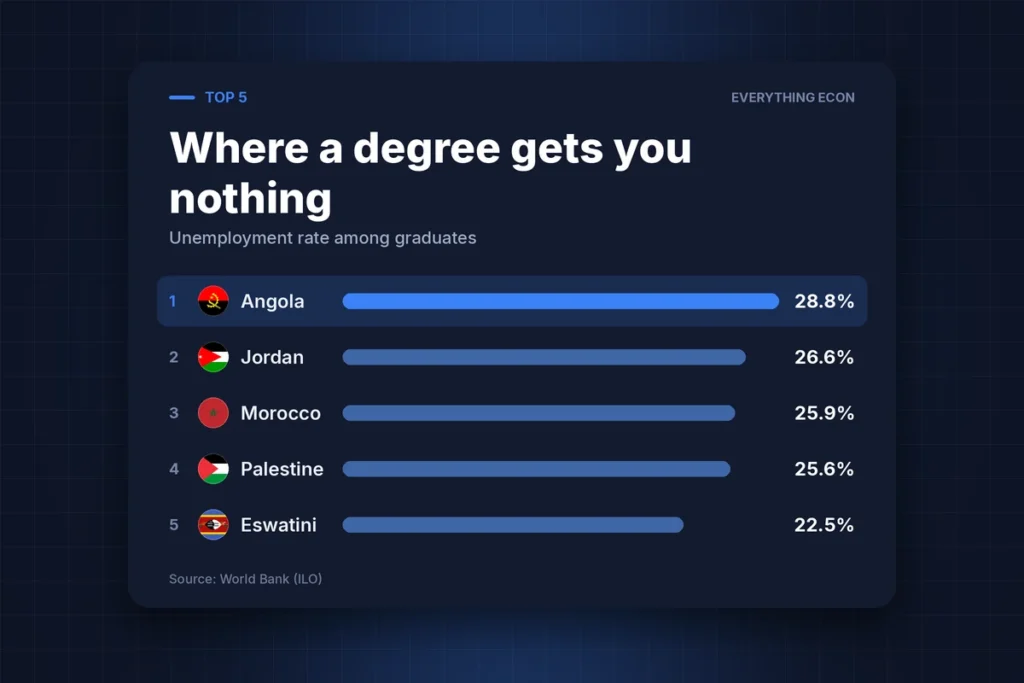
Unemployment rate among graduates
- 1Angola28.8%
- 2Jordan26.6%
- 3Morocco25.9%
- 4Palestine25.6%
- 5Eswatini22.5%
Source: World Bank (ILO)
Where a Degree Backfires
The countries topping this ranking are not places with weak economies overall — many have decent growth. The problem is a mismatch between what universities produce and what employers need. Angola sits at the very top of the list at 28.8%, its economy still leaning heavily on oil, which employs relatively few people and generates little demand for graduates in other fields. Jordan follows at 26.6%, a country producing around 134,000 new graduates a year while its economy can only absorb roughly 74,000 of them into jobs — a gap that leaves tens of thousands stranded every single year.
India offers the clearest illustration of how a degree can become a liability. Among people aged 20 to 24, 44.5% of graduates are jobless, compared with just 3.4% of those who never learned to read or write. That is not a typo: the educated are struggling to find formal jobs while those with no schooling, often working informally in farming or manual labour, are simply absorbed into whatever work is available. Tunisia shows a related pattern — its universities turn out around 70,000 graduates a year, many trained in law and the humanities, fields the country's private sector has little appetite for. And in Morocco, where graduate unemployment sits at 25.9%, the strain was severe enough to help trigger Gen Z-led protests in 2025, with young women in rural areas facing graduate joblessness above 45%.
The Regional Divide
Zoom out, and the pattern becomes regional. Africa's 31 countries average 12.4% graduate unemployment, more than three times Europe's 3.9% average across 41 countries. Nine of the top fifteen countries on this list are African, including Eswatini (22.5%), Sudan (22.4%), Botswana (19.9%) and Lesotho (19.7%) — economies where formal job creation simply hasn't kept pace with the number of young people leaving university each year. Australia does best of all, averaging just 3.1% across the region, helped by strong demand tied to its resource and services industries.
At the other end, Central Europe stands out for the opposite reason. Czechia (1.2%) and Poland (1.4%) have such severe labour shortages that graduates are absorbed almost instantly — Poland alone reported over 60,000 unfilled job vacancies in a single month. This isn't really a sign that these countries produce a smarter mix of graduates; it's simply that demand for workers of any kind outstrips supply.
The Country at the Very Bottom
That brings us to Argentina, which posts the lowest graduate unemployment rate in the entire 125-country ranking: just 0.7%. It is a curious result, because Argentina's overall unemployment rate sits far higher, at around 7%. The gap suggests graduates there are not necessarily walking into brilliant careers — rather, in a country with chronic economic instability and high inflation, holding a degree still marks people out as employable enough to be picked first, even in a tight job market. Tonga (0.8%) and Czechia (1.2%) round out the bottom of the table.
Source: World Bank, using International Labour Organization data.
Get a new data story like this every week — join the newsletter.
Browse every visualisation on the visualisations page.