
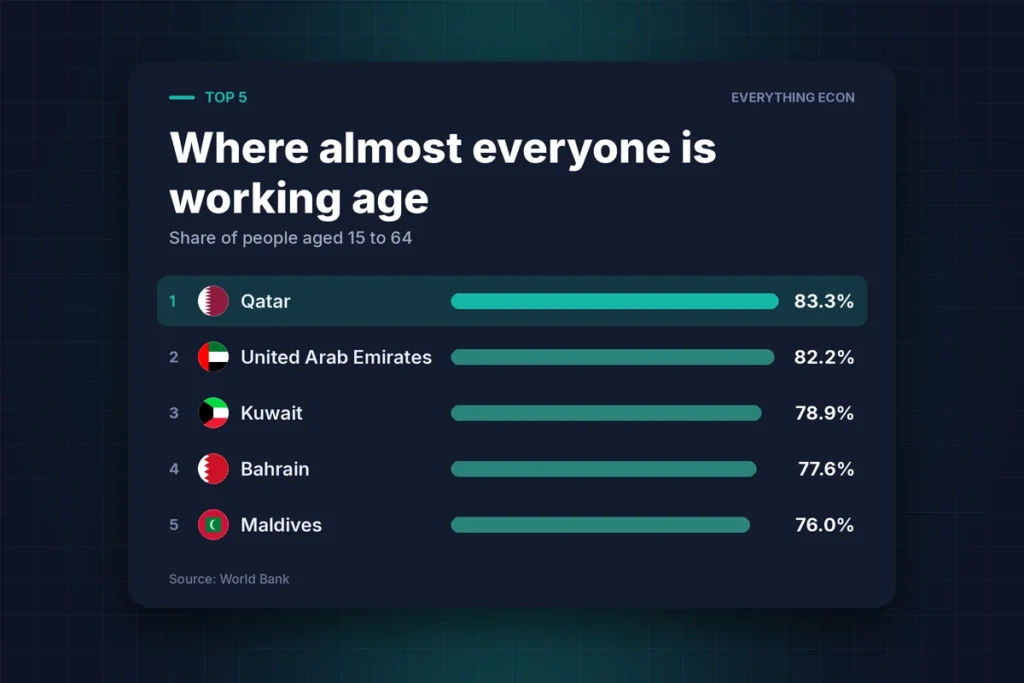
Every country has people who are too young or too old to work, and people who are squarely in their working years — usually counted as those aged 15 to 64. That balance shapes everything from how many taxpayers support each pensioner to how much a country can invest and grow. Some nations have built their populations almost entirely around the workforce; others are dominated by children who won't be ready to work for another decade. The gap between the two extremes is enormous: at the top, more than four in five people are of working age; at the bottom, barely half are.
At a glance · Top 5
Share of people aged 15 to 64
- 1Qatar83.3%
- 2United Arab Emirates82.2%
- 3Kuwait78.9%
- 4Bahrain77.6%
- 5Maldives76.0%
Source: World Bank
The Gulf effect
The top of the ranking is dominated by a specific story: countries that import their workers. Kuwait (78.9%), Bahrain (77.6%) and Saudi Arabia (73.3%) all rank highly for the same reason as the leaders — large numbers of foreign labourers arrive as adults, work for years, and then leave rather than raising families locally. This inflates the working-age share without reflecting anything about local birth rates. It's a demographic profile created by migration policy, not fertility.
Not every high performer fits this mould. Places like Jamaica (73.1%), Saint Lucia (72.8%) and Mauritius (71.3%) get there through a more conventional route: falling birth rates over recent decades that have thinned out the youngest age group, leaving a bulge of working-age adults who haven't yet aged into retirement. This is sometimes called a "demographic dividend" — a window where a country has unusually few dependants to support, which can free up money for investment and growth. The UAE is often cited as the clearest example of this dividend at its peak, with roughly 20 to 22 working-age people for every dependant.
Where children dominate instead
At the other end of the ranking, the story flips entirely. The Central African Republic (49.1%), Somalia (50.8%), DR Congo (51.0%) and Niger (51.2%) all sit below the halfway mark, and the driver is fertility, not old age. Niger has the highest birth rate in the world, at 6.1 children per woman on average, and Somalia isn't far behind at over 6. In DR Congo, nearly half the entire population is under 15. These are young, fast-growing countries — the opposite problem to an ageing nation, but a problem all the same, since a huge share of the population isn't yet contributing economically while still needing education, healthcare and food.
This is also where the biggest countries in the world tell a quieter version of the same story, just less extreme. India still has about 68% of its population of working age, a major reason global manufacturers keep investing there. China, by contrast, is now sliding the other way — its working-age share slipped from 61.3% to 60.9% in just a year, a delayed consequence of its former one-child policy. Japan shows where that road leads: its working-age population has shrunk by 16% since 1995, from 87.3 million people to 73.7 million.
The country at the very top
Sitting above all of them is Qatar, at 83.3%. Like its Gulf neighbours, this isn't the result of unusually few births or deaths — it's the product of a resident population overwhelmingly made up of foreign migrant labourers who move there as working-age adults. It's a reminder that a single statistic can tell very different stories depending on what's producing it: Qatar and Niger sit at opposite ends of the same ranking, but one got there through migration policy and the other through birth rates.
Data: World Bank.
Get a new data story like this every week — join the newsletter.
Browse every visualisation on the visualisations page.