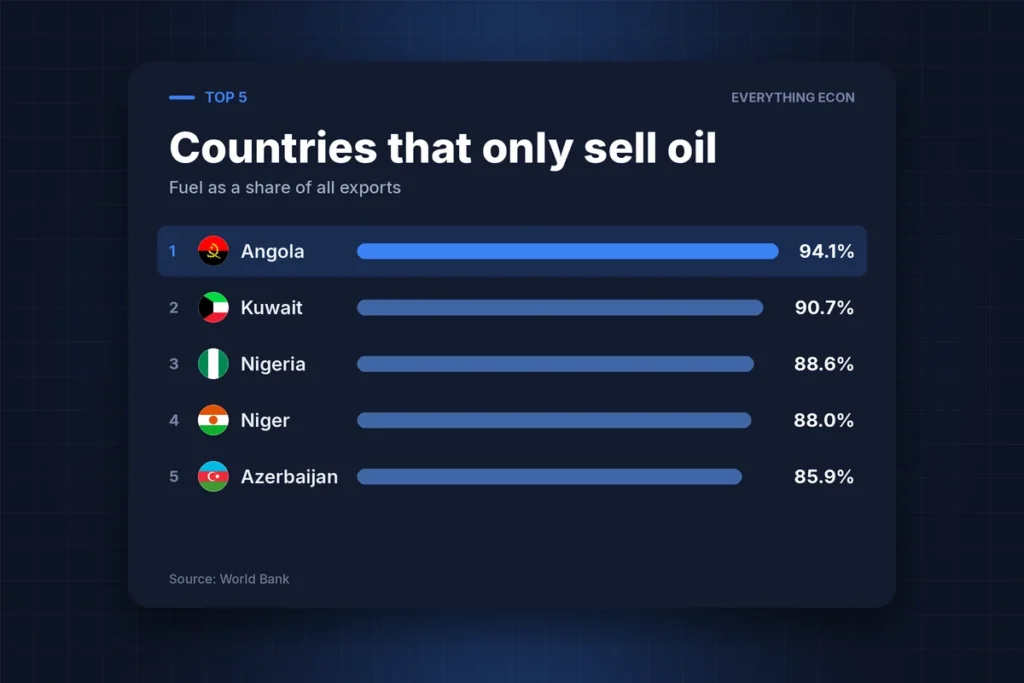
Some countries export cars, others export coffee or clothing or software. Then there's a small group of nations whose export earnings come from almost one thing alone: oil. This ranking, based on World Bank trade data, measures oil's share of total merchandise exports for each country — in other words, out of everything a country sells abroad, how much of that value is crude oil and refined petroleum products. A high number means a country has bet its entire trading relationship with the rest of the world on the price and demand for one commodity.
At a glance · Top 5
Fuel as a share of all exports
- 1Angola94.1%
- 2Kuwait90.7%
- 3Nigeria88.6%
- 4Niger88.0%
- 5Azerbaijan85.9%
Source: World Bank
The usual suspects, and some surprises
Gulf states dominate the upper reaches of the table, as expected. Kuwait sits at 90.7%, Qatar at 83.8%, Saudi Arabia at 79.4% and Oman at 77.2% — all economies built on decades of oil wealth. But the list also throws up some genuine surprises. Niger, one of the poorest countries in the world, ranks fourth at 88.0%, a dramatic shift driven by a new China-backed pipeline that now carries its crude nearly 2,000 kilometres to the coast of Benin for export. Guyana is an even more striking case: once a small agricultural exporter of sugar and rice, it has rocketed to 75.9% oil dependence in less than a decade, transformed almost overnight by a massive offshore oil discovery led by Exxon in 2015.
Nigeria, long Africa's biggest oil producer, sits at 88.6%, with oil making up more than 81% of exports even in the first half of 2025 despite government efforts to grow non-oil trade. Norway is the outlier worth noting: it relies on oil for 62.3% of its exports, but rather than spending the windfall, it has funnelled the proceeds into a sovereign wealth fund now worth around $2.3 trillion — proof that heavy oil dependence doesn't have to mean economic fragility.
Diversifying versus doubling down
Some of the biggest oil producers are actively trying to loosen oil's grip on their economies, with mixed results. Saudi Arabia's Vision 2030 programme has pushed non-oil activity to roughly 56% of its domestic economy, even though oil still dominates what it sells abroad. The United Arab Emirates has gone further: despite ranking 12th at 68.2% oil dependence, non-oil sectors like tourism, trade and finance now make up 77-79% of its domestic economic output, making it the Gulf's clearest diversification success story. Timor-Leste, in contrast, faces a harder reckoning — its dominant offshore gas and oil field, Bayu-Undan, permanently stopped producing in June 2025, leaving the country needing new revenue sources fast.
At the bottom of the table, countries like the Bahamas, Cabo Verde, the Gambia, Macao and Seychelles show 0.0% oil dependence. These are typically tourism- or services-driven economies with little to no oil production, and their exports are spread across other goods and services entirely.
The country that depends on oil more than any other
Topping the ranking is Angola, where oil accounts for 94.1% of everything the country sells abroad. This is despite years of government promises to diversify the economy away from crude. Angola's oil wealth has not translated into broad-based industrial growth, and its near-total reliance on a single volatile commodity leaves its national income exposed to every swing in global oil prices.
Data source: World Bank.
Get a new data story like this every week — join the newsletter.
Browse every visualisation on the visualisations page.