Every country has people who work and people who don't — children too young for jobs, and older people who've left the workforce. The dependency ratio measures how many of these non-working dependants exist for every 100 people of working age. A ratio near 20 means a country is mostly workers; a ratio above 90 means dependants nearly outnumber them. Globally, the countries at the extremes tell very different stories — some are drowning in children, one is drowning in retirees, and several have simply imported their workforce from elsewhere.
At a glance · Top 5
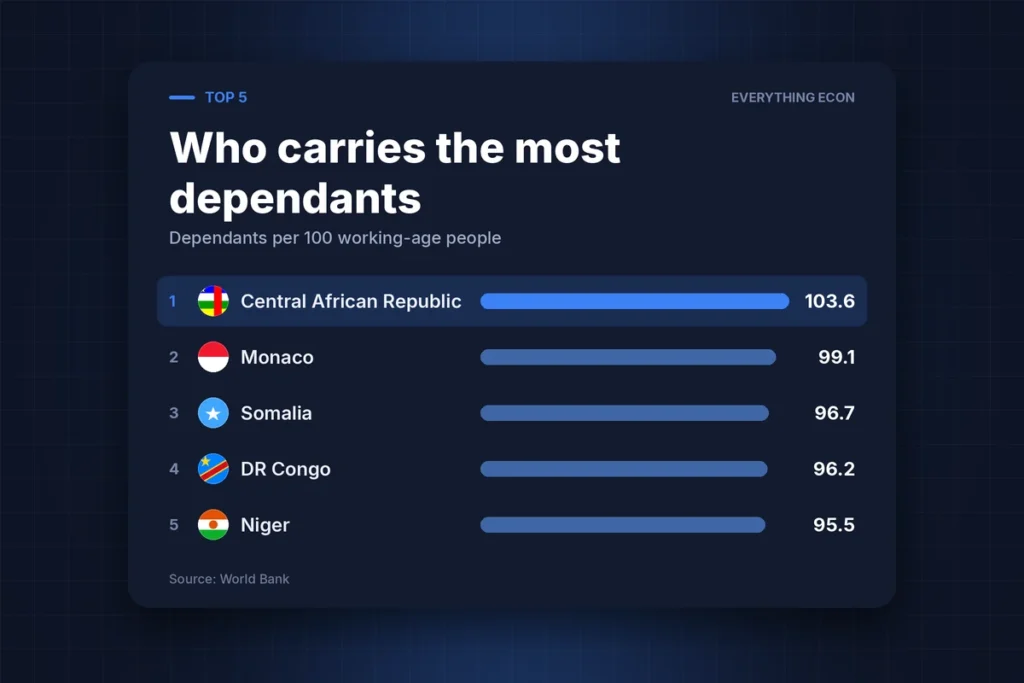
Dependants per 100 working-age people
- 1Central African Republic103.6
- 2Monaco99.1
- 3Somalia96.7
- 4DR Congo96.2
- 5Niger95.5
Source: World Bank
The youth-heavy top of the table
Most of the highest ratios belong to sub-Saharan Africa, and the pattern is consistent: very high birth rates producing a huge share of children under 15. Somalia (96.7), DR Congo (96.2), Niger (95.5), Mali (92.9) and Chad (92.6) all sit above 90. Niger's case is stark — women there have, on average, between 5.6 and 5.9 children, one of the highest fertility rates on Earth, which means for every 100 working-age adults there are 95.5 people who need feeding, schooling or caring for. Angola (88.7), Mozambique (88.3), Burundi (87.0), Mauritania (83.9), Tanzania (83.1), Uganda (82.9) and Benin (79.9) follow the same script. Afghanistan (81.8) is the one entry from outside Africa in this cluster, driven by similarly high birth rates.
When ageing pushes the ratio up instead
Not every high ratio comes from a youth bulge. Monaco ranks second in the world at 99.1, but almost entirely because of an elderly, wealthy population rather than lots of children — a reminder that this measure counts dependants at both ends of life, not just the young. It's a pattern playing out more slowly elsewhere too: Japan's overall ratio has climbed to 70.2, with the highest share of elderly dependants of any major economy at 54.5 per 100 workers. South Korea crossed into what's called a "super-aged" society in December 2024, its over-65 population having grown 340% since 1990. China's old-age ratio is projected to more than double, from 0.21 in 2024 to 0.52 by 2050. Germany, at 60.2 overall, already has nearly a quarter of its population aged 65 or over.
The imported-workforce economies at the bottom
The lowest ratios in the world belong almost entirely to Gulf states, and for a single shared reason: they bring in foreign workers rather than growing their own. Qatar has the lowest ratio anywhere, just 20.0, because roughly 88% of the people living there are migrant workers of working age, with comparatively few children or retirees among them. The United Arab Emirates (21.6) and Kuwait (26.8) follow the same model. Bahrain (28.9) and the Maldives (31.6), which relies heavily on tourism labour, sit just above them. Singapore (35.0) and Saudi Arabia (36.4) land at almost identical figures despite very different economies — both achieve it the same way, by importing working-age labour rather than through any change in birth rates.
The country carrying the most
At the very top of the ranking is the Central African Republic, with a dependency ratio of 103.6 — meaning there are more dependants than working-age people. This is driven by a combination of ongoing conflict and a population structure where close to half the country is under 15 years old. It's the clearest illustration of what this ranking captures: a small working-age population trying to support a very large number of children, in a country still recovering from instability that has also shortened working lives and disrupted the economy that would otherwise support them.
Source: World Bank.
Get a new data story like this every week — join the newsletter.
Browse every visualisation on the visualisations page.