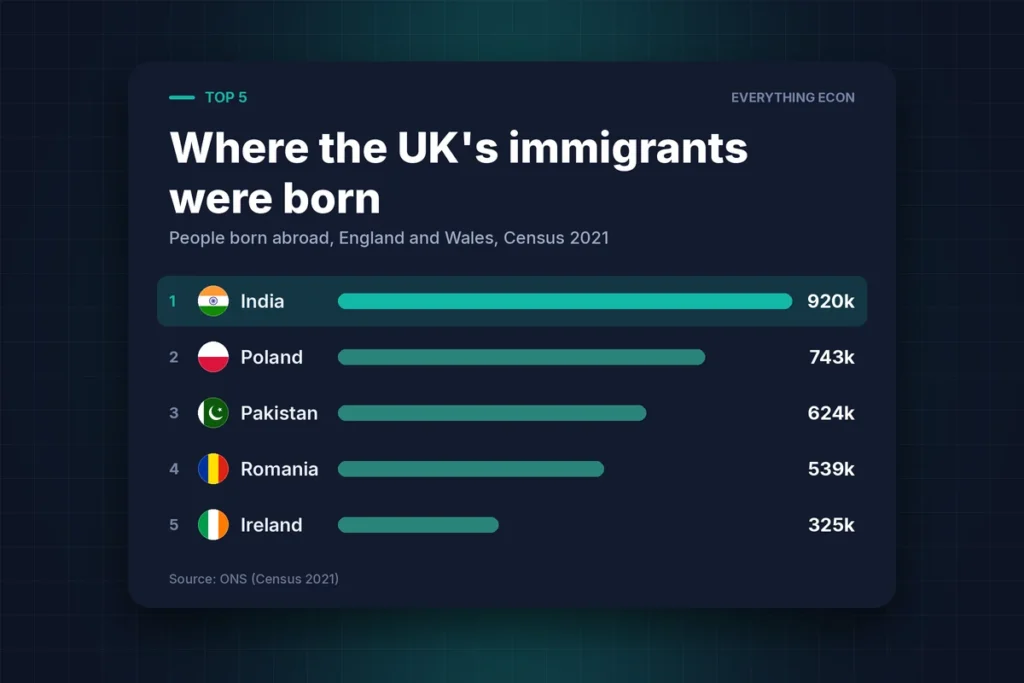
India is the most common country of birth among people living in England and Wales who were born abroad: 920,000 residents at the 2021 Census, ahead of Poland (743,000) and Pakistan (624,000). In total 10.0 million residents, 16.8% of the population, were born outside the UK, up from 7.5 million in 2011. Country of birth counts where people were born, not what passport they hold, so it includes many people who have since become British citizens. That makes it the standard measure of the foreign-born population, and it shows a picture shaped by decades of migration rather than one recent year.
At a glance · Top 5
People born abroad, England and Wales, Census 2021
- 1India920k
- 2Poland743k
- 3Pakistan624k
- 4Romania539k
- 5Ireland325k
Source: ONS (Census 2021)
Three countries, one shared history
The top five countries of birth in England and Wales are India (920,000), Poland (743,000), Pakistan (624,000), Romania (539,000) and Ireland (325,000). Together they account for about 3.15 million people, just under a third of everyone born abroad. Bangladesh (273,000) sits seventh, and with India and Pakistan brings the South Asian total to roughly 1.8 million across the three.
The South Asian pattern has old roots. Migration from the Indian subcontinent to Britain grew through the 20th century, driven by Commonwealth ties, labour demand and family reunion, and later by students and skilled workers. Nigeria (271,000, eighth) and South Africa (217,000, tenth) follow similar links of language, education and colonial-era connections, and both remain in the top ten.
The European middle: Poland and Romania
Poland and Romania tell a different story, one driven by EU enlargement. Poland joined the EU in 2004 and Romania in 2007, and Romanians gained full access to the UK labour market from 2014. The results are stark: the Romanian-born population of England and Wales grew by 576% in a decade, from 80,000 in 2011 to 539,000 in 2021. Poland is also the most common non-UK passport in England and Wales, held by around 760,000 people.
Italy (277,000) and Germany (263,000) complete the European part of the top ten. Ireland, in fifth place, reflects the oldest movement on the list: the two islands have had close, largely open migration for far longer than the EU has existed.
The census also shows how recent much of this is. Of the 10.0 million non-UK-born residents, 4.2 million (42.4%) arrived in the ten years before the 2021 Census, 2.7 million between 2001 and 2010, and 3.1 million before 2001.
What the census covers, and what it misses
Three limits are worth stating plainly. First, the figures above are for England and Wales only. Scotland and Northern Ireland run separate censuses, and Scotland’s was held in 2022. There the ordering differs: Scotland’s Census counted 554,900 residents born outside the UK, with Poland first (75,400), then India (37,700) and Pakistan (28,900). We have not combined the four nations into a single UK ranking, because the published detail is not identical across them.
Second, the census is a snapshot from March 2021. The ONS produces annual population estimates by country of birth and nationality from the Annual Population Survey, but at a grouped level, not as a full country-by-country ranking, so the census remains the most reliable source for individual countries. Third, a count of people born in a country says nothing about their citizenship, their reasons for coming, or how long they have lived here.
The recent flow looks different
The stock of people born abroad and the current flow of arrivals are not the same thing. In the year ending December 2025, the ONS provisionally estimated long-term immigration (people arriving to stay at least 12 months) at 813,000, down from 1,012,000 the year before. Emigration was 642,000, against 680,000, leaving net migration of 171,000, down from 331,000.
By nationality, non-EU+ citizens accounted for 627,000 arrivals, or 77% of the total, against 110,000 for British nationals and 76,000 for EU+ nationals. Net migration was +350,000 for non-EU+ nationals, but negative for British nationals (-136,000) and EU+ nationals (-42,000), meaning more of each group left than arrived. Among non-EU+ nationalities, Indian was the most common, followed by Pakistani, Chinese and Nigerian; study was the most common reason for all four. For EU+ nationalities, Romanian was the most common, at 35,000.
Study accounted for 47% of non-EU+ immigration (294,000), work for 23% (146,000) and asylum for 14% (88,000). Students are a large share of arrivals and often leave again, which is one reason the 2021 stock of Poland- and Romania-born residents and the recent inflow of Indian, Pakistani, Chinese and Nigerian nationals should not be read as the same population. These flow estimates are provisional and are revised as more Home Office data becomes available.
Source: ONS, Census 2021 (TS012, country of birth, England and Wales; International migration, England and Wales: Census 2021); National Records of Scotland, Scotland’s Census 2022; ONS, Long-term international migration, provisional: year ending December 2025 (released 21 May 2026).
Get a new data story like this every week — join the newsletter.
Browse every visualisation on the visualisations page.