
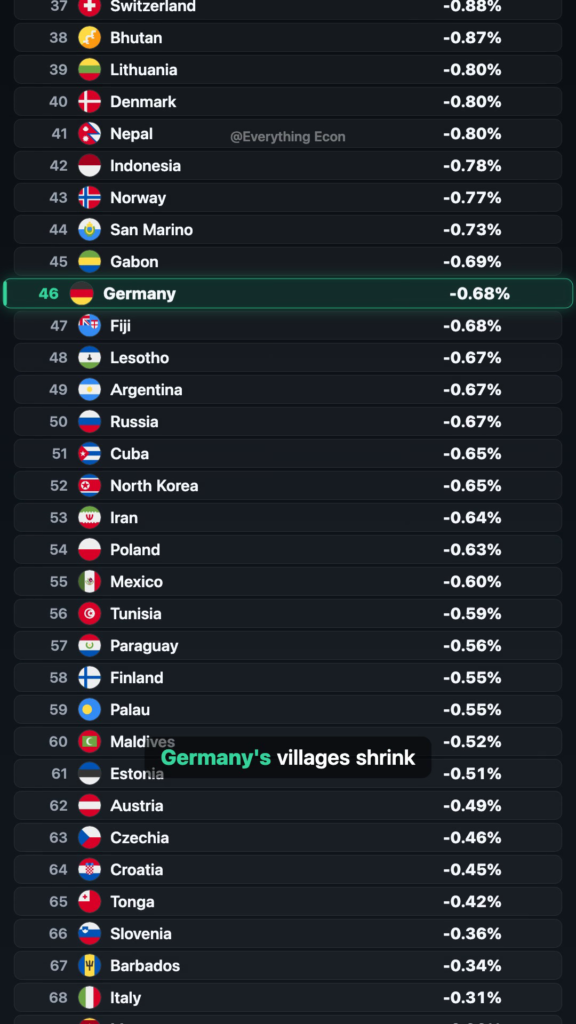
Some countries aren't shrinking overall — they're just hollowing out in the middle. This ranking tracks how fast each country's rural population is growing or shrinking each year, using World Bank data. A sharply negative number means villages and small towns are losing people fast, usually because they're moving to cities. A positive number means the countryside is still filling up, not always for happy reasons.
The fastest-emptying villages
Jordan sits near the very top of the decline list at -4.01% a year. That sounds dramatic, but Jordan's rural population is small to begin with — around 900,000 people — and it's draining steadily into the capital, Amman, which keeps growing as a regional hub for jobs, services and investment.
Thailand tells a similar story on a bigger scale, with villages shrinking -2.54% a year. The pull here is Bangkok, which alone absorbs 19% of everyone who moves within the country. One city acting as a magnet for an entire nation's internal migration is enough to drain the countryside even without any crisis forcing people out.
Brazil, at -1.97%, is further along a very long road. Its countryside has been emptying for decades: 55% of Brazilians lived rurally in 1960, and by 2010 that had fallen to just 15%. The -1.97% figure is really the last stretch of a transformation that mostly already happened.
Eastern Europe's shared exodus
Look down the top fifteen and a pattern jumps out: Kosovo (-2.33%), Belarus (-2.15%), Moldova (-2.14%), Bosnia and Herzegovina (-1.96%) and Albania (-1.95%) all cluster together. These are mostly former communist or Yugoslav states, and they share a common driver — young workers leaving rural areas not just for nearby cities, but for jobs across the European Union. Kosovo's decline reflects both the long tail of post-communist upheaval and this ongoing labour emigration. Moldova's -2.14% is among the steepest anywhere in Europe, a sign of just how much of its working-age population has left for better pay abroad.
Why the bottom of the list looks so different
The countries where rural populations are still growing fastest — Oman (+3.79%), Syria (+3.74%), the United Arab Emirates (+3.66%) and Saudi Arabia (+3.62%) — don't all belong together for the same reason. The Gulf states are growing from high birth rates and continued settlement. Syria is the outlier worth pausing on: its rural population is rising not because village life is thriving, but because war has pushed people out of bombed and besieged cities. A positive number here reflects displacement, not prosperity.
The country losing its villages fastest
At the very top of the ranking is the Netherlands, shrinking at -6.58% a year — nearly double the next fastest decliner. What makes this figure remarkable is its consistency: the Dutch countryside has now recorded 49 straight years of rural decline. This isn't a recent migration wave or a crisis response, it's a near half-century trend in one of the world's most densely urbanised, highly developed economies, where rural life has been steadily giving way to city and suburban living for generations.
Put together, this ranking shows that emptying villages can mean very different things — a booming capital city, a decades-old economic shift, young people chasing EU wages, or a war pushing people the opposite way entirely.
Source: World Bank.
Get a new data story like this every week — join the newsletter.
Browse every visualisation on the visualisations page.