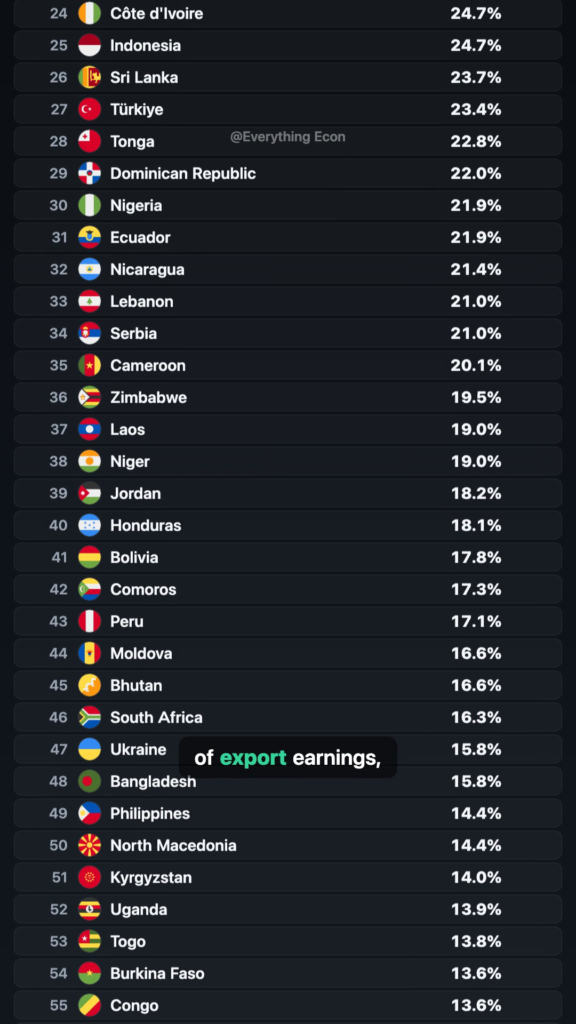
When a government borrows money from abroad, it has to pay that money back in foreign currency, usually dollars. The only way to get that currency is to earn it, mainly by selling things to other countries. The "debt-service ratio" measures how much of that export income gets swallowed up by loan repayments each year. A low number means a country has room to spend its earnings on hospitals, roads or schools. A high number means the lenders get paid first, and everything else waits.
The countries under the most pressure
El Salvador sits at the very top of this list, but before we get there, it's worth looking at the rest of the leading group. Haiti is in second place, handing over 63.2% of its export earnings to debt service. That's a striking number given that Haiti actually improved its underlying debt position in 2024, cutting its external-debt-to-GDP ratio from 12.9% down to just 1.5% through a deal involving Venezuela. The lesson here is that a smaller pile of debt doesn't always mean smaller repayments if that debt comes due quickly or carries steep terms.
Egypt, in third place at 49.2%, shows how fast this pressure can build. Its debt-service ratio jumped from 52.4% to 60.0% in just six months, and the repayments now eat up 47.4% of the entire national budget, not just export earnings. Argentina, at 38.3%, is a repeat case: it has defaulted on its debts nine times since gaining independence, including three times in the last 18 years, so a high ratio there reflects a long-running pattern rather than a one-off shock. Zambia, at 30.5%, is in a different position: it defaulted in 2020, restructured its debts, and exited that process in 2024 with repayments now capped at 14% of government revenue through 2027, a safety valve many others don't have.
Why the bottom of the list looks so different
The countries paying almost nothing to external lenders aren't necessarily in good shape. Iran pays just 0.3%, but that's because sanctions have locked it out of international capital markets altogether. It's not that Iran's finances are healthy. It simply can't borrow in the first place. Somalia, at 0.7%, is similar: decades of conflict have cut it off from global lenders. Algeria, at 0.8%, is a different story again. Its low ratio is propped up by hydrocarbon exports, meaning oil and gas revenue, rather than careful budget management. The pattern across the bottom of the ranking is that low debt-service numbers can mean either financial isolation or a resource windfall, not necessarily sound economic policy.
The country spending almost everything it earns on debt
At the top of the entire ranking is El Salvador, which spends 96.2% of its export earnings on debt service. That means almost every dollar the country brings in from selling goods and services abroad is immediately redirected to lenders, leaving very little room for anything else. It's an extreme position, well above even Haiti in second place, and it underlines how exposed a small economy can become when its export earnings are modest relative to the scale of its foreign debt.
Regionally, the pressure is heaviest in Latin America, the Caribbean, and parts of Africa and South Asia, while the countries with the lowest ratios are clustered among sanctioned, conflict-affected, or oil-rich economies. Pakistan, at 39.5%, and Mongolia, at 32.0%, show that this isn't confined to any single continent. It's a condition driven by export strength relative to debt load, wherever that debt was taken on.
Source: World Bank International Debt Statistics.
Get a new data story like this every week — join the newsletter.
Browse every visualisation on the visualisations page.