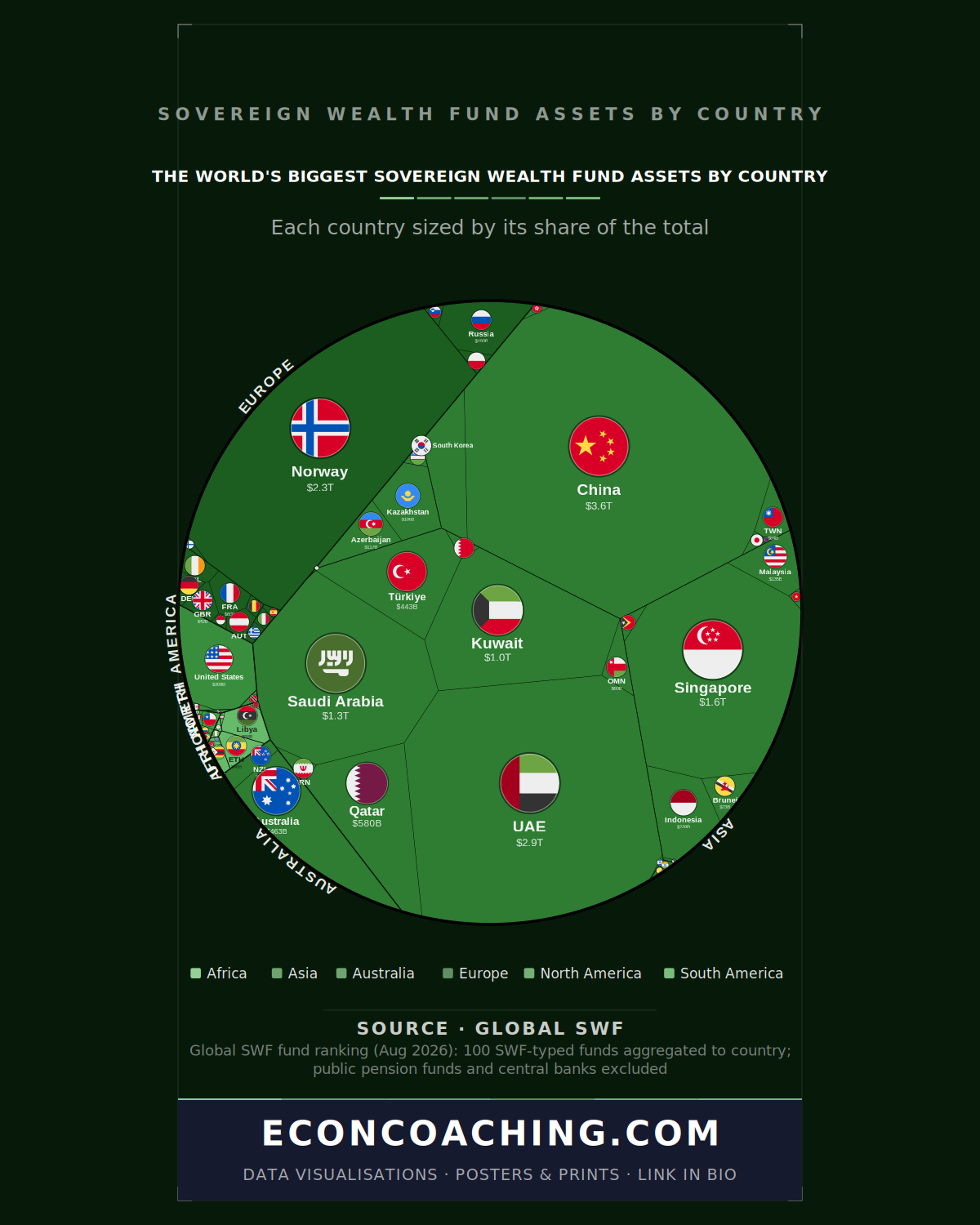
Norway has a population of 5.6 million people. Its sovereign wealth fund, managed by Norges Bank Investment Management, holds over $2 trillion in assets — roughly $415,000 per Norwegian citizen — and earned $248 billion in profit in 2025 alone, a 15.1% return across more than 7,200 companies in 60 countries. On the treemap accompanying this article, Norway’s cell is the third largest on the chart. That proportion is accurate, and it defies nearly every intuition about what a country of that size should control.
Only 67 countries in the world operate a sovereign wealth fund at all. The blank space on the treemap is not missing data — it is the majority of nations, which have no such vehicle. Of those 67, three countries control over 53% of combined assets: China at 21.95%, the UAE at 17.54%, and Norway at 14.14%. Total assets across all 67 funds stand at $16.46 trillion, according to Global SWF data.
How Three Countries Came to Own More Than Half
China’s dominance reflects the accumulation of decades of export surpluses channelled into state investment vehicles. China Investment Corporation alone reported total assets of $1.57 trillion at end-2024, with net profit rising 30.4% year-on-year to $140.64 billion. CIC holds stakes in 19 Chinese state-owned financial institutions and was founded in September 2007 with $200 billion in initial capital, making its growth to $1.57 trillion across 17 years one of the fastest wealth accumulations in the history of state finance. China’s 21.95% share also includes SAFE Investment Company, which manages an estimated $1 trillion or more in international assets with limited public disclosure, making direct cross-country comparisons difficult.
The UAE at 17.54% represents a different model: a federation of nine million people sitting atop hydrocarbon revenues and deploying them through multiple vehicles including Abu Dhabi Investment Authority and Mubadala Investment Company. Norway’s position is the most striking. The Government Pension Fund Global began receiving oil revenues in 1990, crossed $1 trillion in 2017, and reached $2 trillion by 2025 — a trajectory most resource-rich nations have failed to replicate because they spent rather than saved. The fund’s 2025 return of 15.1% was driven by technology, financial, and mining stocks, and its heavy concentration in US equities — roughly 40% of the portfolio — has been both the source of that performance and a structural risk. The Q1 2026 loss of 1.9% illustrated how quickly a sustained US market correction flows through to the fund’s headline figure, meaning the $2 trillion number is partly a function of current equity valuations rather than permanently locked-in wealth.
The Gulf’s Collective Scale and Where the Money Is Going
Saudi Arabia, Kuwait, and Qatar together account for a further 17.67% of global SWF assets, sitting at ranks five, six, and seven respectively. The seven largest Gulf sovereign wealth funds deployed a combined $126 billion in new investments in 2025 — 43% of all sovereign capital invested globally that year, a regional record. Of the $66 billion that sovereign wealth funds globally ploughed into AI and digitalisation in 2025, Mubadala led with $12.9 billion, Kuwait Investment Authority followed with $6 billion, and Qatar Investment Authority contributed $4 billion. The Kuwait Investment Authority is historically notable as the world’s first modern sovereign wealth fund, established in 1953 before Kuwait had even gained full independence.
Saudi Arabia’s Public Investment Fund was established in 1971 but remained relatively inactive for decades before Crown Prince Mohammed bin Salman’s Vision 2030 agenda transformed it from approximately $150 billion to over $900 billion in assets in under a decade.
The Newcomers Reshaping the Top 10
Türkiye Wealth Fund entered the world’s top 10 for the first time in 2024, surpassing $443 billion and ranking ninth at 2.69% of global assets, ahead of Mubadala. TWF was founded only in 2016 and nearly halved in dollar terms during the 2021-2022 lira crisis, because its asset values and dollar-denominated comparisons are directly exposed to exchange rate movements. The 2024 figure reflects the lira’s position at year-end; any sustained currency depreciation would compress that dollar total significantly.
At the opposite end of the asset scale, Ethiopia’s Ethiopian Investment Holdings, founded in 2021-2022, consolidated over 27 state-owned enterprises including Ethiopian Airlines and Ethio Telecom into a structure that rapidly became one of Africa’s largest sovereign funds at approximately $46 billion in assets. Africa as a whole holds just 0.89% of global SWF assets; South America holds 0.16%. Asia, including the Middle East, controls 76.8%.
The United States as a Case Study in the Alternative Model
The United States ranks tenth globally at 1.88% of world SWF assets, despite holding the world’s largest economy by GDP. That ranking reflects a deliberate historical preference for private-sector capital allocation over state-managed sovereign vehicles. The contrast is sharpest when looking at capital flows: state-owned investors deployed $131.8 billion into the United States in 2025, a 92% surge from 2024 and more than double the second-place destination, the UK at $25.8 billion. Foreign state capital is flowing into America at a record pace precisely because the US hosts the equity markets, technology companies, and AI infrastructure that sovereign funds globally are competing to own. Investment into China by the same investors fell from $10.3 billion to $4.3 billion over the same period.
Where the Asset Class Goes from Here
Global SWF assets hit a record $15.2 trillion in 2025, up 13.4% from $13.4 trillion the prior year. The growth is geographically uneven and strategically concentrated: Gulf funds are deploying at record pace into US technology and AI, China’s vehicles are expanding while reducing their international visibility, Norway continues compounding off a base that most resource economies never built, and countries like Türkiye and Ethiopia are entering a tier that was previously closed to them. Libya, ranked 18th globally, holds an estimated $70 billion through its Libyan Investment Authority, but much of that portfolio remains frozen under international sanctions and civil conflict — a reminder that a fund’s stated assets and its deployable capital are not always the same figure. The sovereign wealth fund universe is expanding and concentrating simultaneously, and the distribution visible on this treemap will look different again within a decade.
For more data-driven analysis of global economics and the trends reshaping the world economy, visit econcoaching.com.
Take this one home
Get this visualisation as a download, wallpaper, or printed poster.
← Back to all visualisations & articles
Follow Everything Econ: YouTube · TikTok · X · Instagram · Facebook