Rural population share measures the percentage of people living outside cities and large towns — the countryside, small villages, farmland. In most rich, industrialised nations this figure has been shrinking for over a century as people moved to cities for work. But the global picture is far more varied than that story suggests. Some of the most rural places on Earth are among the poorest, while others are among the wealthiest — a reminder that "rural" doesn't automatically mean "undeveloped."
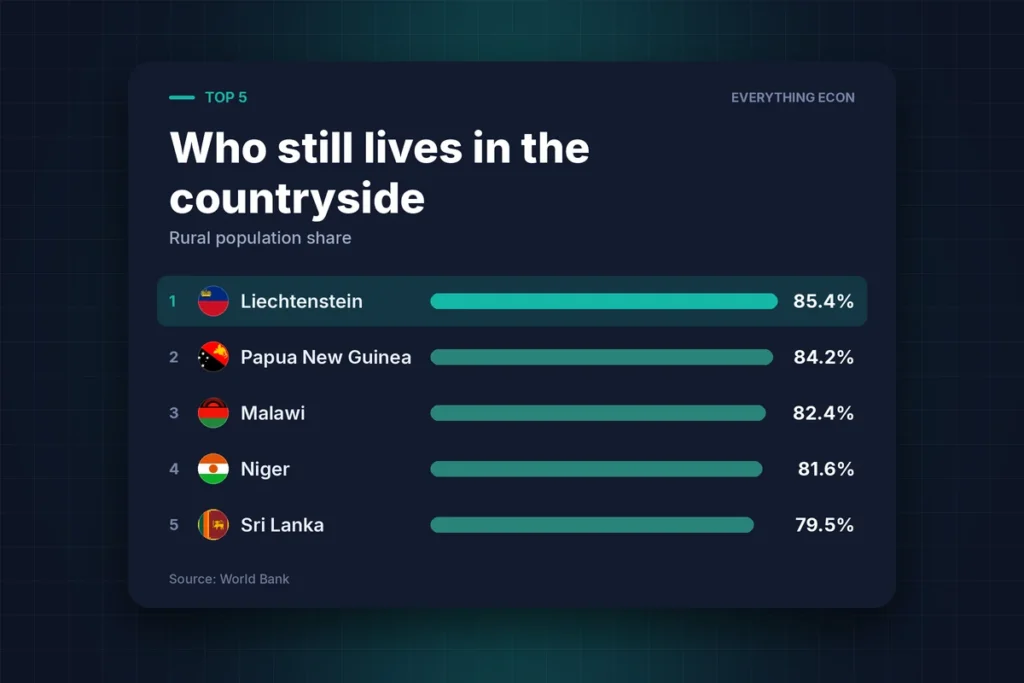
At a glance · Top 5
Rural population share
- 1Liechtenstein85.4%
- 2Papua New Guinea84.2%
- 3Malawi82.4%
- 4Niger81.6%
- 5Sri Lanka79.5%
Source: World Bank
Conflict, farming, and outliers
Several countries near the top of the ranking share an obvious driver: subsistence farming, where families grow food mainly to feed themselves rather than to sell. Niger (81.6%) and Ethiopia (75.9%) both have workforces dominated by this kind of agriculture, which keeps populations spread across the land rather than concentrated in cities. Malawi (82.4%) fits the same pattern.
Conflict tells a related but distinct story. South Sudan (78.3%) and Afghanistan (74.1%) rank highly not just because of farming traditions, but because decades of war have stalled the roads, housing, and infrastructure that normally pull people into cities. When a country can't build urban jobs and services, its population has little reason — or ability — to leave the countryside.
Then there's Sri Lanka (79.5%), which stands out as a genuine oddity. It's a middle-income country with reasonable living standards, yet its rural share is far higher than nations at a similar economic level. This shows that urbanisation doesn't automatically follow income — geography, land policy, and history matter just as much.
The fully urban countries
At the opposite extreme sit six places with a rural share of exactly 0.0%: Hong Kong, Kuwait, Macao, Monaco, Singapore, and Bahrain. These aren't necessarily "less rural" versions of bigger countries — they're mostly city-states or territories so small and densely built that the World Bank simply classifies their entire population as urban. There is no meaningful countryside left to count.
The gap between these countries and the top of the ranking shows how differently nations can develop. Compare this to two giants moving in opposite directions. China's rural share fell from 35.4% to 34.5% in just a single year between 2023 and 2024, yet that still leaves 465 million people living rurally — more than the entire population of the United States. South Korea shows how fast the shift can happen: its rural share collapsed from around 72% in 1960 to just 18.5% in 2024, one of the sharpest rural-to-urban transformations of the past century. India, meanwhile, remains stubbornly rural at 63–64% in 2025, despite being the world's most populous country — a reminder that scale and urbanisation don't move together.
The most rural country of all
The country that tops this ranking isn't a poor, conflict-affected, or agricultural nation at all — it's Liechtenstein, at 85.4% rural. This tiny, wealthy European microstate sits ahead of Papua New Guinea (84.2%) and Malawi (82.4%), but for entirely different reasons. Liechtenstein's high rural figure comes down to strict zoning laws that deliberately limit dense urban development, not poverty or lack of infrastructure. It's a striking case of a rich country choosing to stay rural, standing in sharp contrast to everything else near the top of this list.
Together, the ranking shows that "rural" can mean subsistence farming in Niger, war-disrupted infrastructure in South Sudan, or a deliberate planning choice in one of Europe's wealthiest microstates.
Source: World Bank.
Take one home
Every country drawn to scale, as an instant printable download or a museum-quality matte poster printed to order.
Get a new data story like this every week — join the newsletter.
Browse every visualisation on the visualisations page.