Global drinking habits vary enormously, and one of the clearest ways to see it is by measuring how much pure alcohol the average adult in a country drinks each year, converted into litres. The WHO tracks this figure worldwide, and the results split the globe sharply in two: a cluster of European countries drinking well over ten litres a year, and a group of nations, mostly with strict religious or cultural restrictions on alcohol, recording effectively zero.
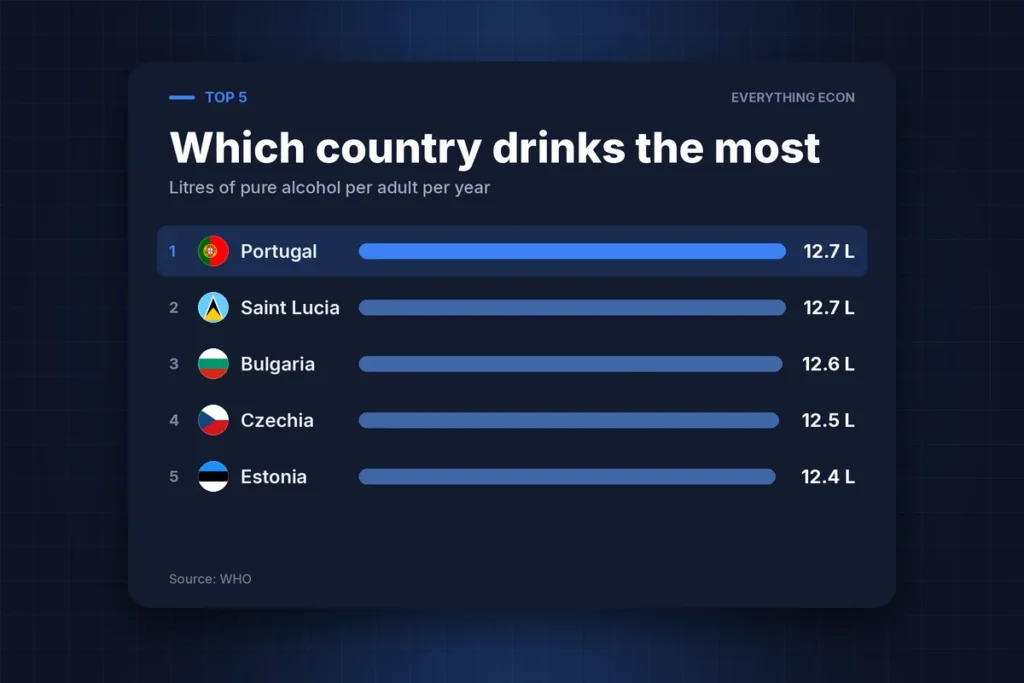
At a glance · Top 5
Litres of pure alcohol per adult per year
- 1Portugal12.7 L
- 2Saint Lucia12.7 L
- 3Bulgaria12.6 L
- 4Czechia12.5 L
- 5Estonia12.4 L
Source: WHO
A Very European Top Table
Of the top 15 countries in this ranking, almost all are in Europe, and the top seven cluster tightly together between 12 and 12.7 litres per adult per year. Bulgaria (12.6L), Czechia (12.5L) and Estonia (12.4L) all sit within a hair's breadth of the very top, while Romania, at 12.2L, stands out for a different reason: its drinking has climbed steeply since 2013, making it one of the fastest risers in Europe over the past decade rather than a country with a long-standing drinking culture. Latvia closes out the top six at 12.0L.
Further down the top 15, Austria is a notable case. At 11.2L per adult, it drinks more than most of its wealthy Western European neighbours, a reminder that high income doesn't necessarily mean lower drinking — if anything, Austria's wine and beer culture keeps it firmly in the world's top 15 despite its wealth.
How the Rest of the World Compares
Step outside this European core and the numbers drop off noticeably. The United States, despite its size and wealth, sits mid-pack among rich nations at about 9.8 litres per adult — lower than most of the countries in the European top 15. Germany, often associated with heavy beer drinking, does make the top 15 at 10.4 litres, but that's still well below the Portugal-to-Latvia cluster at the summit.
Russia offers one of the more striking trends: it has fallen to around 10 litres per adult, down from roughly 15 litres in the early 2010s, a sharp decline driven by tighter alcohol policy and public health campaigns rather than any single event.
At the opposite end of the table entirely, countries including Saudi Arabia, Sudan, Somalia, Tuvalu and Yemen all record 0.0 litres. This isn't a data gap — it reflects near-total abstention, largely because alcohol is illegal or culturally prohibited in these countries, particularly across much of the Middle East and parts of the Muslim world.
What's Driving the Top and Bottom
The pattern at the top is less about wealth and more about culture and tax policy. Portugal, which tops the entire ranking at 12.7 litres per adult per year, has deep-rooted wine traditions and, notably, keeps wine VAT at just 13%, far below the tax rate on many other goods. That combination of cultural normalisation and light taxation helps explain why Portugal edges out even Saint Lucia, which matches it exactly at 12.7 litres, making the two effectively tied for the global top spot.
Elsewhere in the top tier, Eastern and Central European countries like Bulgaria, Czechia, Estonia, Romania and Latvia share a common thread of strong spirits and beer traditions combined with relatively low alcohol taxes compared to Western Europe.
At the bottom, the driver is almost entirely religious and legal: in countries where Islamic law restricts or bans alcohol, consumption isn't just low, it's recorded as essentially non-existent.
Source: WHO Global Health Observatory.
Take one home
Every country drawn to scale, as an instant printable download or a museum-quality matte poster printed to order.
Get a new data story like this every week — join the newsletter.
Browse every visualisation on the visualisations page.